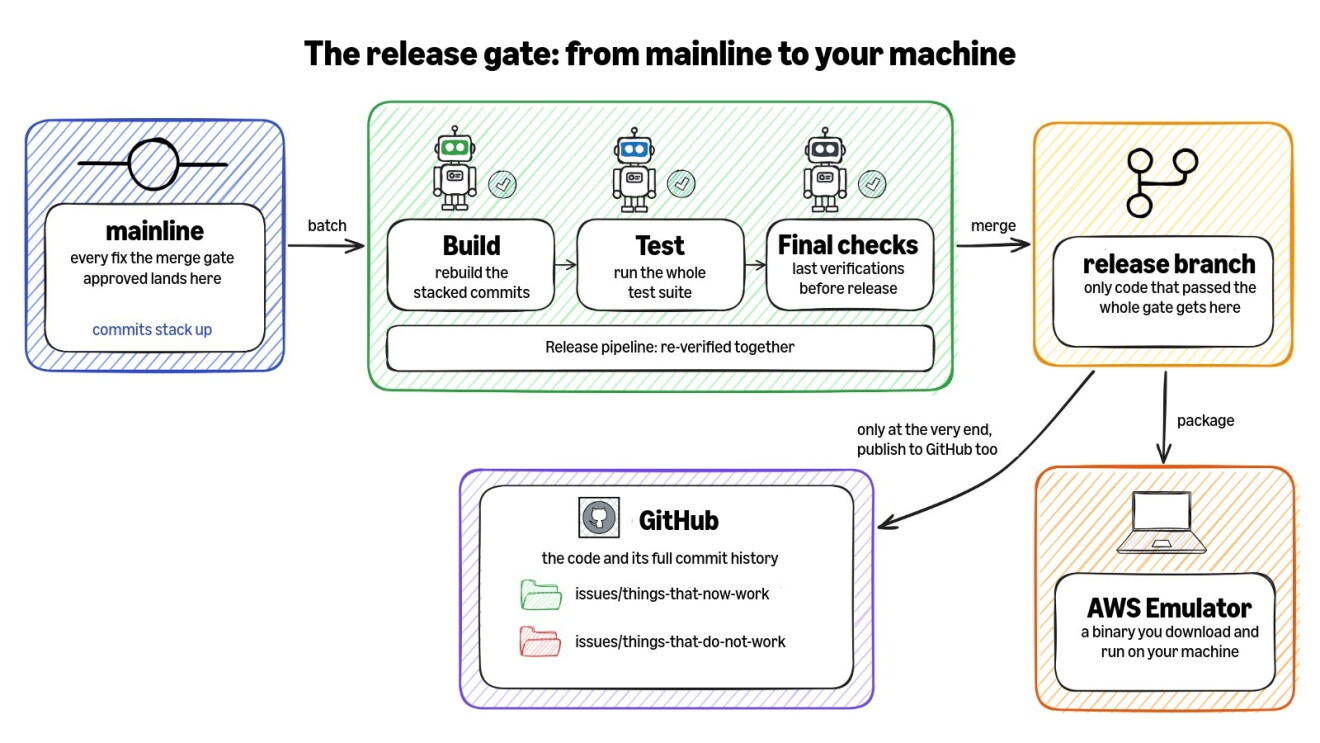
AWS has released a local emulator that allows developers to run and test AWS API endpoints on their own machines, a project distinguished by the fact that every line of code was written by autonomous AI agents. This tool enables software testing in development environments and continuous integration (CI) pipelines without requiring an active AWS account or incurring service fees. By providing a local alternative to live cloud resources, the emulator aims to streamline the development cycle while maintaining high fidelity to the actual AWS environment.
The AI-Driven Development Pipeline
The emulator was developed using a specialized workflow involving three teams of autonomous AI agents. The first team manages a test suite by converting Smithy API models and real-world AWS data into tens of thousands of 'fidelity tests.' These tests represent real-world scenarios, such as creating and deleting an Amazon SQS queue, and are verified against the actual AWS cloud before being saved to a shared repository.
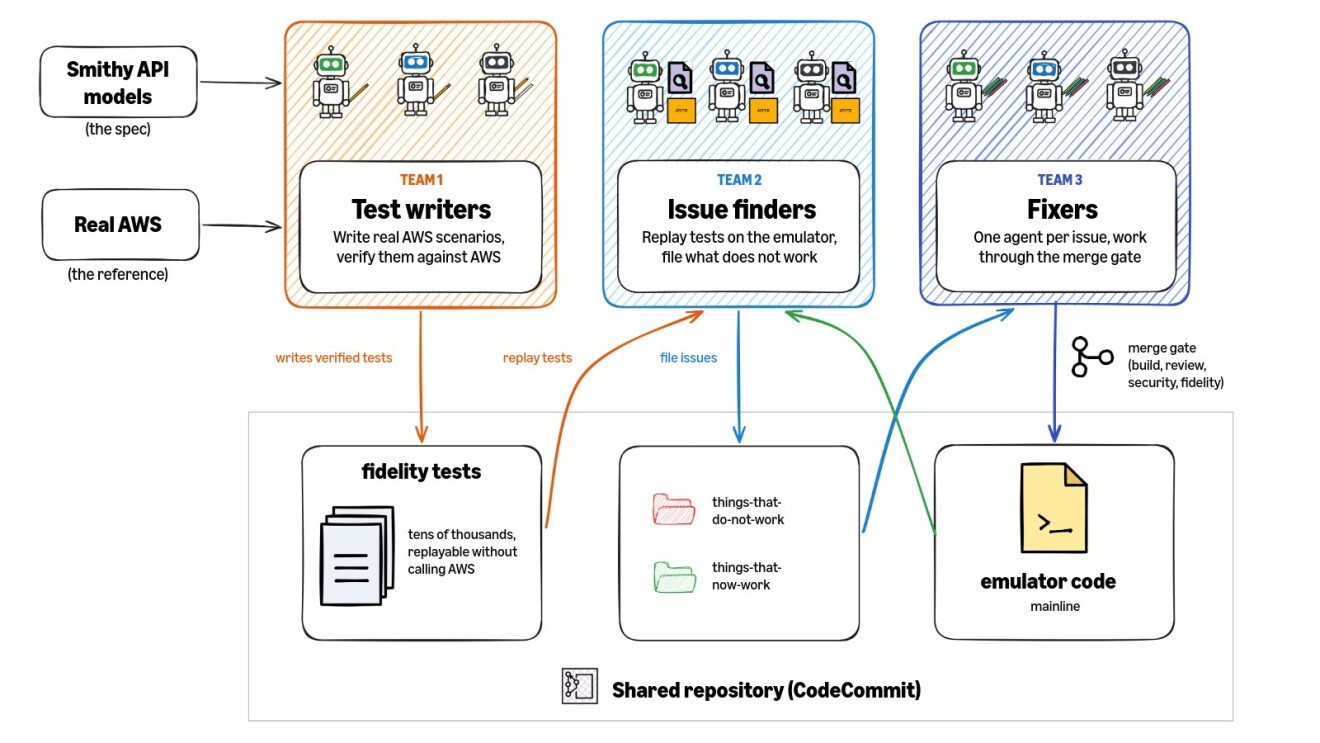
This image provides a more granular look at the first stage of the development pipeline described in the article.
A second team of agents replays these fidelity tests against the emulator code to identify divergences. When a test fails, the agents reason about the failure and group issues by root cause. A third team of agents then picks up individual issues, checks out the code, and edits it until the failure is resolved. These changes must pass a multi-stage gate—including build checks, coding standard reviews, security audits, and fidelity verifications—before being merged into the mainline code.
The diagram visualizes the specialized workflow where different teams of AI agents handle test creation, issue identification, and code fixing.
“Thousands of autonomous AI agents wrote every line of code in AWS Emulator, a new local emulator for AWS now available for download.”
— How we built the agents that built AWS Emulator
Operational Modes and Technical Requirements
Developers can interact with the emulator in two primary ways. In 'Server mode,' the emulator serves as a local program that provides an AWS API endpoint; users point their AWS CLI or SDK at this local address via environment variables. In 'Embedded mode,' specifically designed for Rust tests, the emulator is compiled directly into the test binary, allowing the test to wire the emulator's HTTP client straight into the SDK client without needing an external endpoint or certificate.
While the emulator is free to use, building it from source requires significant local resources. A full debug build of all service crates can require at least 100 GB of free disk space and a multi-core machine. For most users, AWS provides prebuilt packages for Linux (RPM/Debian) and Docker containers for Windows and macOS to avoid these high build costs.
Fidelity and Limitations
AWS provides fidelity scores for each service to indicate how closely the emulator matches the real cloud. While the emulator covers 438 AWS API models, it is explicitly not intended for production workloads or for testing security protocols. The project maintains a public issue tracker where individual gaps in service behavior are documented, categorized into 'things-that-do-not-work' and 'things-that-now-work.'
The emulator also includes telemetry by default to help AWS understand how the tool is used. This telemetry is designed with strict data minimization, ensuring that request content, code, credentials, or personal data are never collected. Users who prefer to keep their local testing private can opt out of telemetry via command-line flags, environment variables, or a configuration file.
What Hacker News readers are saying
- Alternative: One commenter expressed skepticism about the tool's long-term maintenance and suggested using existing alternatives like Floci or Testcontainers. comment ↗
- Skeptical: One user questioned the motivation behind the project, suggesting it might have been created primarily to train large language models rather than for general developer use. comment ↗
- Skeptical: Another commenter argued that the project was essentially a product of AI models rather than AWS's own engineering, suggesting that such capabilities are now easily replicable by others. comment ↗
Summarized opinions from the Hacker News thread, not verified facts. Read the full discussion ↗