Apple is developing a new Mac application called Harbor, designed to transform personal computers into private AI inference servers where data never leaves the local hardware. By leveraging Apple silicon, the app aims to provide a seamless way for users to run open-weight models without relying on cloud-based infrastructure.

The article discusses how Apple's new Harbor app leverages high-performance Apple silicon to run local AI models.
Private Inference and Model Management
Harbor is designed to let users browse, download, and load open-weight models directly within the application. By keeping the inference process local, the app ensures that user data remains on the hardware and does not reach the cloud.
The software aims to simplify the user experience by handling model management automatically. This allows users to focus on their specific work rather than the technical complexities of infrastructure setup.
“Harbor turns your Mac into a private AI inference server.”
— Apple has new Mac app coming to make running local AI models easy - 9to5Mac
Scaling via Thunderbolt 5 Clustering
A standout feature of Harbor is its ability to form a cluster by detecting multiple Mac computers over Thunderbolt 5. This configuration pools the unified memory of the connected devices into a single inference resource.

This image illustrates the hardware that Harbor can cluster together via Thunderbolt 5 to create a private inference server.
This memory pooling enables the system to run models that exceed the capacity of any single computer or to serve a higher volume of concurrent requests across the cluster. The app is intended to automate this process, requiring no manual configuration or infrastructure expertise.
Hardware Requirements and Local Alternatives
While Harbor provides a native Apple solution, other tools like 'Local Code' already offer private AI agents for Apple Silicon. These tools often require specific memory thresholds; for example, running large models like DeepSeek 4.1 Flash 1017 may require 96 GB of memory or the use of SSD streaming to manage memory constraints.
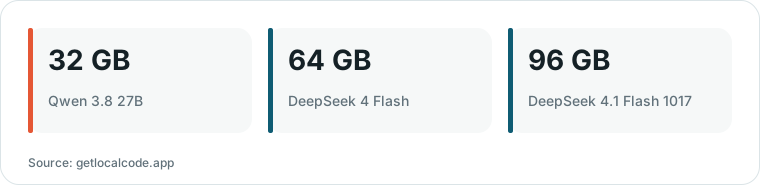
Chart drawn by HN Digest from figures reported by getlocalcode.app; values are shown as written in the source.
The trade-off for local inference involves significant hardware demands. Users with smaller memory capacities may need to rely on SSD streaming, which keeps parts of a model on the disk and loads them as needed, potentially slowing down performance compared to full in-memory execution.
What Hacker News readers are saying
- Technical note: One commenter noted that the primary differentiator for this app appears to be its ability to pool unified memory across multiple Thunderbolt 5-capable Macs to run models that exceed a single machine's capacity. comment ↗
- Skeptical: A commenter argued that cloud computing remains more cost-effective and productive for most users due to industrial-scale efficiencies, suggesting that local models may only be preferable for a small percentage of privacy-focused users. comment ↗
- Skeptical: Another user expressed skepticism regarding whether Apple can provide affordable consumer hardware with enough memory to run large models at useful speeds, given the high cost of memory. comment ↗
- Technical note: One commenter pointed out that users can already interact with local models on M1+ Macs using various open-source servers available on GitHub. comment ↗
Summarized opinions from the Hacker News thread, not verified facts. Read the full discussion ↗