A single passenger's decision to pull an emergency brake on a subway train created a real-life variant of the 'trolley problem,' balancing the risk of a permanent physical injury against a significant delay for approximately 25,000 people. The incident highlights a core challenge in real-world morality: making decisions that are robust to the fact that we often misinterpret the situation in the moment.
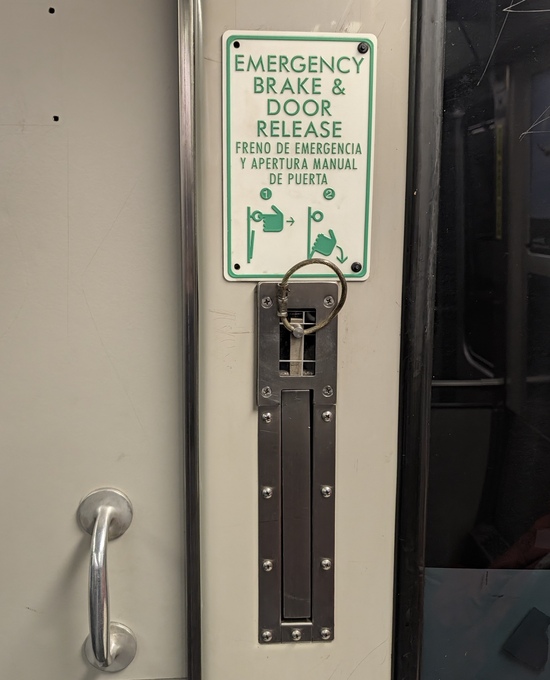
This image depicts the physical mechanism involved in the passenger's decision to stop the train.
Uncertainty vs. Hypothetical Logic
In traditional philosophical thought experiments like the trolley problem, the facts of the situation are usually presented as absolute. In the subway incident, the primary actor faced a situation where the hardest part was assessing the world rather than deciding on a moral rule.
The author notes that while people often 'fight the hypothetical' in theory, real-life morality requires making decisions that are robust to misinterpretation. Because it was unclear if the man's arm or just his bag was caught, the actor had to choose the path that minimized the worst-case outcome of a permanent injury.
“We need to make decisions that are robust to us having misinterpreted the situation.”
— Pulling the Lever in a Subway Problem
The Mechanics of Group Apathy
The incident revealed a breakdown in collective action during a high-stress moment. While several passengers shouted for the brake to be pulled, many others appeared to freeze, illustrating how difficult it is to integrate diverse viewpoints under pressure.
The author suggests that the 'it is okay' position—the belief that the man was only in danger of losing a bag—was harder to communicate quickly than the 'emergency' position. This difficulty in expressing a nuanced view can cause a more easily expressed alarm to dominate group behavior.
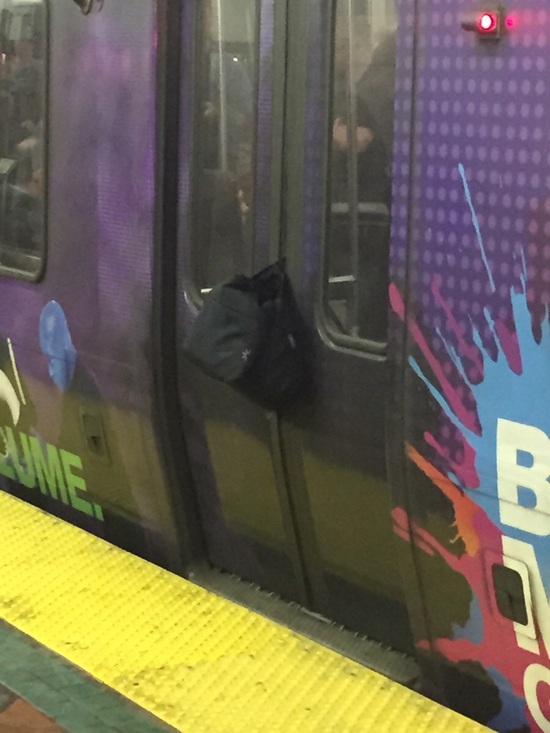
This visual illustrates the specific object that some witnesses believed was the only thing caught in the door.
The Unilateralist's Curse
The situation serves as an example of the 'Unilateralist's Curse,' where a single individual's subjective interpretation of a situation can trigger a large-scale consequence for everyone else. In this case, one person's belief in a medical emergency caused a train delay affecting thousands of passengers.
The trade-off involved balancing a potential permanent injury against a calculated loss of 'waking life' for the crowd. However, the author points out that real-world outcomes are often non-linear; if the injury had occurred, the resulting chaos might have caused an even greater delay than the initial brake pull.
What Hacker News readers are saying
- Alternative: One commenter argued that the situation is not a complex moral calculus but a simple one: if someone tells you to hit the brake because an arm is stuck, you hit the brake. comment ↗
- Skeptical: A commenter expressed skepticism regarding the mathematical calculations used to weigh the loss of commute time against physical injury, questioning if people would actually accept a shorter life in exchange for skipping a commute. comment ↗
- Alternative: Commenters noted that another perspective suggested that the problem is best viewed through its end states, noting that an ordinary person acting on reasonable cause would be judged fairly regardless of the specific outcome. comment ↗
- Skeptical: One reader argued that the complexity of the problem is irreducible because real-world moral decisions always involve uncertainty about the state of the world and the actual effects of one's actions. comment ↗
Summarized opinions from the Hacker News thread, not verified facts. Read the full discussion ↗