While the three-body problem—the challenge of predicting the motion of three interacting masses—has no general closed-form solution, it contains thousands of specific 'periodic' orbits. A new interactive atlas, Three Body Orbits, visualizes 3,942 of these solutions, where three masses fall around each other and arrive, after one period, at precisely their starting positions and velocities.
Mapping the Periodic Solutions
The Three Body Orbits project provides a visual map where orbits that look alike sit next to each other. These families form 'islands' on the map, each leading to a dedicated page where the orbit plays one period at a time.
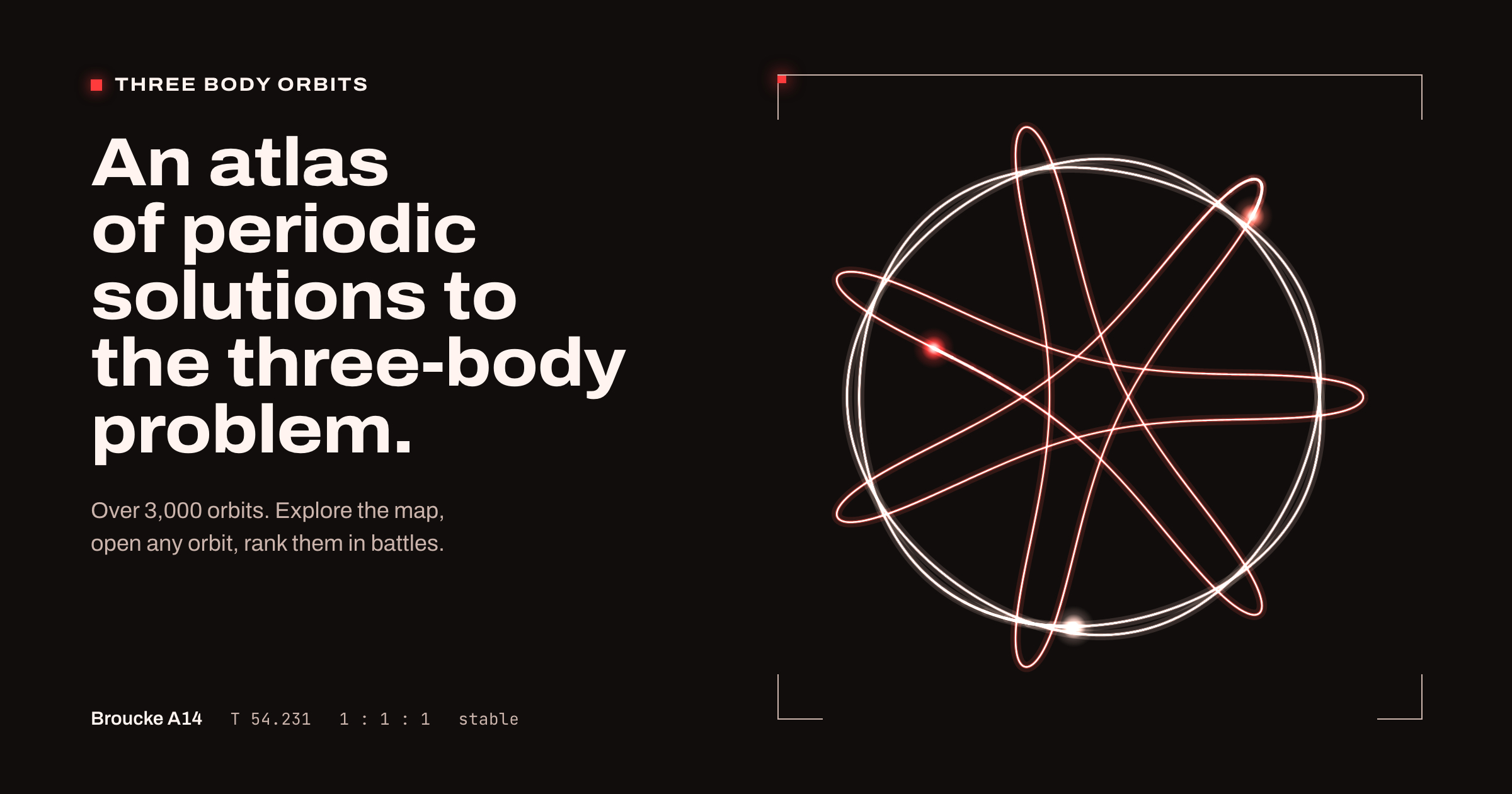
This image illustrates a specific periodic orbit, providing a visual example of the 'families' of solutions mapped by the project.
The project highlights the distinction between the 'general' problem and specific solutions. While a single formula cannot describe all possible three-body movements, these 3,942 orbits represent specific configurations that repeat perfectly over time.
“The three-body problem has no general solution, but it has thousands of periodic orbits: three masses falling around each other and arriving, after one period, at precisely their starting positions and velocities.”
— Three Body Orbits — 3,942 periodic three-body orbits, visualized
Interactive Exploration and Community Contribution
The site features interactive tools that allow users to 'nudge' an orbit off its track to see how the system reacts. It also includes a 'battle' system where orbits can be rated and ranked against one another.
The developer recently added a feature allowing users to contribute compute via their browsers to help discover novel orbits. Users who find a 'linearly stable' orbit are given the opportunity to name it.
Discussion on Stability and Real-World Application
Commenters on Hacker News discussed the practical stability of these orbits, noting that many are likely unstable and would be set adrift by minor random perturbations. Some users questioned if any of these choreographies could survive in practice or be used for practical purposes, such as accelerating a spacecraft.
The discussion also touched on the visual representation of the data. One commenter noted that while the masses are shown as equal (1,1,1), the starting positions—which are critical to the course of events—are not explicitly displayed in the primary view.