Astronomers have identified a massive celestial body, designated 2026 ED138, which orbits the sun at a distance 46 times greater than Earth's. This object takes approximately 281.1 years to complete a single orbit and is currently being evaluated to see if it meets the criteria for a new dwarf planet, a classification that would place it among only six known objects in our solar system.

This mosaic illustrates the actual visual detections of the object 2026 ED138 as identified by astronomers.
Discovery and Verification
Matthew Holman and Kevin Napier discovered the object while analyzing data from the Vera C. Rubin Observatory in Chile. While the telescope had already identified over 2,000 small objects, 2026 ED138 stood out due to its significant brightness and apparent size.
To confirm the object was not a false positive, the team cross-referenced the data with historical records. They successfully located the body in photographic plates from 1937 stored at Harvard, providing high confidence in its orbital path.
Orbital Mechanics and Classification
The object's orbit is notably distinct from the main planets, featuring a tilt of nearly 25 degrees. This deviation suggests that the body was gravitationally disturbed by Neptune during its journey through the outer solar system.
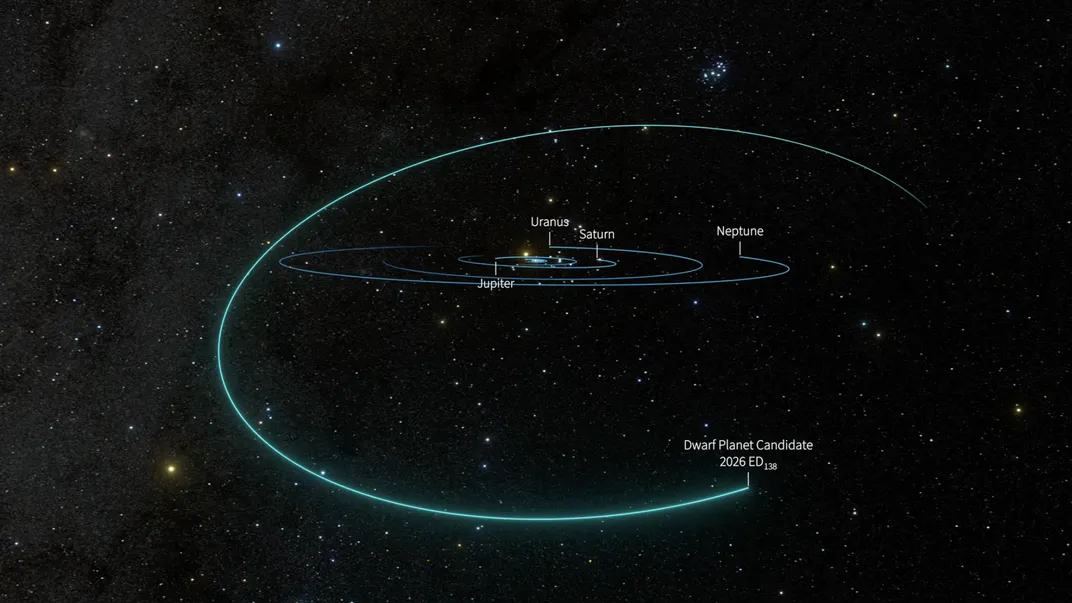
This 3D orbit visualization helps explain the distinct orbital mechanics and tilt of the new candidate.
To be classified as a dwarf planet, an object must have a nearly round shape due to its own gravity but lack the mass to clear its orbital path of other debris. While 2026 ED138 is likely large enough to be round, its exact dimensions remain unconfirmed.
Measurement Challenges and Future Research
Determining the exact size of 2026 ED138 is difficult because brightness alone can be misleading; a small, highly reflective object with ice caps can appear as bright as a much larger, duller body. Astronomers plan to use infrared light to measure thermal energy or observe the object passing in front of a star to calculate its size based on light obscuration.
The discovery is significant because it may represent the 'tip of the iceberg' of many more objects hidden in the outer solar system. Furthermore, because it resides in the southern hemisphere's sky, the Vera C. Rubin Observatory's capabilities provide a new opportunity to map these distant regions more precisely.
What Hacker News readers are saying
- Supportive: One commenter argued that creating the dwarf planet classification was the correct move because it became difficult to justify Pluto's status given the existence of other similar bodies like Eris and Haumea. comment ↗
- Alternative: Another user suggested an alternative classification system where dwarf planets could be considered a subcategory of planets rather than a separate category, which would have allowed for the promotion of objects like Ceres. comment ↗
- Skeptical: One commenter expressed skepticism regarding the gravitational influence of the new candidate, arguing that dwarf planets are generally too small to affect orbits in the manner described. comment ↗
Summarized opinions from the Hacker News thread, not verified facts. Read the full discussion ↗