IBM has announced the Nighthawk r3, a next-generation quantum processor designed to accurately execute 10,000 quantum operations across 520 programmable qubits. This development aims to tackle larger, more complex problems while maintaining the high-speed performance of current hardware, moving IBM closer to its goal of fault-tolerant quantum computing.
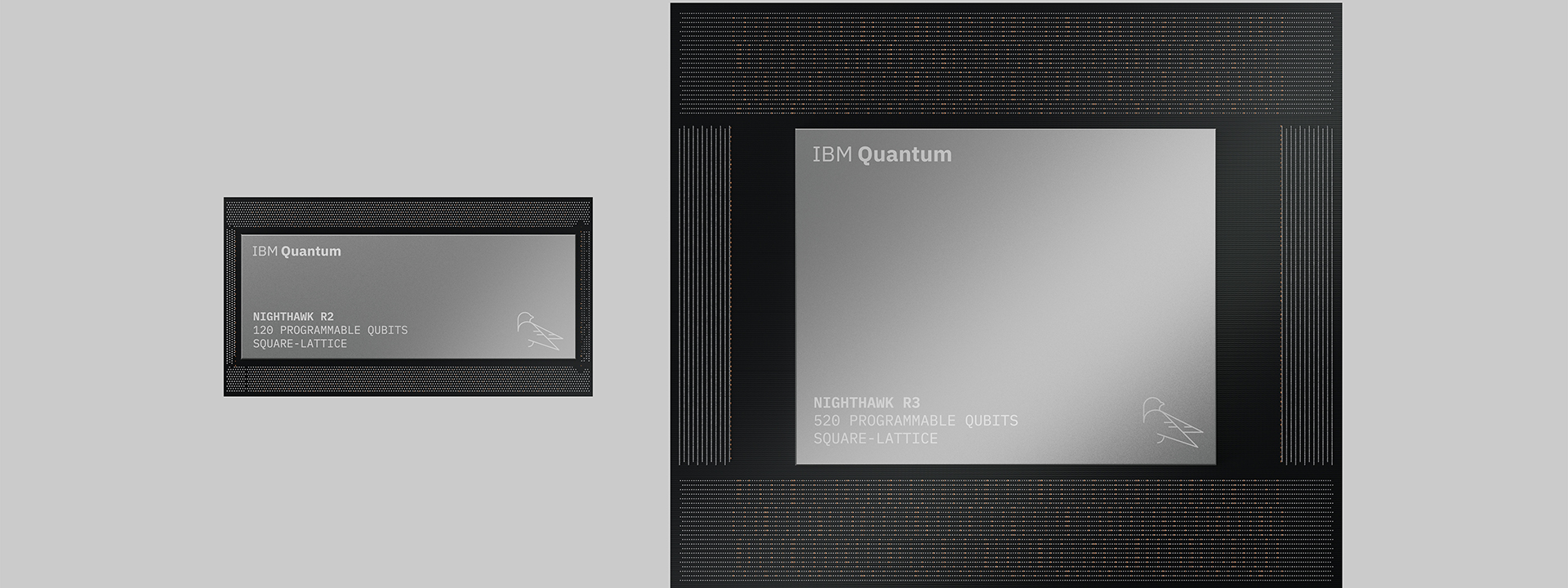
This banner image illustrates the Nighthawk processor architecture discussed in the opening section of the article.
High-Speed Performance of Nighthawk r2
The current Nighthawk r2 processor serves as the foundation for the upcoming r3 model, utilizing high-speed qubit reset technology to reduce the time between circuit executions. This allows the system to support accurate computations with more than 7,500 quantum operations on 120 qubits.
Partners such as E.ON and Algorithmiq have reported significant performance gains using the r2. For example, E.ON achieved a 15x speedup in quantum machine learning for energy grid optimization, while Algorithmiq executed circuits 8 times faster than on the previous Heron processor.
“Nighthawk is already showing us what that looks like today. As we scale this architecture to larger and more powerful quantum computers, the capabilities of quantum computation will reach new levels as we integrate more closely with classical resources and march ahead to fault tolerance.”
— IBM Quantum Nighthawk Demonstrates New Levels of Speed and Quality, with Plans to Scale Beyond 1,000 Qubits in 2027
Modular Architecture and l-Couplers
To scale beyond the limits of a single chip, the Nighthawk r3 introduces 10 chip-to-chip interconnects known as l-couplers. These components are designed to link multiple processors into a single, larger system while maintaining the square-lattice connectivity and fast operations of the r2 architecture.
IBM has already demonstrated the feasibility of this modularity by connecting Nighthawk r1 processors using four l-couplers. This test achieved a 99.3 percent quantum state transfer fidelity, moving closer to the 99.9 percent target required for reliable large-scale computation.
Integrating Quantum and Classical Computing
IBM is moving toward a unified environment where quantum workflows are integrated directly with classical high-performance computing (HPC). This integration is essential for handling the layers of quantum error correction and noise learning required for industry-relevant applications.
The IBM Quantum Platform now allows users to connect quantum workflows to resources ranging from personal laptops to supercomputers. In one instance, Cleveland Clinic and RIKEN used this automation to process 608 million samples for biological modeling, completing the task 33 times faster than without the automated workflow.
Scaling Challenges and Roadmaps
While the Nighthawk r3 provides a path toward larger systems, the transition to fault tolerance remains a long-term goal. The current architecture focuses on improving speed and quality to make demanding workloads—which may require millions or billions of samples—practical in reasonable timeframes.
A key technical milestone for 2027 involves connecting two Nighthawk r3 processors into a single system with more than 1,000 qubits. This modular approach is intended to tackle increasingly complex problems that are significantly more challenging for classical computers to simulate.
This screenshot captures the primary source's presentation of the Nighthawk r3's technical specifications.
What Hacker News readers are saying
- Technical note: One commenter who has worked with dilution fridges expressed concern regarding the high power consumption and the scarcity of helium required to operate such systems at a data center scale. comment ↗
- Skeptical: Several commenters expressed skepticism regarding the practical utility of these machines, with one person questioning if the processor can achieve results beyond the capabilities of classical computers and another predicting a 'quantum winter' due to unfulfilled commercial projections. comment ↗
- Technical note: A commenter clarified that 'programmable qubits' in this context likely refer to physical qubits where gates can be applied rather than error-corrected logical qubits, noting that the non-programmable qubits are used for leakage removal. comment ↗
Summarized opinions from the Hacker News thread, not verified facts. Read the full discussion ↗