A study presented at the SIGBOVIK 2019 conference found that 93% of random paint splatters are parsed as valid Perl programs. By using optical character recognition (OCR) software to analyze a dataset of 100 paint-splatter images, researcher Colin McMillen addressed a long-standing joke in the programming community regarding the language's permissive syntax.
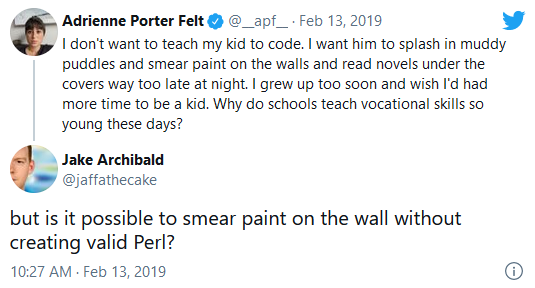
This image captures the social media interaction that prompted the research into Perl's permissive syntax.
Empirical Methodology and Findings
The research employed an empirical approach to determine if it is possible to smear paint on a wall without creating a valid Perl program. The author used OCR software to convert 100 different paint-splatter images into text strings, which were then tested against a Perl interpreter.
The analysis revealed that 93% of these splatters successfully parsed as valid Perl. For the remaining 7% that were not valid, the author provided specific visual examples to demonstrate the boundaries of the language's syntax.
This visual represents the type of chaotic noise that the study found to be valid Perl code.
“We answer this question in the affirmative: it is possible to smear paint on the wall without creating a valid Perl program.”
— 93% of Paint Splatters are Valid Perl Programs | Colin McMillen
The Nature of Paint-Splatter Perl
The programs generated from these splatters often evaluate to simple values or strings. For example, one splatter was recognized as the string `lerzfijglpFiji-j`, which evaluates to the number 0 in Perl.
The study used a dataset of such images to test the limits of Perl's interpreter.
Other complex visual patterns were interpreted as strings like `;i;c;;#\\?z{;?;;fn':.;`, which evaluates to the character `c`. The study highlights how Perl's ability to handle various symbols and structures allows it to find 'meaning' in nearly any visual noise.
Limitations and Context
The study's results are dependent on the specific settings of the OCR software used. If different OCR configurations were employed, the software might recognize different valid programs from the same physical splatter.
While the study focuses on Perl, it stands in contrast to other systems where invalidity is much easier to achieve. For instance, a Java properties file is only invalid if it contains specific incorrect Unicode escape sequences, making it far less likely to be 'accidentally' valid compared to Perl.