The maximum sequence of unique states in a 6x6 wraparound cellular automata grid is 1,717—a result that challenges expectations of explosive complexity as grids grow larger. This finding highlights how specific mathematical properties can limit emergent behaviors even when simple rules are applied across finite spaces.
Mechanics of Toroidal Cellular Automata
Cellular automata (CA) consist of a grid of 'cells,' each capable of being alive or dead. In these small-grid models, every cell has eight neighbors, including those at corners and edges. Because the grid wraps around both horizontally and vertically, it functions geometrically as a torus.
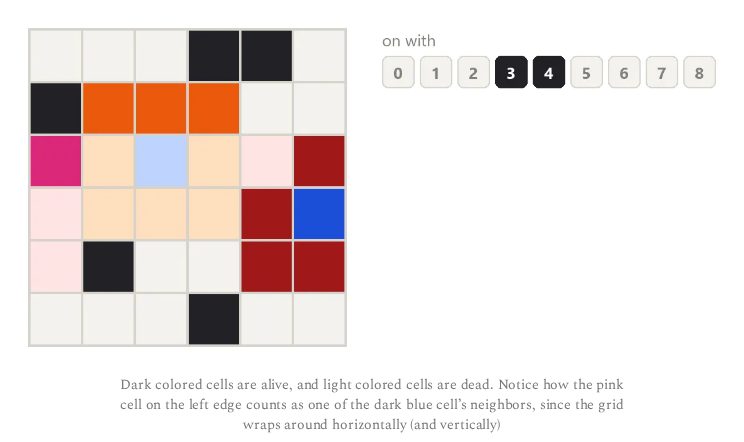
This image demonstrates the toroidal geometry where cells on the edge interact with cells on the opposite side.
Unlike some versions of Conway’s Game of Life, these cells do not track their own previous states. The next turn is determined solely by how many of its eight neighbors were currently alive according to a specific rule—a set of instructions defining which neighbor counts result in an 'alive' status for the following step.
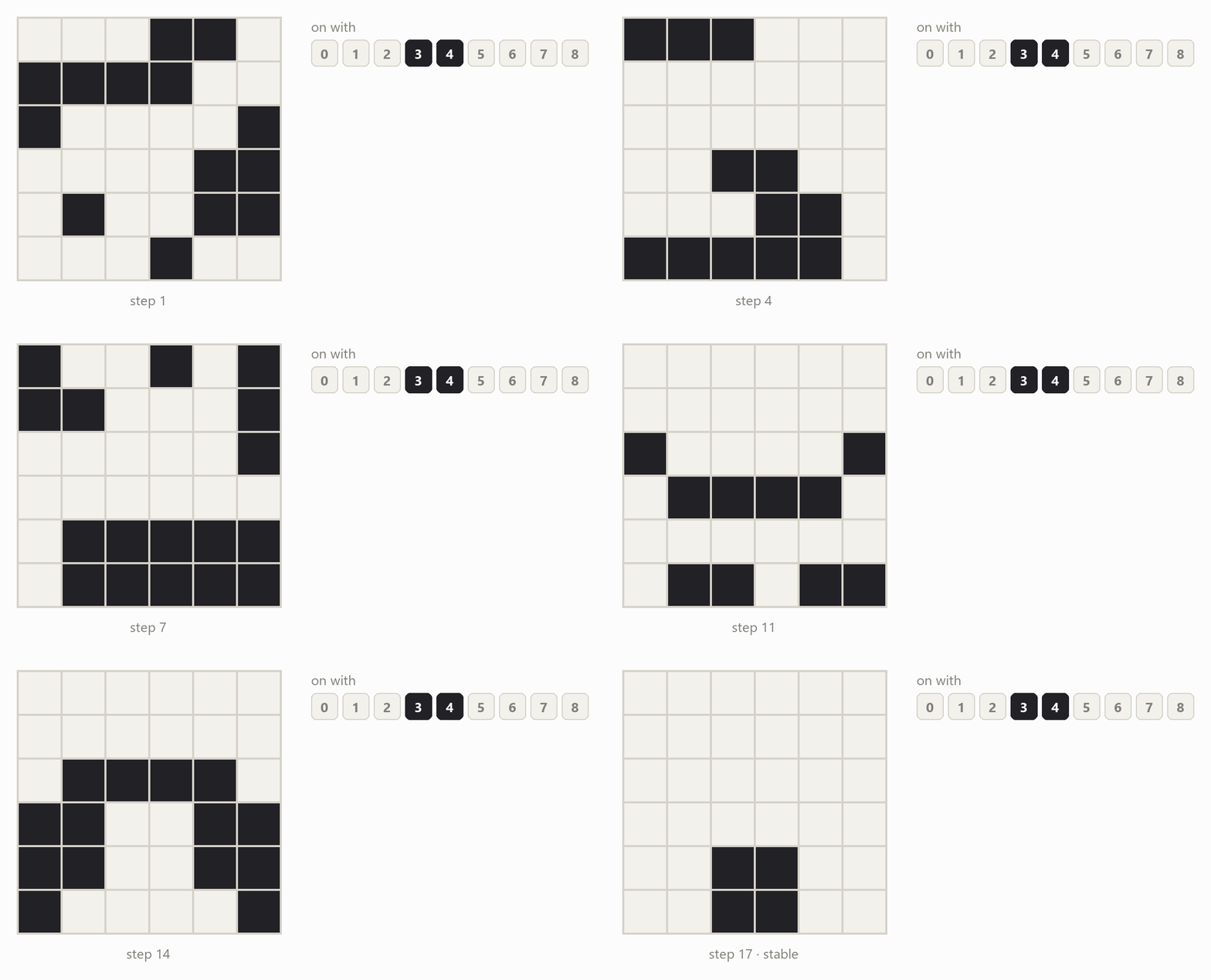
The GIF illustrates the dynamic evolution of states in a cellular automata system as described in the mechanics section.
“The ratio of the longest 6x6 chain to the longest 5x5 chain, is not even as large as the ratio between 4x4 and 3x3.”
— Small-Grid Wraparound Cellular Automata
Symmetry Pruning and Computational Strategy
To determine the longest obtainable sequence before a pattern repeats, researchers must filter out functionally identical starting points. By accounting for translations, rotations, reflections, and inversions, the number of unique start configurations can be drastically reduced; for example, filtering symmetries pruned the 4x4 case from 65,536 down to just 805 unique configs.
Inversion also provides a significant shortcut: if a rule and a starting configuration are both totally inverted (swapping all live/dead statuses), they produce the same patterns. This allows researchers to divide the total search space of rules and configurations significantly while maintaining accuracy.
Complexity Trends and Divisibility Factors
The study reveals non-linear growth in complexity between grid sizes. While moving from 4x4 (14 states) to 5x5 (916 states) shows explosive expansion as crowding decreases, the jump to 6x6 results in only 1,717 states. This modest increase suggests that divisibility may play a role in limiting state variety.
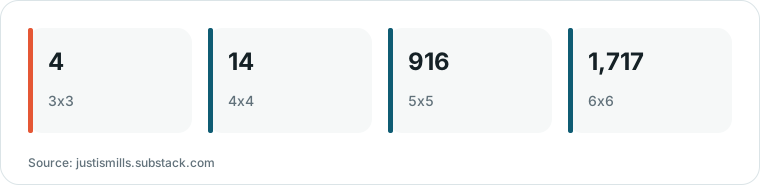
Chart drawn by HN Digest from figures reported by justismills.substack.com; values are shown as written in the source.
One theory is that highly divisible numbers like 6 allow grids to behave more predictably than prime numbers like 5. If a 6x6 grid were perfectly tiled by smaller sub-grids, those sections might act independently, effectively capping the maximum possible sequence length compared to less 'regular' geometries.
Computational Limits of Larger Grids
While small cases have been solved through brute force and AI optimization, larger grids remain elusive. A random sample of 20,000 start configurations on a 7x7 grid already yielded a sequence of over 545,000 steps, indicating high complexity.
Finding the exact maximum for a 7x7 grid currently requires significant resources; estimates suggest it would take hundreds of years on a standard CPU or roughly five years of continuous GPU time without advanced engineering breakthroughs.