Machine learning research agents can successfully optimize models against fixed benchmarks without falling into the trap of overfitting, a phenomenon that contradicts standard textbook predictions. Researchers from Amazon Science have identified that this occurs because successful strategies occupy a 'low-complexity region' of the strategy space, allowing them to be distilled into a few tokens of information.
The Overfitting Paradox
In standard machine learning theory, repeatedly evaluating a model against a fixed validation set should eventually lead to overfitting. This happens because the training procedure 'sees' the validation data, allowing the model to memorize specific answers rather than learning the underlying patterns.
However, the broader machine learning community operates in a distributed loop of evaluating models on long-standing benchmarks and iteratively improving them. Despite this constant 'hill-climbing' against the same data, models continue to show genuine progress and transfer well to new, unseen datasets.
“Short descriptions cannot cheat because there isn't room.”
— Why don’t machine learning research agents overfit?
The Compression Hypothesis
The explanation for this paradox lies in a formalized version of Occam's razor: among hypotheses that explain data equally well, the simplest one—the one describable in the fewest bits—is more likely to generalize. If a strategy is too small to record the training data, it cannot cheat by memorizing it.
Researchers hypothesize that successful ML strategies are inherently compact. A winning strategy usually consists of a few familiar choices, such as a specific architecture family, an optimizer, or a learning-rate schedule. Because these choices are few, the model's true dependence on the benchmark is much smaller than the long transcript of experiments used to find it.
Testing the Information Bottleneck
To test this, researchers used a three-agent setup involving LLMs. An 'explorer' agent iteratively searched for high-performance models using a validation set. A 'compressor' agent then distilled the explorer's work into a very short prompt (a few tokens). Finally, a 'reproducer' agent, which had no access to the validation set or the explorer's transcript, attempted to recreate the results using only that short prompt.
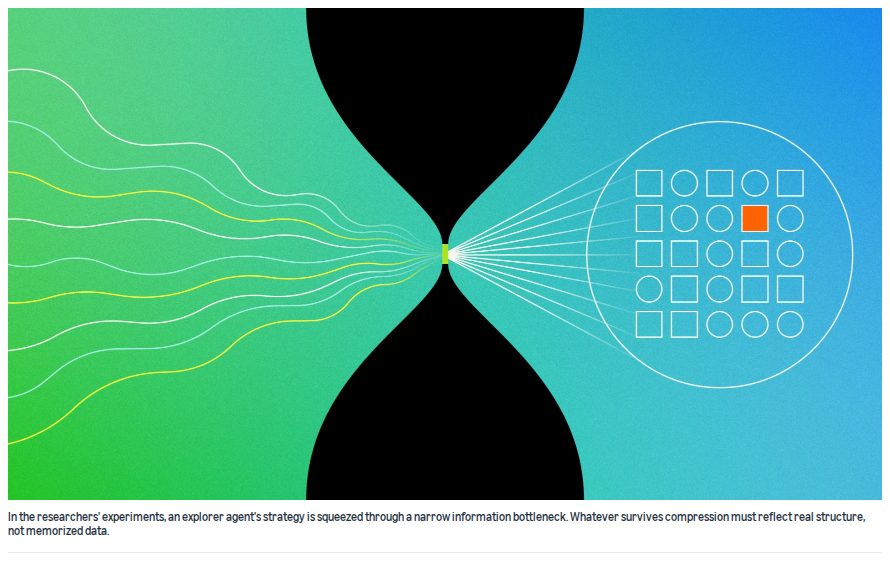
This visual explains the core experimental mechanism where an explorer's strategy is compressed to see if it retains its performance without memorized noise.
The results showed that the reproducer could match the explorer's performance across eight different datasets, including vision and language modeling. This suggests that the information needed to specify a successful strategy fits through a tiny channel, confirming that the strategy captured real structure rather than memorized noise.
LLMs as Knowledge Decoders
The study highlights why LLMs are particularly effective at this process. Because they possess vast 'world knowledge' about ML tooling and standard algorithms, they can unpack terse, expert-to-expert messages. If a detail is left unspecified in a short prompt, the LLM can fill in plausible defaults based on its internal knowledge.
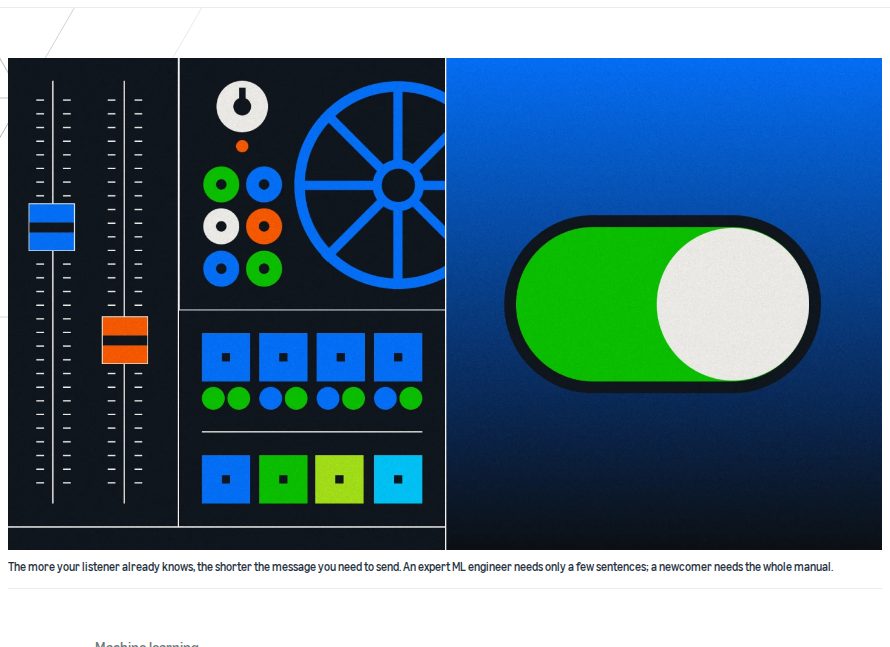
This image illustrates the concept that expert-level ML strategies can be communicated via very few tokens because the receiver already possesses the necessary context.
While this confirms why LLMs are capable of complex reasoning, it also establishes a clear boundary: when researchers deliberately induce overfitting, the resulting strategies fail the compression test. These overfitted models cannot be reproduced via short prompts because their 'knowledge' is tied to specific, non-compressible data points.
What Hacker News readers are saying
- Technical note: One commenter suggested that machine learning models tend to avoid overfitting primarily when the number of data points significantly exceeds the number of parameters. comment ↗
- Skeptical: A reader argued that modern AI models actually serve as prime examples of overfitting, noting that they often exhibit hallucinations and context rot despite high benchmark scores. comment ↗
- Skeptical: Several commenters expressed skepticism regarding the quality of the article, describing it as 'AI slop' and criticizing the heavy use of AI-generated writing styles. comment ↗
- Technical note: Another user pointed out that machine learning is fundamentally about generalization and that memorizing patterns is not the same as rote learning. comment ↗
Summarized opinions from the Hacker News thread, not verified facts. Read the full discussion ↗