Brave has launched a new payment architecture for its Search API that allows autonomous AI agents to pay for search results on-demand, eliminating the need for developers to manage traditional API keys or pre-paid plans. By leveraging the x402 protocol, the system enables a 'pay-as-you-go' model where agents can programmatically query Brave’s independent search index and settle costs in real-time using USDC stablecoins.
This image serves as the primary visual for the announcement of Brave's new payment architecture for autonomous AI agents.
The x402 Payment Workflow
The technical mechanism shifts authentication from a static key to a per-request payment verification. When an agent sends a request to the Brave Search API, the system checks for an accompanying payment; if missing, it returns an HTTP 402 response containing the specific price of that search.
The agent then signs a USDC payment for that amount and retries the request with the signed payment attached. Once Brave verifies the transaction on the Base blockchain, the search is executed, and the agent receives the results along with a transaction receipt.
Optimizing for AI Agents
A core component of this update is the LLM Context API, which differs from traditional web search by returning extracted page chunks and source metadata. This data-first ranking is designed to satisfy the needs of an LLM without requiring the agent to perform additional scraping.
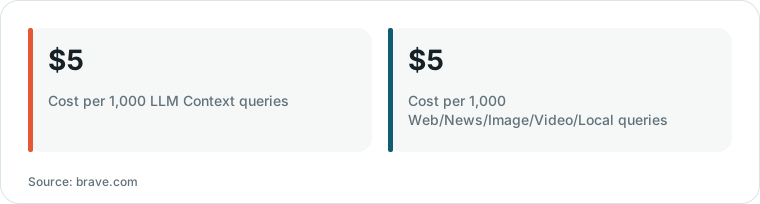
Chart drawn by HN Digest from figures reported by brave.com; values are shown as written in the source.
The API allows for fine-tuned control over the amount of context provided, including configurable token and URL limits. It also supports 'Goggles' re-ranking to ensure only the most relevant content is fed into the agent's context window.
Economic Trade-offs and Adoption
By moving to a micro-payment model, Brave is positioning its search index as a pro-consumer alternative to ad-supported models. While this removes the need for account creation, it places the cost of search directly on the agent's wallet, which may impact the economics of high-volume autonomous systems.
While Brave covers gas fees on the Base blockchain for a limited time, the long-term viability of the x402 protocol depends on its adoption by the broader developer community. Currently, the system is designed to be easily accessible through tools like Purl Wallet, a CLI wallet developed by Stripe for AI agents.
What Hacker News readers are saying
- Experience: One commenter who implemented the x402 protocol on a heavily crawled site reported that they have yet to see any successful transactions, suggesting the system might not be functioning as intended. comment ↗
- Skeptical: A commenter expressed concern that the lack of a budget envelope or per-task cap could lead to runaway spending, as autonomous agents might repeatedly search the same query with slight variations. comment ↗
- Skeptical: Another user argued that the model might be impractical because agents are unlikely to convert on paid impressions, potentially leading to a shift where humans eventually demand the same premium experience as agents. comment ↗
- Skeptical: One commenter raised concerns about the security and trust of using a stablecoin-based system, noting that users may be uncomfortable with an agent spending funds from a digital wallet without a clear path to recourse. comment ↗
Summarized opinions from the Hacker News thread, not verified facts. Read the full discussion ↗