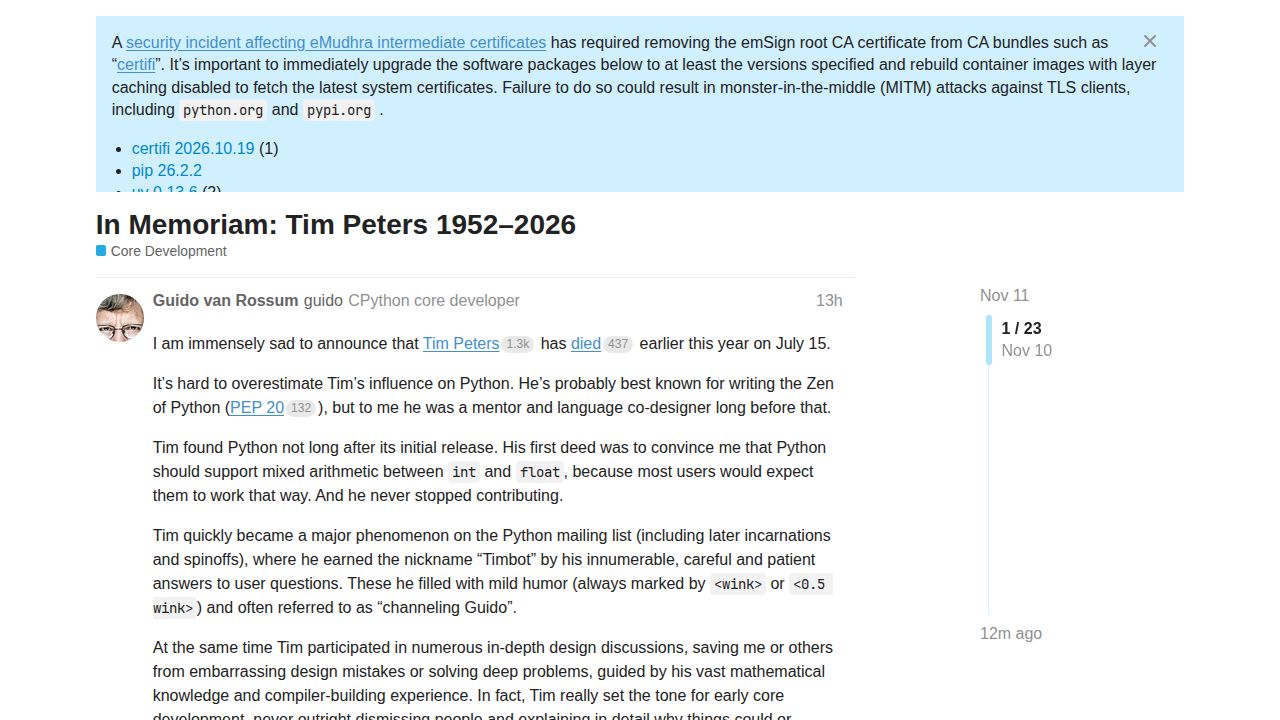
Tim Peters, a pivotal figure in the evolution of the Python programming language, died on July 15, 2026, at the age of 74. As a core developer and early adopter, Peters worked alongside Python's creator, Guido van Rossum, to transition the language from a niche project into a global standard. His influence spanned from high-level design philosophy to low-level algorithmic optimizations used in modern computing systems.
Architecting Python's Core and Philosophy
Peters was one of the first users of Python and became a primary partner in its early design evolution. He advocated for fundamental features, such as allowing mixed arithmetic between integers and floats, to ensure the language met the practical expectations of its users.
He is perhaps most recognized for writing the 'Zen of Python' (PEP 20). This set of principles—such as 'Readability counts' and 'Simple is better than complex'—remains a guiding framework for Python developers and is still accessible as an 'easter egg' within the Python interpreter.
The Impact of Timsort
In 2002, Peters introduced Timsort, a hybrid sorting algorithm designed specifically for Python lists. By combining elements of merge sort and insertion sort, Timsort was engineered to perform efficiently on the common cases found in real-world data.
The algorithm's success led to its adoption across the software ecosystem. It is currently utilized in the V8 JavaScript engine powering Google Chrome and Chromium, as well as in the Android operating system and the Java programming language.
Community Leadership and Technical Rigor
Beyond his code contributions, Peters was a 'gatekeeper' for the Python community. He was known for his patient, humorous, and non-elitist approach to technical discussions on mailing lists, where he earned the nickname 'Timbot' for his exhaustive and careful answers to user questions.
His professional history at companies like Cray Research and Dragon Systems provided him with the deep mathematical knowledge and compiler-building experience necessary to solve complex problems. He was instrumental in moving Python from an 'interesting but ignorable' project to a primary language for the planet.
What Hacker News readers are saying
- Experience: One commenter shared that they learned to become a better software developer by reading Tim Peters' posts, noting his influence on their ability to write better code and support others. comment ↗
- Experience: A reader recalled learning the art of programming and numerical methods from Peters' contributions to the Usenet channel in the late 1990s. comment ↗
- Experience: Another user described Peters as a mentor figure who provided approachable technical dives and human connection through his work on the Python Cookbook. comment ↗
- Experience: One commenter noted that Peters' 'Zen of Python' became a foundational part of their office culture and a set of rules they use weekly. comment ↗
Summarized opinions from the Hacker News thread, not verified facts. Read the full discussion ↗