A developer's attempt to improve Linux performance for Dell docking stations was halted after Synaptics, the owner of DisplayLink technology, issued a cease-and-desist notice alleging patent infringement. The conflict arose when Mike Lothian attempted to build 'Vino,' a Rust-based driver designed to provide better feature parity for Linux users than the company's existing proprietary software.
The Development of the Vino Driver
Mike Lothian sought to improve the Linux experience for a Dell dock that uses DisplayLink chipsets. Because the vendor-supplied DisplayLink Manager (DLM) software is proprietary and only available in binary form for x86 platforms, Lothian used LLM assistance to develop a new driver called Vino.
Vino was designed as a Rust-based DRM/KMS driver. Lothian shared early patches with the Linux kernel's dri-devel mailing list and opened an issue on the Extensible Virtual Display Interface (EVDI) project to seek help with reverse-engineering the proprietary DL3 protocol.
“An independently written or clean-room implementation does not necessarily avoid patent infringement if it implements patented inventions.”
— Synaptics patent claims stop work on DisplayLink drivers
Synaptics' Patent Enforcement
Synaptics responded to Lothian's outreach by stating that DisplayLink is not an open standard and is protected by a substantial portfolio of patents. They argued that even 'clean-room' implementations—where a developer writes original code without seeing the source—can still infringe on patents if the resulting software replicates patented inventions.

The image identifies Synaptics, the company that issued the cease-and-desist notice regarding the DisplayLink patents.
The company eventually issued a formal cease-and-desist notice listing 125 patents. They demanded that Lothian stop all development, withdraw his code from all public platforms, and provide a signed confirmation of compliance. Synaptics also threatened a $25,000 weekly penalty for non-compliance.
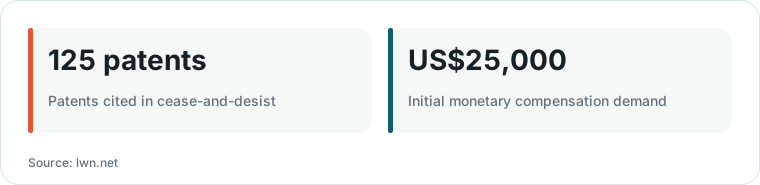
Chart drawn by HN Digest from figures reported by lwn.net; values are shown as written in the source.
Limitations of Open Source Protections
Lothian attempted to seek protection through the Open Invention Network (OIN), a cross-licensing organization designed to shield open-source developers from patent litigation. However, OIN's Linux System Definition explicitly excludes codecs unless they are specifically listed.
Because the DisplayLink technology involves proprietary codecs, OIN's protections did not extend to Lothian's kernel contributions. This left the developer without a legal shield against Synaptics' claims, leading him to take down his GitHub repository to avoid the costs of a legal defense.
What Hacker News readers are saying
- Technical note: One commenter provided a technical analysis of the patent's history, suggesting the patent might be invalid because the specific claims regarding network transport were added later to overcome prior art. comment ↗
- Experience: A user shared their experience of being unable to use DisplayLink docks due to persistent bugs in the Linux implementations, leading their company to avoid the hardware. comment ↗
- Skeptical: One commenter expressed skepticism regarding the company's claim that a single developer could significantly damage their competitive advantage, noting that competitors could perform similar reverse-engineering privately. comment ↗
Summarized opinions from the Hacker News thread, not verified facts. Read the full discussion ↗