Seagate has launched the FireCuda Forge, a hybrid storage solution that pairs an 8TB or 20TB mechanical hard drive (HDD) with a user-provided solid-state drive (SSD) to balance high capacity with fast responsiveness. The move comes as the AI boom drives storage prices to historic highs, making the combination of relatively cheap high-capacity spinning disks and expensive, fast flash memory economically viable again.
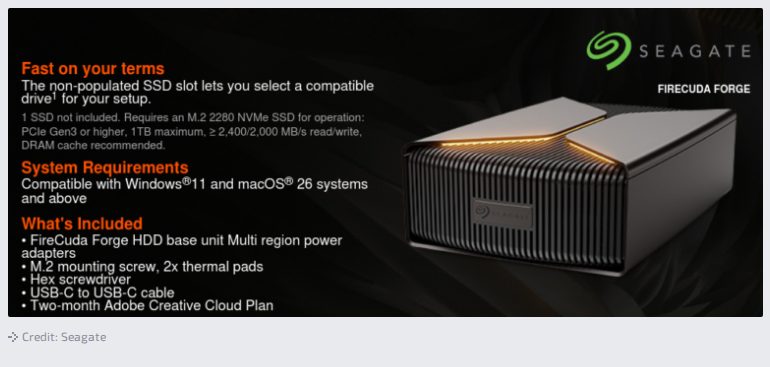
This visual depicts the physical product being discussed in the article's introduction.
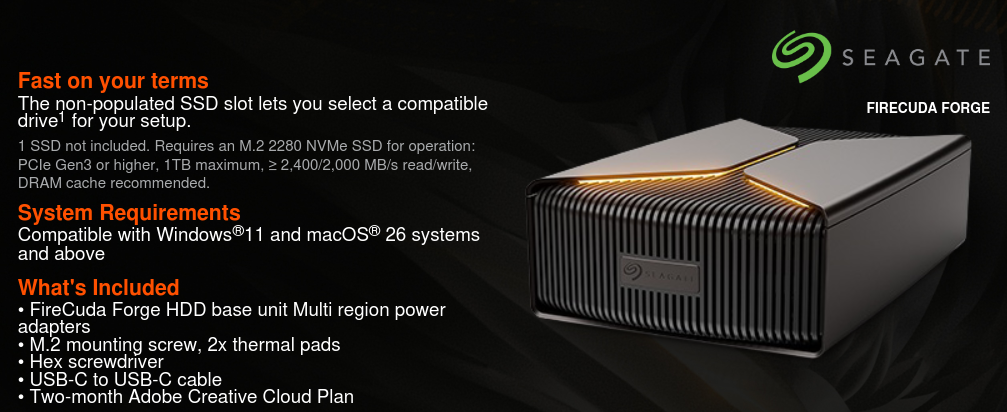
This image illustrates the hardware configuration and specifications for the new hybrid storage solution.
The Return of Hybrid Storage
Hybrid drives, which combine a large HDD with a smaller SSD into a single storage pool, were popular in the early 2010s but faded as SSD prices dropped. However, the 2026 storage market has seen a reversal in this trend, with both SSD and HDD prices exploding due to high demand.
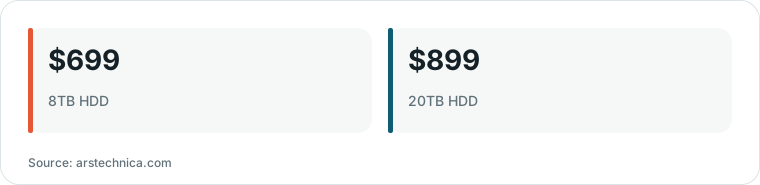
Chart drawn by HN Digest from figures reported by arstechnica.com; values are shown as written in the source.
For example, a Seagate Exos 24TB drive that sold for approximately $299 in the summer of 2025 reached a price of nearly $700 by August 2026. This price volatility makes the '2012 math' relevant again: NAND flash remains fast but expensive, while mechanical drives offer a more affordable path to high-capacity storage.
“Alkemi learns and adapts over time to keep high-demand content fast and accessible on a user’s SSD, while the HDD provides space for growing libraries.”
— Seagate's new hybrid drive raises some old questions
Alkemi Platform and Hardware Requirements
The FireCuda Forge is powered by the Alkemi intelligent storage platform, which manages the two-tier storage system. Unlike previous solutions like Apple's Fusion Drive, which relied on the operating system to manage tiering, Alkemi manages the storage pool directly from the enclosure.
To function, the system requires a user-supplied M.2 2280 NVMe drive compatible with PCIe Gen3 or higher. The maximum supported NVMe capacity is 1TB, and the drive must meet specific performance thresholds of 2,400MB/s read and 2,000MB/s write speeds.
Operational Trade-offs and Uncertainties
Seagate claims the Alkemi platform learns and adapts over time to keep high-demand content on the SSD while using the HDD for larger libraries. However, the specific mechanism—whether it uses SSD caching, automated tiering, or a hybrid of both—remains undefined in current product documentation.
A significant unresolved question involves system reliability. Previous hybrid designs were often fragile; if one drive failed, the entire volume could become unrecoverable because the data was spread across both disks. Seagate has not yet published technical documentation regarding how Alkemi handles drive failures or how it distributes data during the initial boot.
What Hacker News readers are saying
- Experience: One commenter who manages heterogeneous workloads shared that using layered storage systems like ZFS can lead to unexpected performance cliffs and makes reasoning about reliability more difficult as more tiers are added. comment ↗
- Experience: A commenter noted that while software like bcachefs attempted to simplify hybrid setups, the complexity of these systems has increased significantly over time. comment ↗
- Experience: One user reported experiencing a dramatic price increase for high-capacity hard drives in their region, noting that prices tripled in a single year. comment ↗
Summarized opinions from the Hacker News thread, not verified facts. Read the full discussion ↗