To ensure the 3D character of the Iron Giant felt like a living part of a 2D world, the production team developed a custom system called "Gartoons" to simulate the irregularities of hand-drawn art. This technical approach allowed the Giant's simulated lines to wobble and vary in thickness, mimicking the aesthetic of traditional pencil and paper animation.
Simulating Hand-Drawn Irregularity
Director Brad Bird intended the Giant to be a 3D character living seamlessly in a 2D world, a goal that required more than just standard CGI. Because perfect digital smoothness can feel disconnected from hand-drawn art, the team needed the 3D elements to possess the same 'warmth' and imperfection as the 2D characters.
Crewmember Brian Gardner built the 'Gartoons' system to solve this. It allowed the Giant’s simulated lines to vary in thickness and wobble, capturing the look of meticulous hand-drawn animation. This was intended to emulate the style of Japanese mechanical animation, where vehicles are drawn with high accuracy but maintain a hand-crafted feel.
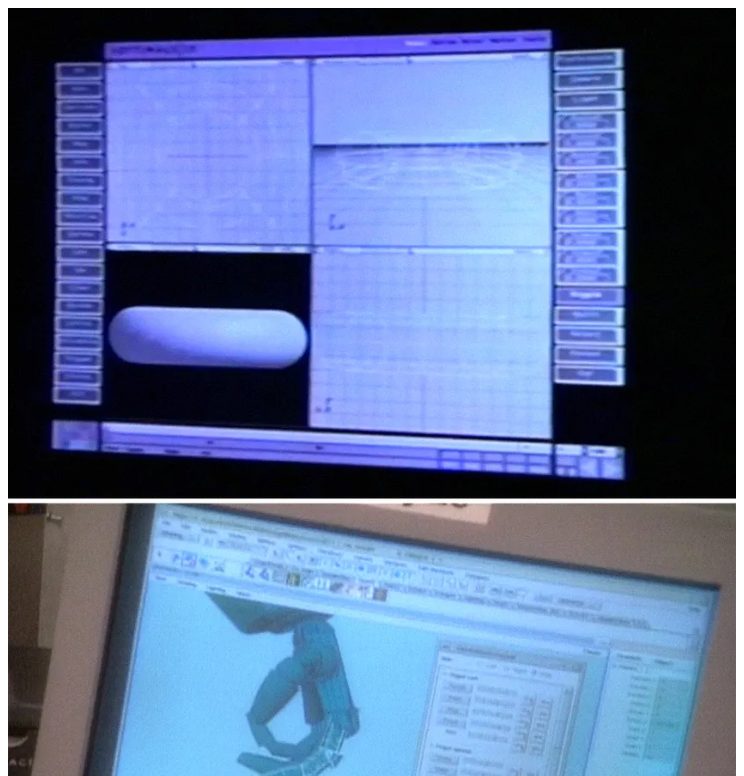
This image illustrates the production process of the Iron Giant, specifically showing the character in progress during the animation phase.
“The CGI had to be as emotive as the 2D animation," he said.”
— Making the Iron Giant Live
Frame-Rate Modulation and Design
A key technical hurdle was matching the movement of the 3D Giant to the 2D animation's stability. While computers typically animate at 24 frames per second (on 'ones'), 2D animation often mixes 'ones' and 'twos' (12 drawings per second) for slower movements. The team adjusted the Giant to move on 'twos' during slow sequences to ensure it felt like it was in the same universe as the 2D characters.
Design choices also played a critical role in this integration. The Giant’s final design, based on a train, used minimal shapes and a small color palette. These choices helped the character appear as if it were from a different planet rather than a different movie, ensuring it didn't clash with the surrounding 2D artwork.
Prioritizing Acting Over Smoothness
The production relied heavily on the experience of 3D animators who were originally trained in 2D. They focused on the 'quality of movement' in terms of character acting—such as the Giant's searching eye movements and the slight opening of its jaw—rather than achieving perfectly smooth digital transitions.
While software like the beta version of Maya provided a simple interface for these 2D-trained animators, it could not solve every problem. The final emotional impact of the film relied on the animators' ability to deliver subtle performances, such as the Giant's reaction to death, which the production team noted was successful even in rough-animation stages.
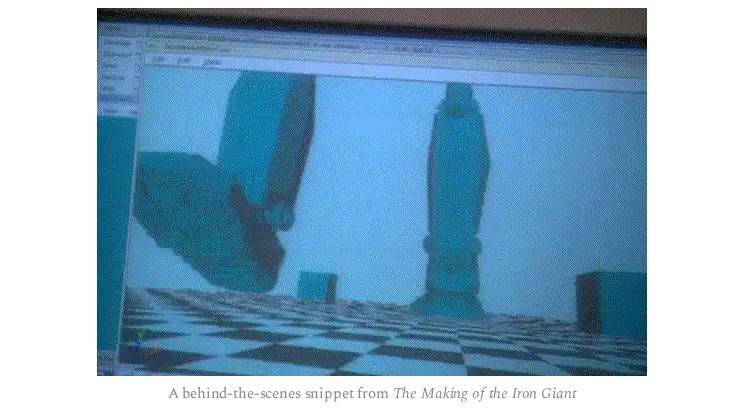
This behind-the-scenes visual supports the discussion of the technical and artistic efforts required to integrate 3D and 2D elements.