A paper airplane's flight performance is dictated by its specific aerodynamic design, meaning there is no single 'best' model for every situation. The Fold 'N Fly database offers a curated selection of over 50 designs, ranging from simple five-fold 'Darts' for beginners to complex 'Gliders' designed to stay aloft for several seconds.
Performance-Specific Design Choices
Different flight goals require distinct aerodynamic profiles. For instance, a design optimized for distance, such as 'The Bird,' is relatively easy to fold but requires careful adjustment to glide effectively. In contrast, the 'Sonic Jet' is engineered for speed, utilizing a sleek design to cut through the air quickly.
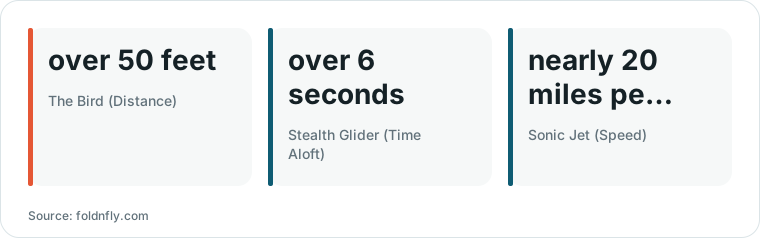
Chart drawn by HN Digest from figures reported by foldnfly.com; values are shown as written in the source.
For those prioritizing time aloft, the 'Stealth Glider' is the preferred model. While it is more complex to fold and adjust than a standard dart, it is designed to level off and glide in circles. In testing, this design stayed in the air for over six seconds, more than triple the average flight time of a standard paper airplane.
“There is no single design that we can call the "best paper airplane design" or "greatest paper airplane".”
— Fold 'N Fly » The Best Paper Airplane
Construction and Training for Beginners
The 'Basic Dart' serves as the standard for teaching children because it only requires five folds. This design is intentionally forgiving, meaning it will still fly well even if the folds are not perfectly symmetrical or accurate.
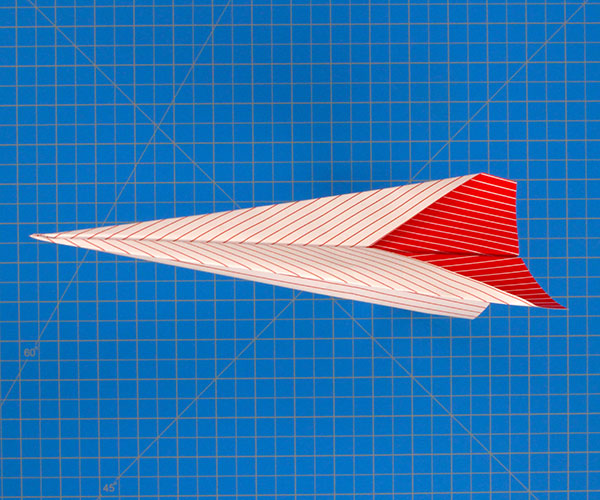
This image illustrates the 'Basic Dart' design mentioned as the standard for teaching children.
To assist with construction, Fold 'N Fly provides printable templates with numbered lines. These help children maintain smooth, crisp creases, which are essential for reducing drag and improving the aircraft's aerodynamics.
Optimization and Flight Mechanics
Achieving optimal performance involves both construction precision and manual 'trimming.' Symmetry is critical; any imbalance between the left and right sides of the aircraft will cause it to veer off course. Users can adjust the angle of the wings to control the plane's behavior: bending wings up makes the plane climb, while bending them down makes it descend.
Beyond folding, pilots can experiment with the center of mass by adding a staple or paperclip to the nose or tail. Environmental factors also play a role, as throwing with the wind at one's back can provide a significant boost to both speed and distance.

This image relates to the section on optimizing flight mechanics by adjusting the center of mass.
Trade-offs and Limitations
There is a direct trade-off between a design's complexity and its ease of adjustment. While advanced models like the 'Stealth Glider' offer superior hang time, they can be 'tricky to adjust' for long flights compared to simpler models.
The database provides subjective 'best' picks based on internal testing rather than standardized aerodynamic data. Furthermore, while some designs are optimized for specific maneuvers like loops or corkscrew spirals, their performance may vary significantly based on the weight of the paper used and the force of the launch.
What Hacker News readers are saying
- Experience: One commenter shared that they used to experiment with various designs by launching planes from a high-rise building and iterating on the folds based on the results. comment ↗
- Alternative: Several commenters recommended specific books, such as the 'Advanced Paper Aircraft Construction' volumes, as superior resources for complex designs. comment ↗
- Skeptical: One user expressed frustration with the website's user interface, citing slow load times and unintuitive navigation. comment ↗
- Open question: A commenter questioned how the performance of standard school-made planes compares to the high-fold, measured designs found on the platform. comment ↗
Summarized opinions from the Hacker News thread, not verified facts. Read the full discussion ↗