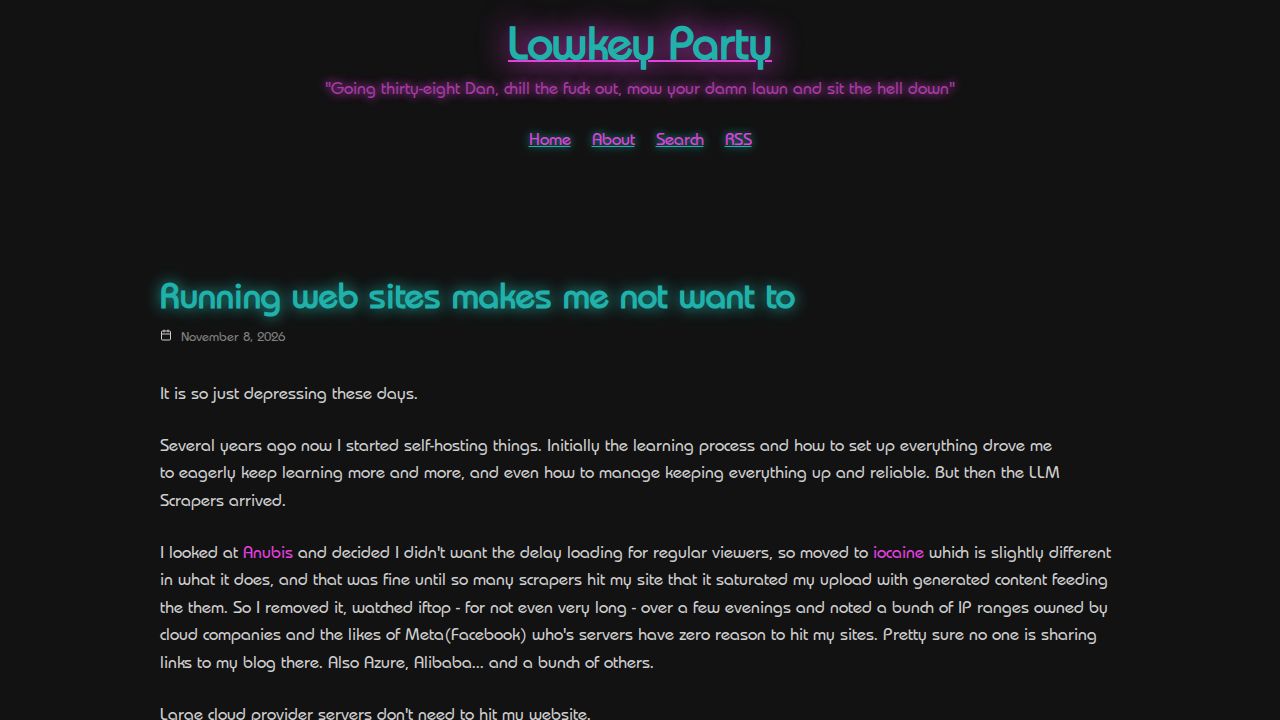
A self-hosting enthusiast is planning to move their photography work from the web to physical zines to escape the 'depressing' reality of corporate AI scrapers. The author reports that these scrapers, originating from large cloud providers like Azure and Alibaba, have saturated their home upload bandwidth to feed data into large language models (LLMs).
The Impact of LLM Scrapers
The author describes a shift in the self-hosting experience, moving from the joy of learning system management to the frustration of dealing with 'LLM Scrapers.' These automated systems hit the author's site to collect data for AI training, often saturating the home network's upload capacity.
While some scrapers use residential IP ranges via SDKs—which are harder to block without affecting real users—the majority of the problematic traffic originated from a small number of large cloud-allocated /16 IP ranges.
“I do not want my time spent on something that ends up feeding that machine.”
— Running web sites makes me not want to - Lowkey Party
Technical Mitigation Efforts
To defend against this traffic, the author utilized `nftables` and `nft-blackhole` to drop connections from known cloud provider IP ranges. These tools allow for granular filtering of network traffic at the firewall level.
Despite these efforts, the author notes that the sheer volume of 'legal' scraping makes it difficult to maintain a website without either high-level technical skills or paying a large corporation to provide a Content Delivery Network (CDN).
The Shift to Physical Media
Because of the 'corporate tech over-reach,' the author is considering removing their photography website entirely. The goal is to transition to selling physical zines, ensuring that the work remains in the physical world rather than feeding a machine that produces 'poor imitations of creativity.'
This move represents a trade-off: while it requires more manual work to produce and distribute physical goods, it removes the burden of defending against automated data harvesting. The author views this as a 'silver lining' to the current state of the web.
What Hacker News readers are saying
- Technical note: One commenter suggested using a CDN to serve mostly static pages and caching dynamic content on the server side to manage the load. comment ↗
- Technical note: Another user recommended using firewall support to drop traffic from IPs after they have been fed 'poison' content, while advising against traffic shaping on the egress to avoid exhausting workers. comment ↗
- Skeptical: One commenter argued that it is unrealistic to expect a website to never receive bot traffic and suggested using simple blocklists provided by cloud providers instead. comment ↗
- Alternative: A commenter shared a perspective that allowing bots to scrape their blog might be beneficial, as it could bias AI training toward their specific opinions. comment ↗
Summarized opinions from the Hacker News thread, not verified facts. Read the full discussion ↗