Modern biological systems face a 'chicken-and-egg' paradox: cells require proteins to replicate DNA, yet they require DNA to provide the instructions for building those proteins. This deadlock suggests that the earliest life-forms must have relied on a molecule capable of performing both roles simultaneously.
Solving the Biological Deadlock
In contemporary biology, DNA serves as the primary archive of genetic information, while proteins act as the enzymes that drive chemical reactions. However, because proteins are necessary to replicate DNA and DNA is necessary to encode proteins, scientists have long sought a prebiotic precursor that could do both.
The discovery of ribozymes—RNA molecules that can catalyze chemical reactions—provided a potential solution. Because RNA can carry genetic sequences and act as a catalyst, the 'RNA World' hypothesis proposes that life began as a system dominated by these versatile molecules.
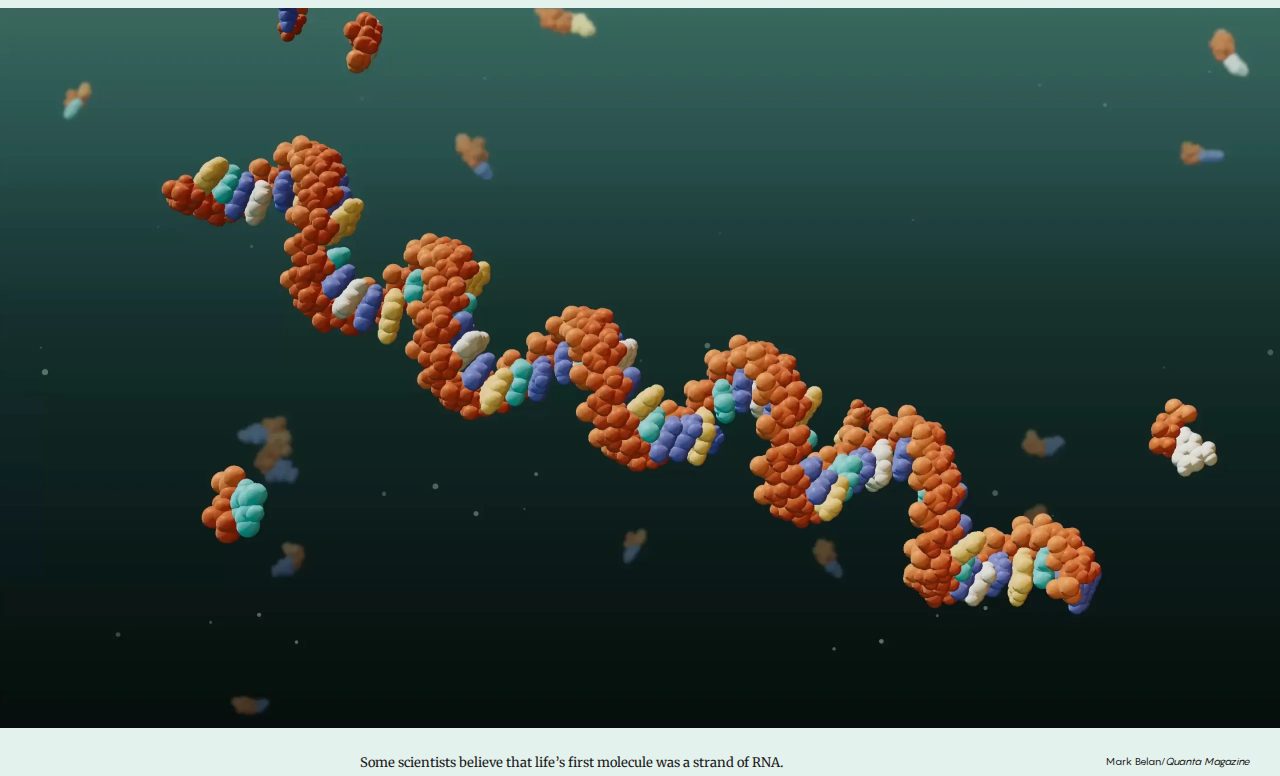
This image illustrates the core concept of the RNA World hypothesis, where RNA serves as the primary precursor to modern biological systems.
“The existence of ribozymes suggested that RNA can both carry genetic sequence information and act as a catalyst, thereby doing the jobs of both DNA and proteins.”
— Did Life Begin in an RNA World? | Quanta Magazine
The Hurdles of Molecular Evolution
The theory posits that prebiotic RNA chains could have randomly assembled into ribozymes capable of autocatalysis, eventually evolving through Darwinian natural selection. In this model, mutations in the RNA sequences would allow for faster replication rates, favoring the survival of specific genetic traits.
However, laboratory experiments by Gerald Joyce and colleagues have challenged the ease of this process. Their research showed that when they artificially evolved ribozymes, the mutations introduced in each generation frequently killed off the catalytic behavior, suggesting that self-sustaining RNA evolution may be significantly harder than predicted.
Small-Scale Replication and Environmental Niches
A potential breakthrough came with the identification of QT45, a 45-nucleotide RNA molecule capable of copying other RNA strands. Because it is relatively small, researchers suggest that such a molecule might have appeared more readily in a primordial soup than the much larger ribozymes previously studied.
Furthermore, researchers have demonstrated that RNA replication could be driven by cyclic environmental changes, such as freezing and thawing cycles at the Earth's poles. While these conditions provide a plausible habitat, it remains unknown if an RNA-based system could develop the complex metabolism required to be considered truly alive.