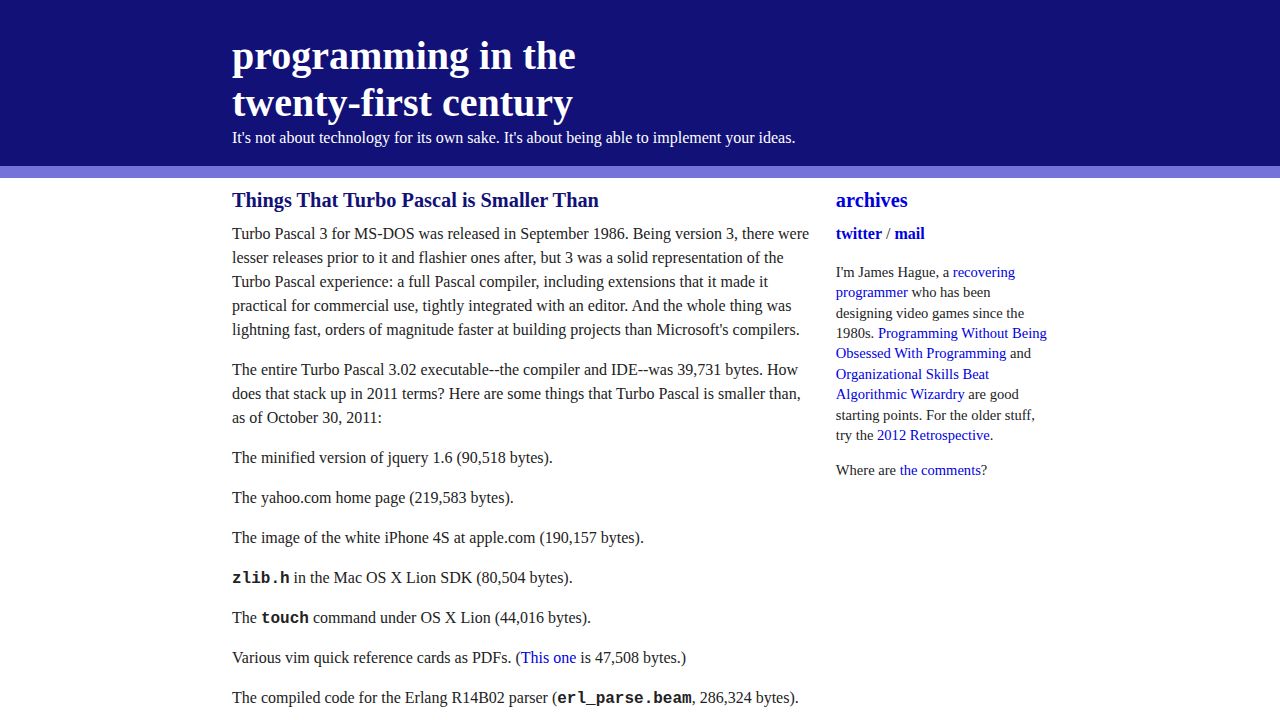
The entire Turbo Pascal 3.02 executable—which includes both the Pascal compiler and its integrated development environment (IDE)—occupies only 39,731 bytes. Released in September 1986 for MS-DOS, this software was engineered for an era of severe memory constraints, yet its footprint remains remarkably compact even when compared to modern digital assets.
A Benchmark of 1980s Efficiency
Turbo Pascal 3 was a definitive representation of the Pascal experience in the mid-1980s. It provided a full compiler with extensions for commercial use, tightly integrated with an editor, and was noted for being orders of magnitude faster at building projects than contemporary Microsoft compilers.
The 39,731-byte footprint was a necessity of the time, when software often needed to run on computers with a single 360KB floppy drive and a 640KB DOS memory limit.
“The entire Turbo Pascal 3.02 executable--the compiler and IDE--was 39,731 bytes.”
— Things That Turbo Pascal is Smaller Than
Comparison to Modern Web and System Assets
When measured against 2011-era technology, the Turbo Pascal executable is smaller than several ubiquitous modern components. It is notably smaller than the minified version of jQuery 1.6, which occupies 90,518 bytes.
The compiler also weighs less than the Yahoo.com home page (219,583 bytes) and the Wikipedia entry for C++ (214,251 bytes). Even the image of a white iPhone 4S on the Apple website (190,157 bytes) exceeds the size of the entire Turbo Pascal 3.02 suite.
Trade-offs Between Size and Productivity
The disparity in size highlights a fundamental shift in software development. While modern tools prioritize developer productivity and high-level abstractions, Turbo Pascal was optimized for extreme hardware limitations where RAM was expensive and storage was minimal.
While the source does not provide a technical breakdown of the byte-count differences, the comparison illustrates how much modern software has expanded to accommodate features and complexities that were not feasible or required in the 1980s.
What Hacker News readers are saying
- Technical note: One commenter argued that the small size of Turbo Pascal was a necessity of the era, noting that software had to fit on single floppy disks and operate within strict memory limits. comment ↗
- Technical note: A commenter who lived through that period disagreed with the idea that inefficiencies were justified for productivity, stating that developers often had to use C or assembly specifically to achieve necessary runtime efficiency. comment ↗
- Technical note: Another user suggested that the modern era of near-zero iteration costs might allow for new paradigms that prioritize mechanical developer effort over human ergonomics, potentially leading to more robust software structures. comment ↗
- Technical note: One observer suggested that the software of the 1980s demonstrated what was possible when developers prioritized performance, implying that modern software often lacks that same level of optimization. comment ↗
Summarized opinions from the Hacker News thread, not verified facts. Read the full discussion ↗