In 1890, the United States Congress passed the Sherman Anti-Trust Act, the first federal measure designed to prohibit the formation of trusts that were destroying competition in major industries. By authorizing the government to dissolve these massive corporate arrangements and allowing private parties to sue for triple damages, the act fundamentally shifted the power to regulate commerce from individual states to the federal government.
Defining the Trust and the Scope of Federal Power
Toward the end of the 19th century, trusts began to dominate major industries by consolidating the ownership of several companies into the hands of a single board of trustees. For example, the Standard Oil Trust was formed in 1882, where nine trustees managed all properties and determined dividends, effectively creating a monopoly.
While several states had passed laws against such practices, those regulations were restricted to businesses operating within a single state. The Sherman Anti-Trust Act expanded this authority by utilizing the federal government's power to regulate commerce among several states and with foreign nations.
Legal Mechanisms and Penalties
The act authorized the federal government to institute proceedings to dissolve any combination, trust, or conspiracy that restrained trade or commerce. Violators faced a misdemeanor conviction, punishable by a fine of up to $5,000 and a year in jail.
To encourage private enforcement, the law permitted individuals or companies who suffered losses due to trusts to sue in federal court. These plaintiffs were entitled to recover three times the damages they sustained, including reasonable attorney's fees.
Judicial Limitations and Long-term Application
Because the act failed to define critical terms like 'monopoly' or 'conspiracy,' the Supreme Court initially limited its reach. In the 1895 case United States v. E. C. Knight Company, the Court ruled that the American Sugar Refining Company did not violate the law because its control of manufacture was not considered a control of trade.
Despite this early setback, the act remained a potent tool for 'trust-busting' campaigns. It was used successfully to dissolve the Northern Securities Company in 1904, and later against Standard Oil and American Tobacco in 1911. The law's continued relevance is evidenced by its use in the 1990s against Microsoft.
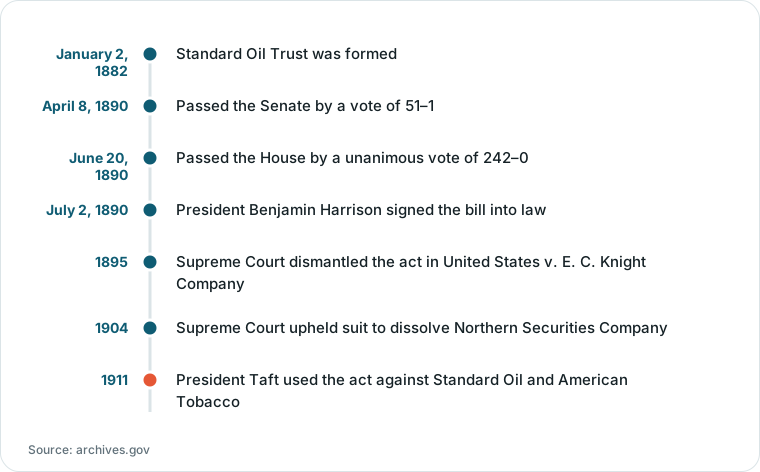
Chart drawn by HN Digest from figures reported by archives.gov; values are shown as written in the source.
What Hacker News readers are saying
- Technical note: One commenter pointed out that the act was poorly drafted because it failed to define key terms like 'trust' or 'monopoly,' which led to early judicial rulings that effectively dismantled its power. comment ↗
- Skeptical: A commenter expressed skepticism regarding the effectiveness of breaking up monopolies, arguing that such actions can lead to worse products for consumers and the loss of significant research and development powerhouses. comment ↗
- Alternative: One reader suggested a different statutory mechanism where companies reaching a certain size would be required to become public or submit a plan to split if they maintained a market supermajority. comment ↗
- Open question: Another commenter raised an open question regarding how antitrust laws could address international monopolies and the risk of foreign entities choosing which local companies survive. comment ↗
Summarized opinions from the Hacker News thread, not verified facts. Read the full discussion ↗