DATE ARCHIVE
2026-09-28
Articles published on 2026-09-28.
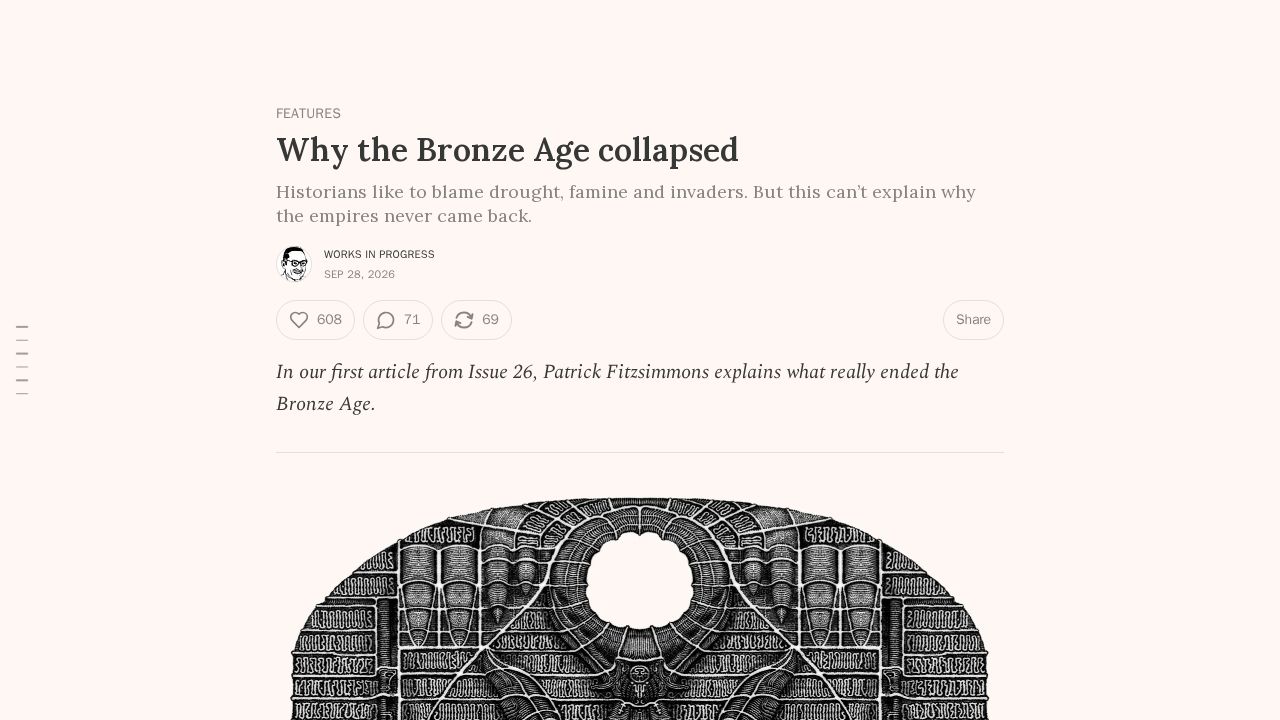
Why the Bronze Age Collapsed: Tin, Iron, and the Politics of Empire
The Bronze Age collapse of the eastern Mediterranean great powers around 1200 BC is usually blamed on drought, invaders and famine, but the Works in Progress article argues the real driver was a shift in who could make weapons. Bronze required tin from mines thousands of miles away, which concentrated military power in the hands of large empires; iron could be smelted locally in bloomeries, breaking that monopoly and making empire-building far harder — which may be why nothing like those empires returned for centuries. The article treats this as one significant factor among several, and the supplied sources do not explain how large empires later re-formed under iron.

Why Code Review Resists Automation: Human Judgment Beyond Detectable Defects
A new AI paper argues coding agents have matured enough to replace human code review, reducing it to automatable functions like defect detection, style enforcement, knowledge transfer, and awareness. A seasoned practitioner counters that peer review is simultaneously a coordination, sensemaking, and governance process whose human contributions—questioning necessity, spotting absences, applying contextual knowledge, and bearing accountability—cannot be decomposed and reassembled without loss. The critique does not dispute that agents can replicate individual functions; it argues the integration across functions is itself the human value being discarded.
What Is Earth's Dominant Species by Mass? Not Humans or Ants, But Boreal Trees
Despite the myth that daite ants outweigh humans, humans actually outweigh all ants five to one. By measuring biomass in terms of carbon content—a metric that reflects energy flow in the biosphere—plants vastly outnumber animals. Among individual species, the black spruce of boreal forests stores over 11 billion tonnes of biomass, equating to nearly 5.6 billion tonnes of carbon, almost triple the carbon found in all animals combined.

Security Researchers Extract and Analyze Eufy HomeBase 2 Firmware
Researchers from Adepts of 0xCC detailed the process of extracting firmware from a Eufy HomeBase 2 device, involving hardware desoldering and reverse engineering of Wi-Fi credential algorithms.

Retrospectively Reverse-Engineering Apple's Neural Engine
Eileen Yoon finishes a three-year project to document the Apple Neural Engine (ANE) inside the M1 chip, revealing a 2017 CNN-era design that shaped every subsequent Apple NPU decision — including the recent folding of ANE cores into M5 GPU clusters.
Relativity Park Simulator Redefines Light Speed at 5 km/h
A web‑based interactive demo reduces the speed of light to 5 km/h, letting users walk through a virtual park and experience relativistic effects such as length contraction, time dilation, Terrell rotation, and Doppler shifting in real time.

Phyllotaxis: A Physical LED Display That Dances to Sound
Engineer Jagi Natarajan built a 90-LED display arranged in the mathematical spiral pattern found in sunflowers. The device analyzes audio in real time across six frequency bands, translating sound into dynamic light patterns. After two hardware iterations—from hand-soldered 3D-printed cells to a five-PCB ring running Rust and WebAssembly—the installation now lives at Recurse Center where visitors can upload their own animations via a local web interface.

How Delhi Cut Electricity Losses from 50% to 5%
Delhi's electricity distribution system transformed over 25 years, reducing technical and commercial losses from over 50% in 2002 to 5-6% in 2026 through infrastructure upgrades, advanced metering, and targeted anti-theft measures, achieving grid reliability comparable to European nations.

Houthis 'take control' of Perim Island, a Red Sea chokepoint
In early September 2026, Iran-backed Houthi rebels announced they had seized Perim Island in the Red Sea, a small landmass at the southern entrance to the Bab al-Mandab Strait. The strait is one of the world's most critical maritime chokepoints, connecting the Gulf of Aden to the Red Sea and providing the alternative route to the Suez Canal for oil tankers unable to pass through the Strait of Hormuz. The Houthis declared a blockade against Saudi-linked vessels while claiming their operation succeeded and that they had expelled Saudi-backed forces from Yemen's western coast. The development has implications for global energy markets, as Saudi Arabia has increasingly relied on this route after the Strait of Hormuz was effectively closed. The International Organization for Migration reported that at least 46,000 people have been displaced in Yemen since fighting escalated the previous week. The United States has offered intelligence and targeting support to Saudi Arabia but has said it is not prepared, at least for now, to take direct military action.

Hijacking the PS5's RTMP Stream
A developer redirected the PS5's native RTMP video stream to a personal computer using DNS manipulation, enabling custom screen sharing without a capture card or official Sony support.

Efforts to Reduce Undefined Behavior in C Show Progress but Challenges Remain
At Kernel Recipes 2026, Martin Uecker discussed ongoing work to reduce undefined behavior in the C language, highlighting improvements in the evolving C2y standard while acknowledging that complete memory safety remains a long‑term goal requiring significant effort.

Distributed Renewables and Ukrainian Energy Resilience
A report from EnergyTransition.org describes how distributed solar installations in Ukraine—particularly in the frontline city of Mykolaiv—have kept critical services running despite Russian strikes on centralized power infrastructure. The article frames Ukraine's rapid renewable rollout as a security-driven transformation, not a climate policy, and cites experts who argue that scattered generation with storage is harder to destroy than large thermal plants.

Capsule Packages Web Apps and Their Data Into a Single Portable File
Capsule is a free, open-source tool that wraps a web application—its interface, assets, and an embedded SQLite database—into a single .capsule file that runs locally without an internet connection. While browser-native storage APIs like the Origin Private File System already offer local data persistence through a different mechanism, Capsule takes the distinct approach of making every app self-contained and shareable like a document.

Bodily Oddities: A Catalog of 161 Strange Things the Human Body Can Do
A new searchable website collects 161 unusual bodily phenomena — from ear wiggling to blue field entoptic sparks — each with prevalence data where available. A companion article on hypnagogic hallucinations draws on surveys of nearly 19,000 people and lab studies to separate common experiences from red-flag symptoms.
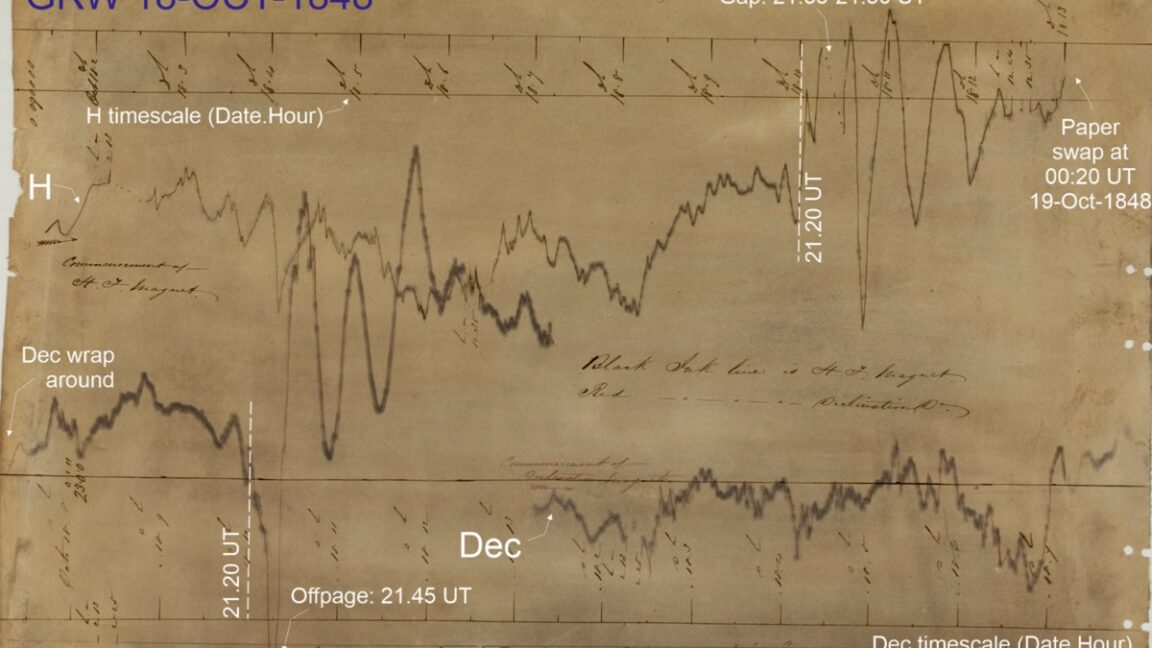
An 1840s space-weather mystery is solved: the Exeter train delay was 1848, not 1841
A widely cited 1871 Nature report claimed a geomagnetic storm delayed a train in Exeter in October 1841, which would have been the earliest known case of space weather disrupting technology. A new study published in the journal Space Weather shows the date is almost certainly a typographical error: the line did not exist in 1841, and the delay most likely occurred on 18 October 1848. The earliest documented example is now a March 1847 incident on the Midland Railway. The finding underscores how long electrical infrastructure has been exposed to solar storms.
A Minimal Swift Kernel Runs on QEMU
A developer built a tiny operating‑system kernel in Swift that boots on the QEMU emulator, demonstrating how Embedded Swift can run on bare‑metal hardware without an underlying OS.
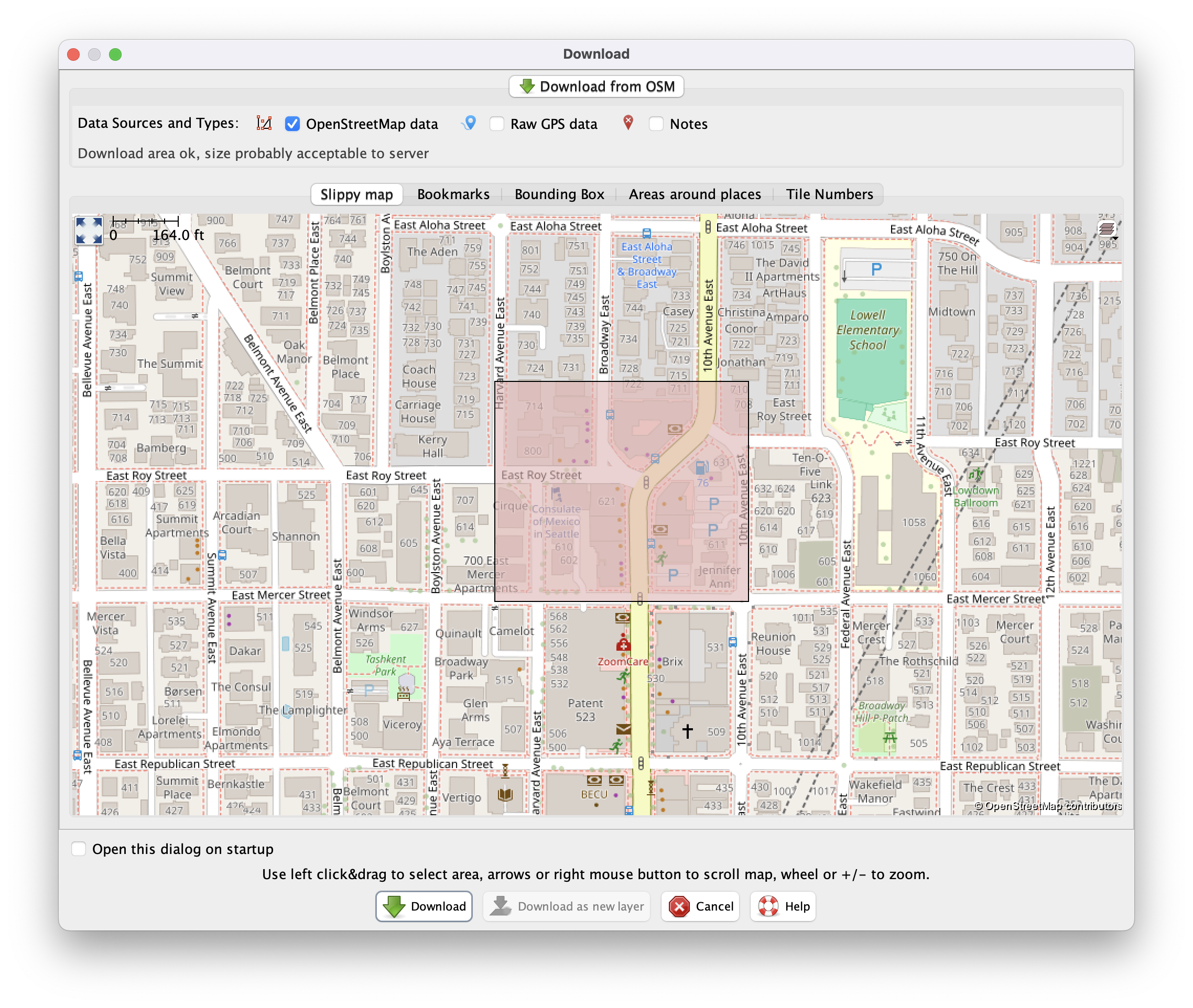
A 15-Minute Guide to Your First OpenStreetMap Edit Using the Website Wizard Plugin
A new tutorial for the Website Wizard JOSM plugin walks newcomers through adding an official website tag to a nearby shop or amenity in OpenStreetMap in roughly 15 minutes. The guide covers account creation, data download, filtering, plugin setup, website search, and changeset upload. Simpler mobile and in-browser alternatives are noted for those who find JOSM too complex.