The Carrington Event of 1859 remains the most powerful geomagnetic storm ever recorded. Auroras lit up the skies around the world, telegraph stations sparked and caught fire, and some people reported reading newspapers by the glow of the northern lights. But the Carrington Event was not the first time a solar storm met human technology.
In 2013, scholars uncovered an anonymous report published in Nature in 1871 describing a "very intense magnetic disturbance" that disrupted rail travel in Exeter, on the southern coast of England, in October 1841. If accurate, it would have been the earliest known account of space weather affecting technology — nearly two decades before Carrington.
A new study published in the journal Space Weather in September 2026 says that 1841 date is almost certainly wrong. A team led by Jim Wild of Lancaster University, with researchers from the British Geological Survey, Natural Resources Canada, Baylor University, RMIT University, and STFC RAL Space, concludes that the real disruption happened several years later, on 18 October 1848. The 1841 date, they argue, was a typographical error in the 1871 report.
The original account is specific. It describes how a 10:05 p.m. express train departing Exeter was delayed by sixteen minutes because the telegraph operator could not tell whether the rail line ahead was clear or occupied by another train. Most emerging railway companies of the era had wired their lines with electrical telegraphs for train control, precisely to avoid collisions. The anonymous author wrote that the operators "reported next morning that someone was playing tricks with the instruments."
The first problem with the account is logistical. The South Devon Railway Company built the tracks between Exeter and Plymouth in stages, and Parliament did not approve construction until July 1844. The relevant section of track did not open until 30 May 1846 — five years after the reported delay. A train could not have been delayed on a line that did not exist.
So why a typo? The researchers found that the details, while wrong in year, are right in other respects. Contemporary railway timetables show a 10:05 p.m. express departing Exeter between 11 March 1848 and 26 July 1849. And 18 October 1848 was, by multiple independent measures, a day of strong geomagnetic activity. Digitized magnetograms from the Greenwich Magnetic Observatory in London record "extraordinary" magnetic-field disturbances that evening. Contemporary newspapers carried accounts of the storm, and the British astronomer Temple Chevallier recorded sunspot observations on 19 October 1848. Under the assumption that the story is true, the simplest explanation is that "1841" was a slip of the pen for "1848."
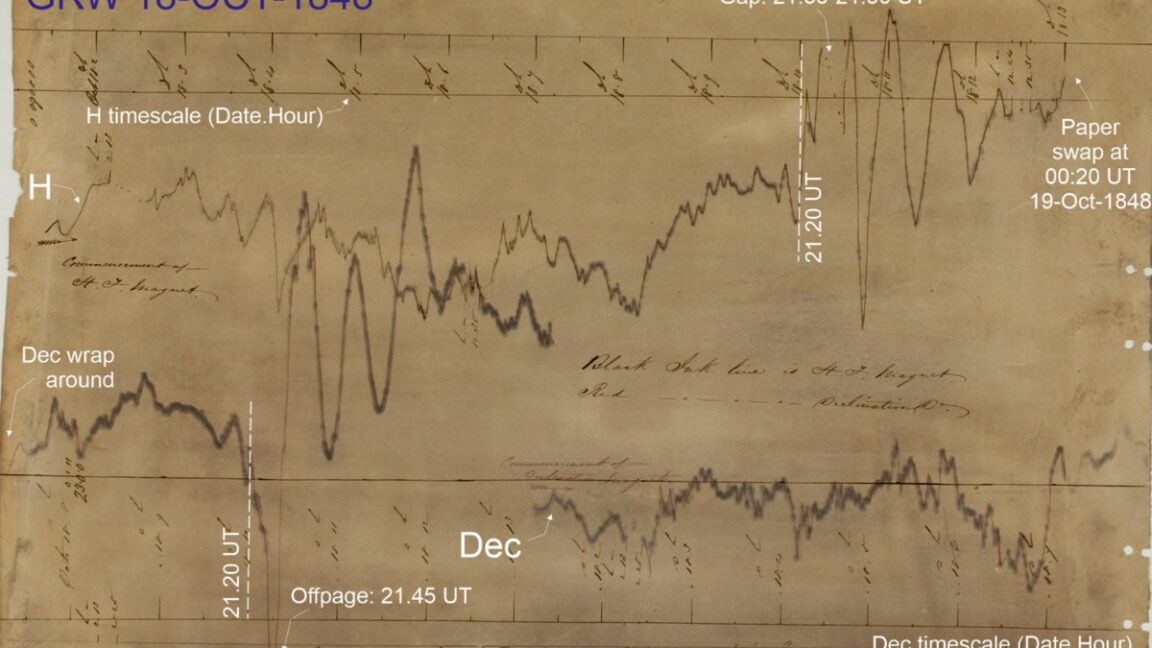
The article's sixth paragraph explains that digitized magnetograms from the Greenwich Magnetic Observatory recorded extraordinary magnetic-field disturbances on the evening of 18 October 1848, one of several independent lines of evidence the researchers used to pin down the correct date of the Exeter rail delay.
The researchers also tracked down the anonymous author. Unable to locate the original source material for the 1871 Nature article, they found the publisher's copy with a handwritten annotation: "N. [J.] Holmes." They identify the author as Nathaniel John Holmes, a prominent electrical engineer who helped deploy undersea telegraph cables across parts of the North Sea. In 1871, Holmes lived in Hampstead, about a mile from Nature's editor, Sir Norman Lockyer. Contemporary newspapers record Holmes giving a lecture on the chemical effects of the solar spectrum in Scotland, and an 1877 letter shows Holmes inviting Lockyer for a visit — evidence of a business relationship. The attribution suggests the account came from someone with genuine expertise, which makes the date error all the more puzzling.
But the paper is careful about what it can and cannot prove. Wild and his co-authors note that "no citation is provided that would enable an investigation into the veracity of the statement." The phrase about "someone playing tricks with the instruments" hints that the account may have come from a contemporary newspaper report, yet the team could not find any report containing that language. The 1848 dating is therefore a strong inference built from converging evidence, not a document that directly confirms it.
What the study does firmly establish is a corrected timeline. With the 1841 account ruled out, the earliest documented example of space weather disrupting technology becomes a March 1847 incident in which "spontaneous electrical currents" interfered with telegraph systems on the Midland Railway while a "brilliant aurora" glowed across the British Isles. The Exeter delay, whenever precisely it happened, remains one of the first clear examples of solar activity disrupting critical infrastructure — but it is not the first.
That correction matters because it reframes the history of the relationship between solar activity and electrical technology. As Wild puts it, space weather is often discussed as a modern challenge because of our dependence on satellites, communications systems, and electricity networks. What this study shows is that "society has been experiencing the effects of space weather on technology for almost as long as electrical technologies have existed." The Exeter story sits at the point where emerging technologies first began to encounter the realities of the space environment.
The historical episode also sharpens the contemporary stakes. Were a storm the size of the Carrington Event to strike today, the sources say, it would likely seriously damage the electrical power grid, causing widespread outages and blackouts, and disrupt satellite communications. Modern critical infrastructure — power systems, railway signalling, satellite navigation, and communications networks — remains vulnerable. As Dr. Mike Hapgood of STFC RAL Space notes, today's space-weather forecasting is far more advanced than anything available in the 1800s, but "the modern technologies we depend on are also much more vulnerable to solar storms."
Here the evidence has a boundary worth stating plainly. The supplied sources do not present new modeling or risk assessment; the claim about modern damage is a projection from historical analogs, not an empirical test. How a contemporary grid, with its protections and redundancies, would actually fare against a Carrington-class storm remains an open question that this study does not resolve.
The study's method may be its more lasting contribution. It is, in Hapgood's words, "a hint of a detective story" — piecing together railway timetables, historical newspapers, solar observations, auroral reports, and digitized magnetograms to reconstruct an event that no single record captures cleanly. The lesson is that the older records we preserve, however obscure, form the evidence base we need to interpret past events and strengthen future predictions. The mystery of the 1840s is solved, but the archive it draws on is what made the solving possible.