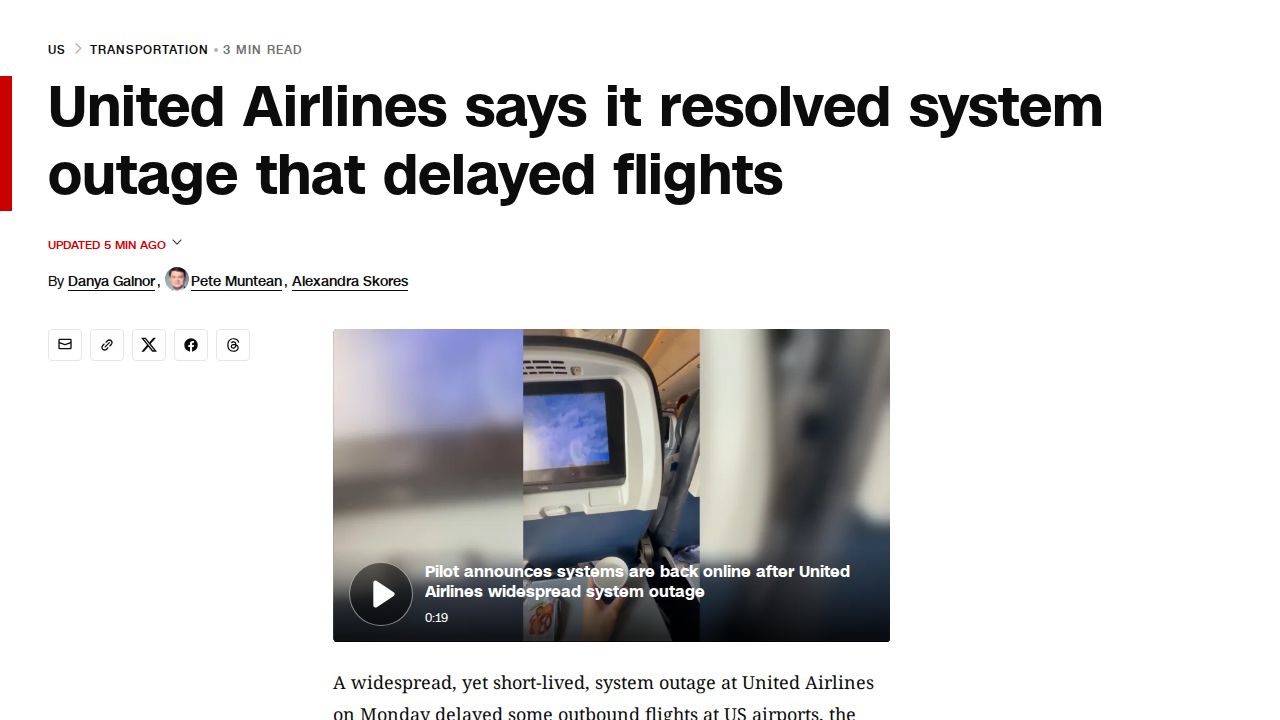
United Airlines is currently navigating a widespread system outage that has disrupted flight operations and sparked a broader conversation about the fragility of modern industrial systems. While the airline has characterized the event as a production bug, the incident has become a focal point for observers questioning whether such disruptions are the result of aging infrastructure, aggressive security patching, or evolving cyber threats.
The Reported Outage and Official Stance
The primary report indicates that United Airlines is experiencing a widespread system outage. While the specific technical cause was not detailed in the initial report, the airline's stance aligns with a pattern of attributing such events to internal production bugs rather than external interference.
Commenters on Hacker News, such as mminer237, noted that the airline's assertion of a 'good old fashioned production bug' mirrors the explanations given for several recent high-profile outages in the tech and aviation sectors.
Public Suspicion and the Cyberattack Narrative
Despite official denials, some members of the public expressed skepticism regarding the 'production bug' explanation. Commenter empath75 suggested that the speed with which various entities issue denials of cyberattacks can sometimes be a point of suspicion.
Other participants, including eggdaft, argued that a series of outages across different sectors—including the FAA and the banking system—points toward a coordinated cyberattack. These commenters suggested that official narratives might be managed to prevent public panic while authorities determine a response.
The Patching Paradox and Infrastructure Risks
A significant point of discussion involved the 'patching paradox,' where the pressure to deploy security fixes immediately clashes with the need for rigorous testing. Commenter al_borland described this as a workplace tension where one side demands immediate updates while the other insists on multi-level approvals and coordination across hundreds of teams.
This tension is compounded by the observation that many legacy systems may not be built to handle the velocity of modern security patches. Commenter ernubufiei suggested that rushing out fixes for AI-discovered bugs could lead to further instability in systems not designed for such rapid iteration.
Labor Trends and AI-Driven Threats
The discussion also touched on the human and technological factors contributing to system fragility. Commenter zytoon argued that the loss of experienced teams through layoffs, combined with the emergence of smarter AI-based attacks, makes these disruptions an increasing reality for transportation and power sectors.
Conversely, some participants offered a more grounded perspective on the scale of the issue. Commenter kylecazar pointed out that a 13% delay rate for a single airline's departures is not statistically rare, suggesting that media coverage may be creating an 'availability cascade' that overstates the severity of the event.