AT&T has filed a lawsuit in a U.S. District Court in California, accusing Comcast of using 'literally false' advertising to market its Xfinity Internet service as 'fiber-powered.' The legal challenge targets the way Comcast describes its network architecture, which AT&T argues misleads consumers into believing they are receiving a fiber-to-the-home service rather than a hybrid system.
This image identifies Comcast, the service provider being sued by AT&T for its 'fiber-powered' marketing claims.
The Technical Distinction of 'Fiber-Powered'
The core of the dispute lies in the difference between a fiber-to-the-home (FTTH) network and a hybrid fiber-coaxial (HFC) network. In an FTTH setup, fiber optic cables deliver internet directly to the customer's premises, allowing for symmetrical speeds where upload and download capabilities are equal.
In contrast, Comcast's HFC architecture uses fiber for the backbone but transitions to copper coaxial cable for the final connection to the home. AT&T argues that by using the term 'fiber-powered,' Comcast conveys a misleading impression that the service is comparable to true fiber-to-the-home connections.
“Describing that service as ‘Fiber-Powered,’ ‘Powered by fiber,’ and ‘the most reliable, fiber-powered Wi-Fi’—particularly alongside Comcast’s own representations that fiber connections outperform ‘copper-based’ alternatives—is literally false or false by necessary implication,”
— Comcast's "fiber-powered Wi-Fi" is just cable, AT&T says in false advertising case
Regulatory History and Previous Settlements
This is not the first time the 'fiber-powered' terminology has faced scrutiny. The National Advertising Division (NAD) previously ruled that Comcast's disclosures regarding its cable-and-fiber mix were not prominent enough, requiring the company to make those disclosures more conspicuous.
AT&T has successfully used similar tactics against other providers. In a separate case, Charter Communications was forced to voluntarily modify its 'fiber-powered' disclosures after an NAD challenge. Charter agreed to stop using the term 'HFC' in its ads and clearly state that its services are not delivered via fiber-to-the-home infrastructure.
Market Competition and Business Impact
The lawsuit comes as Comcast faces intensifying competition from fiber and fixed wireless providers. The company reported a sharp increase in customer churn, losing 144,000 residential broadband subscribers in the third quarter of 2026.
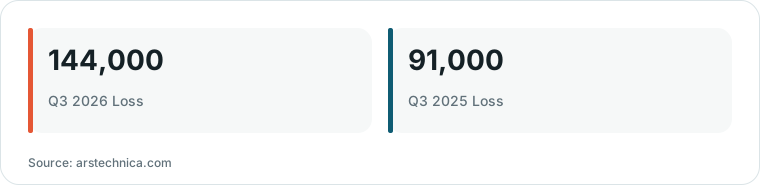
Chart drawn by HN Digest from figures reported by arstechnica.com; values are shown as written in the source.
Comcast executives have expressed concern over 'irrational pricing' from fiber competitors who offer monthly deals between $30 and $40. While Comcast argues that deploying fiber costs $1,500 or more per home, the lawsuit suggests that Comcast's marketing is a primary tool used to maintain its market share against these lower-cost alternatives.
What Hacker News readers are saying
- Alternative: One commenter pointed out that other providers, such as Google Fiber, also utilize microwave technology in certain areas despite their branding. comment ↗
- Skeptical: A commenter argued that both companies use similar marketing tactics, suggesting that AT&T also uses 'fiber' branding to appeal to customers who may not understand the technical differences between optical and DOCSIS connections. comment ↗
- Technical note: One user noted that while Comcast's DOCSIS 4.0 could potentially offer higher speeds than some older fiber setups, they questioned the cost-effectiveness of choosing that path over XGS-PON, which is more common in Europe. comment ↗
- Skeptical: Several commenters expressed frustration with the industry's marketing, noting that terms like 'gig wifi' make it difficult for consumers to distinguish the actual type of internet connection being provided. comment ↗
Summarized opinions from the Hacker News thread, not verified facts. Read the full discussion ↗