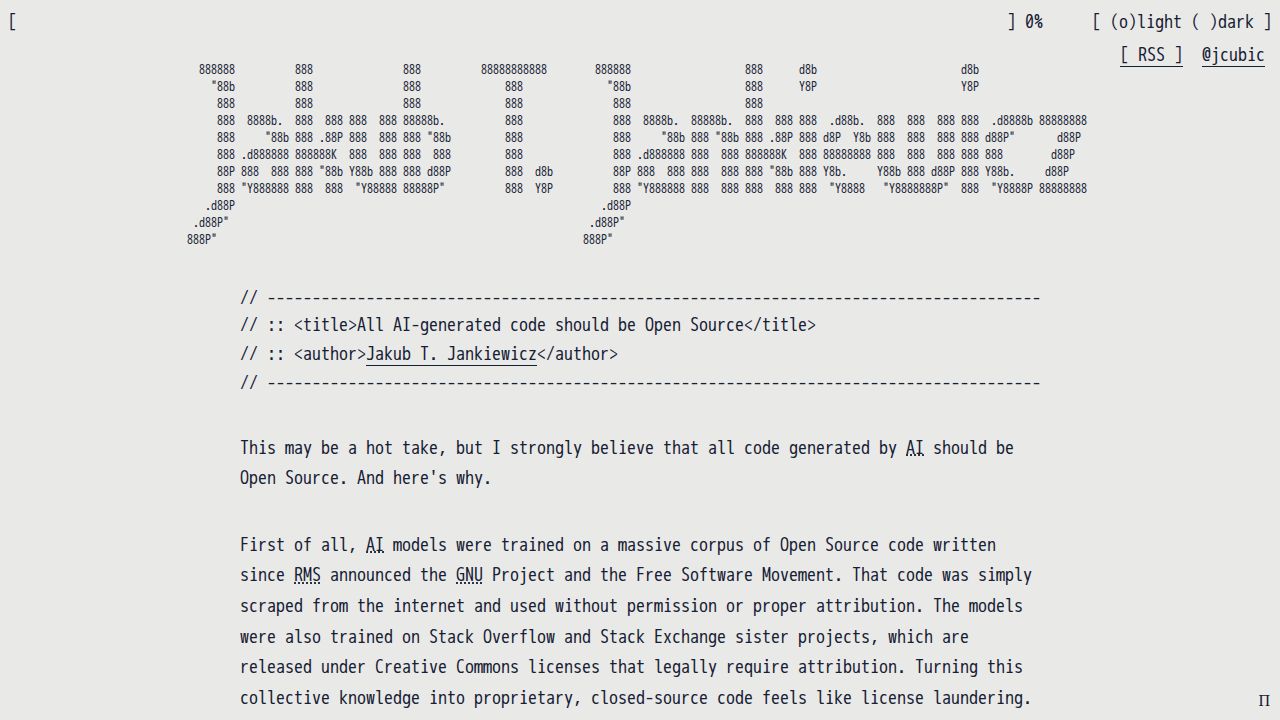
The rapid integration of AI into software development has sparked a debate over the ownership and licensing of the resulting code. Because large language models (LLMs) are trained on massive datasets of open-source repositories and Stack Overflow contributions, some argue that proprietary claims on purely AI-generated output constitute a form of 'license laundering' that exploits the free software movement.
The 'License Laundering' Argument
The core argument for open-sourcing AI-generated code rests on the origins of the training data. AI models were trained on a massive corpus of open-source code written since the inception of the GNU Project and the Free Software Movement.
Much of this data was scraped from the internet without permission or proper attribution. Furthermore, models were trained on Stack Overflow and Stack Exchange projects, which are released under Creative Commons licenses that legally require attribution. Turning this collective knowledge into proprietary, closed-source code is viewed by some as a violation of the spirit of those licenses.
“Turning this collective knowledge into proprietary, closed-source code feels like license laundering.”
— All AI-generated code should be Open Source
Legal Precedents and Copyrightability
Legal frameworks in several jurisdictions provide a basis for the claim that AI-generated code should be public domain. In the United States, the 'Monkey Selfie' dispute established that non-humans cannot hold copyrights, a principle the U.S. Copyright Office has cited regarding AI.
Current guidance suggests that copyright protects original expression created by a human author. If a human provides only a prompt and does not exert sufficient control over the expressive elements of the code, the output may not be copyrightable. To ensure fairness across different jurisdictions, some suggest explicitly releasing such code under Creative Commons Zero (CC0) or other open-source licenses.
Human Effort and Ownership Trade-offs
A key distinction is made between code that is human-assisted and code that is almost entirely automated. The argument focuses on instances where developers rely on AI without reviewing or modifying the output to fit specific needs.
Conversely, some argue that software engineering is about taking ownership of the final product. From this perspective, a developer's use of an AI tool does not strip them of their intellectual property rights, as the human remains responsible for the product's success or failure. The debate remains open on exactly how much human intervention is required to move a piece of code from 'purely AI-generated' to 'human-authored'.
What Hacker News readers are saying
- Technical note: One commenter who is an author of AGPL systems shared their experience of a company using an LLM to clone their creative work, arguing that the resulting AI output still feels like a derivative of their original content. comment ↗
- Skeptical: Several commenters argued that the proposal is logically inconsistent, noting that developers have always learned from open-source materials and that human ownership of a product's outcome should remain with the person taking the business risk. comment ↗
- Technical note: Others pointed out that current legal precedents and copyright office guidance suggest that purely AI-generated material may not be copyrightable at all, which would make the discussion of open-source licensing moot. comment ↗
- Skeptical: One commenter argued that forcing AI-generated code to be open source would unfairly seize the results of extensive human effort, such as the hours of testing and real-world feedback required to refine agentic software loops. comment ↗
Summarized opinions from the Hacker News thread, not verified facts. Read the full discussion ↗