The Fursoy Slice-1 processor has achieved a significant milestone by booting mainline Linux 6.6.50 and BusyBox under Sv39 virtual memory. Developed as a clean-slate 64-bit out-of-order superscalar RISC-V core, the project demonstrates that complex, high-performance microarchitectures can be implemented in SystemVerilog while meeting rigorous timing requirements for standard-cell synthesis.

This image provides a visual overview of the Fursoy Slice-1 processor platform described in the article.
Microarchitecture and Pipeline Design
The Fursoy Slice-1 core utilizes a 2-wide fetch, decode, and register rename pipeline designed for out-of-order execution. To manage speculative execution, it employs a 128-entry Reorder Buffer (ROB) with 4-bit wrap-safe epoch tags, allowing for precise exception and interrupt flush recovery.
The design includes dedicated issue queues for different instruction types: 32-entry queues for Integer and Memory instructions, a 64-entry queue for Floating Point, and a decoupled 8-entry queue for Vector instructions (VLEN=256). It also features 8 branch checkpoints to facilitate single-cycle speculative RAT (Register Alias Table) rollbacks.
Memory Management and Cache Coherency
The processor supports Sv39 virtual memory through a dual-port DTLB and an ITLB. A key architectural feature is the shared hardware Page Table Walker (PTW), which walks page tables with non-destructive L1D dirty snoop coherency. This allows page-table writes sitting dirty in the L1D to be observed directly without requiring eviction.
The memory subsystem is supported by a 16 KiB 4-way set-associative L1I cache and a 16 KiB 8-bank non-blocking L1D cache. The L1D cache includes a 16-entry Load Queue, a 16-entry Store Queue, and 4 Miss Status Holding Registers (MSHRs) to handle concurrent memory requests.
Synthesis Results and Performance Telemetry
Physical synthesis was evaluated using Yosys, sv2v, and OpenSTA on the Nangate 45nm library. The design successfully met the 500 MHz timing target across eight standalone core blocks, including the branch unit, CSR, DTLB, ITLB, AGU, decode unit, and ALU.
During verification, the core achieved an IPC of 0.84838 over approximately 89.8 million simulated cycles. The cycle-exact telemetry shows that 47.94% of cycles were productive, while 16.72% were spent on branch misprediction and exception flush recovery, and 6.18% were attributed to L1D misses or bank conflicts.
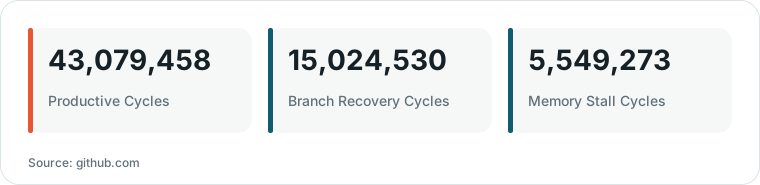
Chart drawn by HN Digest from figures reported by github.com; values are shown as written in the source.
Current Limitations and Scope
While the core meets timing targets for its primary functional blocks, the project has not yet executed full SoC place-and-route or SRAM macro compilation. The current 500 MHz timing closure applies to the eight standalone blocks rather than the fully integrated System-on-Chip (SoC) environment.