While Apple's new 'PROLED XDR' display offers superior contrast and deep blacks, a subset of users is reporting headaches, dizziness, and nausea shortly after using the new MacBook Pro. These reports center on the display's use of Pulse Width Modulation (PWM), a technique that rapidly switches light output to control brightness, which can cause physical distress for individuals with high sensitivity to screen flickering.
The Mechanics of Pulse Width Modulation
Pulse Width Modulation (PWM) is a common method for controlling screen brightness by rapidly modulating the light output. On OLED displays, where pixels produce their own light, varying the frequency of these 'on' and 'off' cycles determines the perceived brightness of the screen.
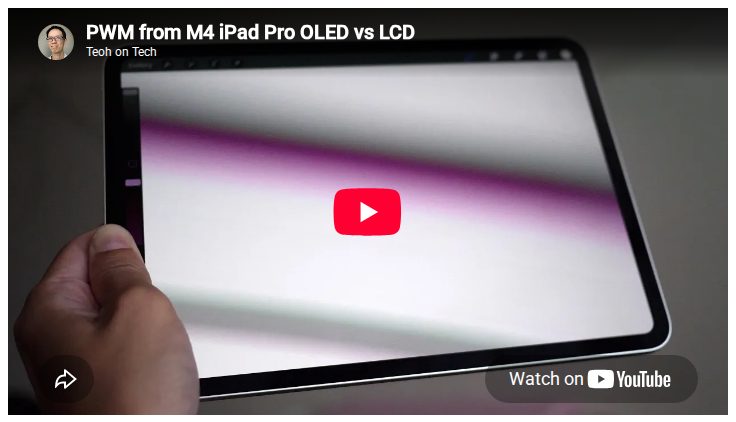
This figure illustrates the technical mechanism of Pulse Width Modulation (PWM) described in the article's explanation of how OLED displays manage light output.
At high frequencies, this flickering is generally imperceptible to most people. However, for those with high sensitivity, these rapid fluctuations can trigger physical symptoms like eye strain or nausea, regardless of whether the user can consciously see the flicker.
“The reported modulation frequency of the new MacBook Pro’s OLED panel is roughly 62 times lower than that measured on the Mini-LED model.”
— The MacBook Pro’s OLED PWM Problem: When a ‘Better’ Display Becomes Worse to Use
A Significant Drop in Modulation Frequency
Laboratory testing by Notebookcheck revealed a stark difference in how Apple manages brightness between display generations. The new MacBook Pro's OLED panel was measured at a worst-case PWM frequency of 240Hz at brightness settings of 99% and below.
In contrast, the previous MacBook Pro model with a Mini-LED display measured a PWM frequency of 14,880Hz. This represents a massive shift in hardware behavior, as the new OLED panel's modulation repeats only 240 times per second compared to nearly 15,000 times per second on the older model.
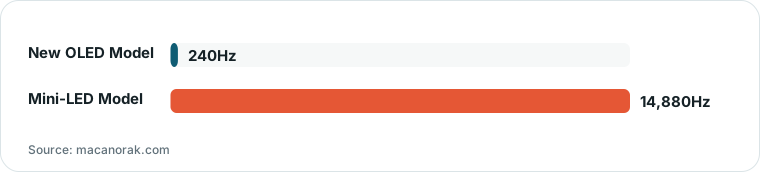
Chart drawn by HN Digest from figures reported by macanorak.com; values are shown as written in the source.
User Impact and Engineering Trade-offs
The issue is particularly notable because some users report being affected despite years of using OLED technology. This suggests that the specific implementation of the tandem OLED panel—rather than the technology itself—is the primary factor in the reported discomfort.
Engineering a flagship laptop display involves balancing brightness, power consumption, and thermal management. While the PROLED XDR display achieves extraordinary blacks and HDR highlights, the specific choice of a 240Hz PWM frequency remains a point of contention for users who prioritize display comfort.
Uncertainties and Potential Solutions
It remains unclear why Apple chose this specific dimming behavior or what engineering constraints necessitated the lower frequency. While some users have suggested software-based dimming overlays or firmware adjustments, it is unknown if such changes would negatively impact the display's performance or power efficiency.
For now, the existing Mini-LED MacBook Pro remains a viable alternative for those sensitive to low-frequency flickering. Apple has previously offered 'Display Pulse Smoothing' on iPhones to mitigate similar issues, but such a feature has not yet been confirmed for the MacBook Pro OLED lineup.
Discussion Digest
Commenters on Hacker News discussed the technical specifics of the 240Hz claim, with one user suggesting the tandem OLED panels might be operating out of phase to create an effective higher frequency.
Others expressed shock at the low frequency, noting that humans can perceive flicker at frequencies more than double a display's rate. Some users shared personal experiences with concussions or other conditions that heighten sensitivity to screen flicker, while others questioned how common these issues are at Apple's scale.
The discussion also explored potential technical workarounds, such as using software dimmers or firmware tuning to adjust the PWM settings, though no consensus was reached on the feasibility of these solutions.
What Hacker News readers are saying
- Technical note: One commenter who analyzed the source data suggested that the actual PWM frequency might be higher than reported, potentially reaching 480Hz or even 960Hz depending on how the tandem OLED panels interact. comment ↗
- Skeptical: Several commenters expressed shock at the 240Hz frequency, noting that industry standards typically require much higher frequencies to avoid observable flicker and eyestrain for a significant portion of the population. comment ↗
- Experience: Users with personal experience with PWM sensitivity reported significant physical discomfort, such as headaches and difficulty focusing, and noted that some individuals may be more susceptible due to underlying conditions like concussions. comment ↗
- Alternative: One commenter argued against the 'OLED is better' narrative, suggesting that LCD technology remains preferable due to longer lifespans and a lack of burn-in issues. comment ↗
Summarized opinions from the Hacker News thread, not verified facts. Read the full discussion ↗