A single public IPv4 address can cost a hosting provider as much as €3.50 per month at retail prices, a figure that exceeds the total cost of some entry-level virtual private server (VPS) plans. To offer a $1.00 monthly plan, providers like natbox.io utilize a Network Address Translation (NAT) model where dozens of customers share one public IP, effectively splitting the cost of the address into small fractions.
The Economics of IPv4 Scarcity
IPv4 addresses are a finite resource, with only about 4.3 billion in existence. Because the free pools have been exhausted for years, these addresses are now traded as property. In 2026, broker reports suggest an average purchase price of $20 per address, while wholesale rental leases fluctuate between $0.35 and $0.60 per month.
The disparity between wholesale and retail pricing is significant. While a wholesale lease is inexpensive, a retail provider like Contabo may charge €3.50 per month for an additional IPv4 address on a VPS. If a hosting provider assigned a unique retail-priced IP to every $1 server, the address alone would cost more than the entire hosting plan.
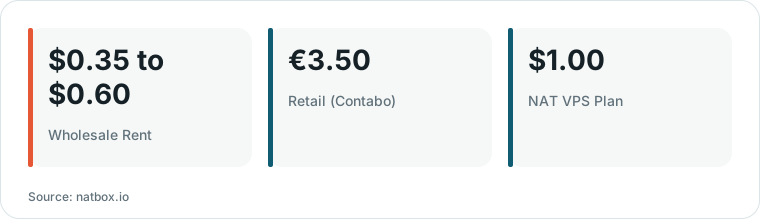
Chart drawn by HN Digest from figures reported by natbox.io; values are shown as written in the source.
“So the cost of one address is split dozens of ways. Even at Contabo's retail €3.50, that's well under 10 cents a month per server on our busiest host.”
— Why a NAT VPS can cost $1: the economics of an IPv4 address · natbox.io blog
The Port-Sharing Mechanism
To maintain a $1 price point, natbox.io shares a single public IPv4 address across many customer servers. Each server is allocated a specific block of ports; for example, the 'Nano' plan provides 10 ports. The first port in the block is typically assigned to SSH, while the remaining ports are forwarded directly to the corresponding port numbers inside the customer's server.
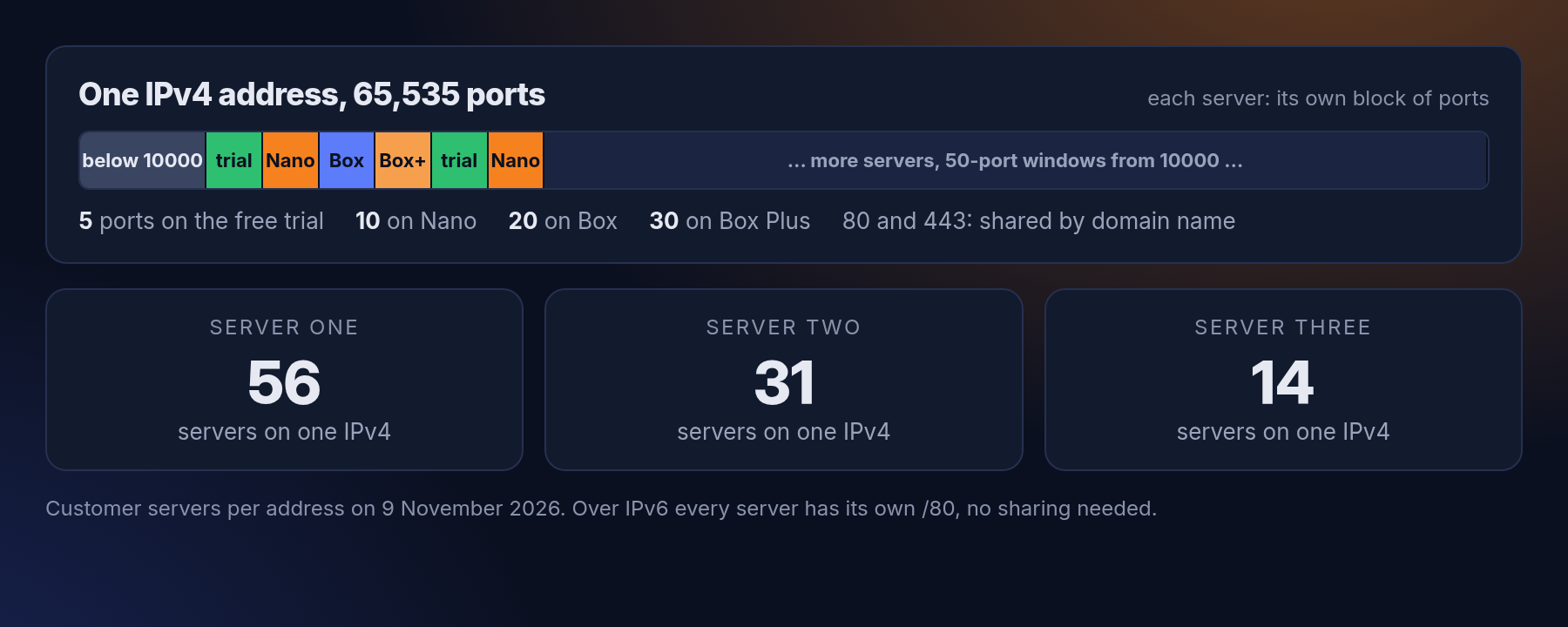
This figure illustrates the core mechanism of the NAT model, where a single public IP is divided into port blocks to support multiple servers.
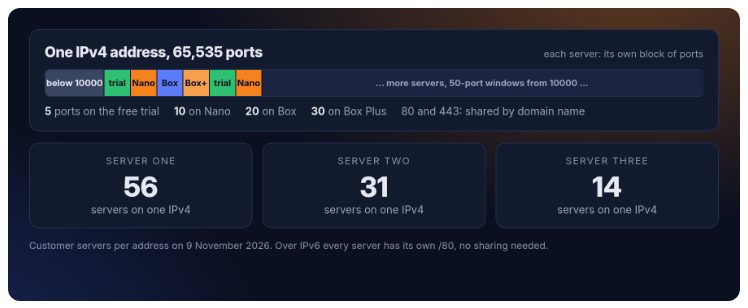
This screenshot provides specific data on how different service plans are allocated unique port blocks from a shared IP.
Because standard web ports (80 and 443) cannot be split into blocks, the provider uses a proxy system. When a user links a domain name to their account, the provider's proxy identifies the incoming request and routes it to the correct server based on the domain name, without needing to decrypt the traffic.
Technical Trade-offs and Limitations
Choosing a NAT VPS involves specific technical constraints. Users cannot use standard port 22 for SSH; instead, they must use a high-numbered port like 10050. Additionally, outgoing mail ports (25, 465, and 587) are blocked for all users to prevent a single spammer from getting the shared IP address blacklisted.
There is also a shared reputation risk. If one customer abuses the shared IP address, the resulting blacklisting could affect all other customers on that same host. Conversely, because IPv6 provides a virtually unlimited supply of addresses, every natbox server receives a routed /80 block, allowing every port and service to run without sharing constraints.
What Hacker News readers are saying
- Alternative: One commenter pointed out that the hoster appears to be a reseller of a specific provider's VPS services. comment ↗
- Skeptical: A commenter expressed surprise at the significant markup between wholesale and retail prices for IPv4 addresses, noting a potential five-to-tenfold difference. comment ↗
- Skeptical: Another user suggested that the service being described is actually a container offering rather than a traditional VPS. comment ↗
Summarized opinions from the Hacker News thread, not verified facts. Read the full discussion ↗