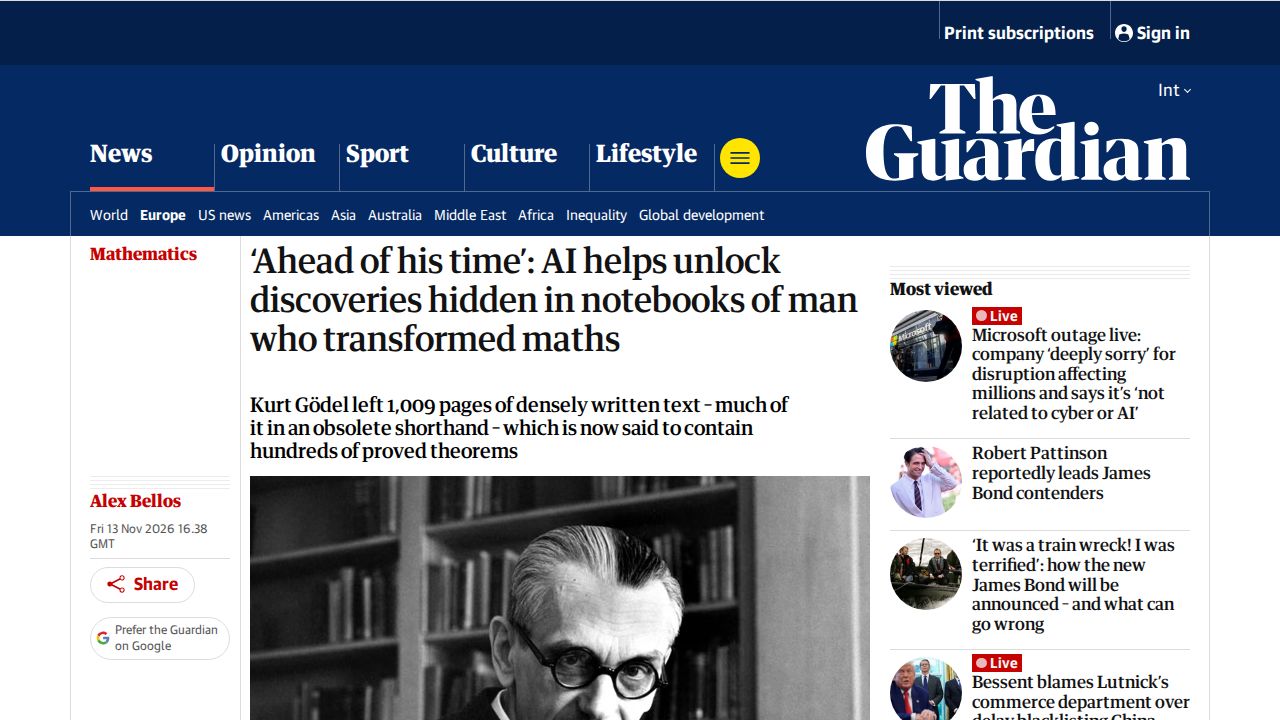
A research project led by Jan von Plato is utilizing artificial intelligence to decode the private notebooks of Kurt Gödel, one of the most influential logicians in history. Because Gödel published relatively little of his work, these notebooks—written in a nearly obsolete shorthand—are believed to contain hundreds of proved theorems that have remained hidden for decades.
Unlocking the Logician's Private Notes
The project focuses on the notebooks of Kurt Gödel, a figure whose work fundamentally transformed mathematics and logic. While Gödel is renowned for his contributions, he was known to be slow to publish, sometimes waiting decades to release his first ideas on complex subjects like the Dialectica interpretation.
These notebooks provide a rare, unpolished look at his thought process. By decoding them, researchers hope to recover a vast amount of mathematical content that Gödel never shared with the public during his lifetime.
“AI unlocks Gödel's notebooks, said to contain hundreds of proved theorems”
— AI unlocks Gödel's notebooks, said to contain hundreds of proved theorems
The Challenge of Gabelsberger Shorthand
A primary technical hurdle in accessing these notes is Gödel's use of Gabelsberger shorthand. This stenographic system was taught in schools around 1920 but became technically obsolete, leaving very few people in the world capable of reading it.
Jan von Plato, a leading expert on Gödel, reportedly taught himself the shorthand to begin the project in 2017. To scale the effort, his team used a €2.5m grant from the European Research Council to train an AI model on existing transcriptions of the shorthand to automate the decoding process.
Hacker News Discussion and Perspectives
The Hacker News discussion regarding this development features various perspectives on the intersection of AI and historical mathematics. One commenter, writing as 'semolinapudding', expressed excitement about the project, noting that Gödel's work is of such high importance that even a small amount of new output would be a 'huge deal'.
Other participants discussed the practicalities of the shorthand. For instance, a commenter named 'hobo123' noted that while Gabelsberger shorthand is often considered obsolete, it was still used by some individuals well into the 2020s. Another commenter, '2aFds', pointed out that the AI's effectiveness likely stems from being trained on pre-existing transcriptions of the shorthand that were still widely available.
The discussion also touched on the social implications of the project. A commenter named 'alterom' suggested that this could change the 'publish or perish' culture by providing a way to establish a record of thinking about a problem early on, even if the work remains incomplete. Conversely, another commenter, 'cyanydeez', speculated that the most complex critiques of logic within the notes might eventually reach the 'maddening limits' of current large language models.
Limitations and Uncertainties
While the project promises to reveal hundreds of theorems, the specific mathematical content and the exact number of successfully 'unlocked' theorems remain to be fully detailed. There is also an ongoing question regarding how well an AI can capture the nuanced, high-level logical critiques Gödel was known for compared to standard mathematical proofs.