Voice assistants often experience a perceptible delay because they must wait for a 'speech-off' signal before they can trigger Large Language Model (LLM) calls or generate audio output. RealtimeVAD addresses this bottleneck by providing a 'pause' event that occurs a median of 100ms earlier than the standard Silero VAD model, allowing for faster transitions in generative voice pipelines.
Mechanism of Faster Detection
RealtimeVAD maintains the use of the Silero VAD model to determine what constitutes speech but overlays a high-frequency check. Every 10ms, the system compares the current audio level with both the ambient room noise and the speaker's own volume.
The moment the audio goes quiet relative to these baselines, the system triggers a 'pause' event. This happens long before the Silero model's internal probability score has fallen enough to signal the end of a turn.
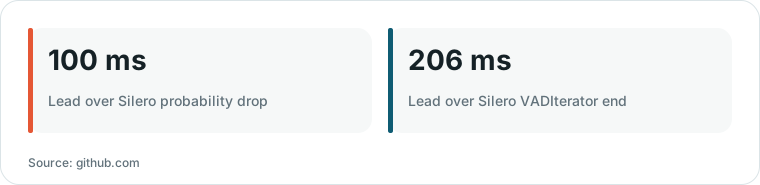
Chart drawn by HN Digest from figures reported by github.com; values are shown as written in the source.
“RealtimeVAD makes it sooner. It keeps Silero VAD to decide what is speech, and adds a second, faster check: every 10 ms it compares the audio level with the room's noise and with the speaker's own level.”
— GitHub - KoljaB/RealtimeVAD: Faster speech off signals for spec gen voice pipelines
Performance Benchmarks and Trade-offs
In tests across 3,279 real voice-assistant turns, RealtimeVAD's 'pause' event arrived 82% of the time before Silero's end signal. However, this speed comes with a higher frequency of false positives; the tool fires on every breath or stop consonant, meaning it identifies many 'pauses' that are actually just brief gaps within a single sentence.
Developers can use these frequent 'pause' events to begin speculative work, such as preparing a transcript or pre-fetching LLM data, which can then be canceled if the speaker continues. If a system cannot handle rapid cancellations, it can ignore the 'pause' events and wait for the final 'end' signal, which still arrives faster than Silero's default settings.
Environmental Constraints and Limitations
The effectiveness of the 100ms lead depends heavily on the audio environment. In rooms where the ambient noise is within 20dB of the speaker's volume, the lead is lost because the system cannot distinguish soft speech endings from background noise.
Additionally, the tool requires 16 kHz mono audio and performs best when noise suppression is active. For very quiet or narrowband speech, such as a phone line, the system may still hit the inherent limits of the underlying Silero model.