NVIDIA allegedly orchestrated a 'circular financing' model by investing billions into AI startups to ensure those companies could purchase its GPUs. This strategy reportedly aimed to manage an 'avalanche' of semiconductors from TSMC that lacked immediate buyers while the industry shifted toward custom hardware solutions.
The Mechanism of Circular Financing
The reported strategy involves a loop where NVIDIA provides capital to a startup, which then uses that capital to purchase NVIDIA's high-margin products. This creates a cycle of revenue that may be more about moving inventory than organic market growth.
Specific examples include a $10 billion annual investment in OpenAI and a deal with CoreWeave, a cloud provider that leases out NVIDIA chips. These deals allow NVIDIA to secure large-scale commitments while simultaneously funding the customer's ability to pay.
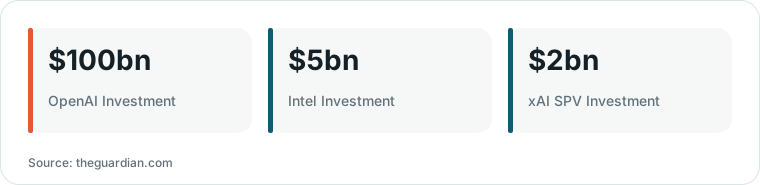
Chart drawn by HN Digest from figures reported by theguardian.com; values are shown as written in the source.
“Nvidia insists it isn’t Enron, but its AI deals are testing investor faith”
— Nvidia insists it isn’t Enron, but its AI deals are testing investor faith
Managing Oversupply and Market Perception
The reports suggest these investments were a response to a looming oversupply of semiconductors from TSMC. By funding small-scale cloud providers, NVIDIA could maintain the perception of high demand even as major hyperscalers began moving toward custom-built silicon.
This approach allegedly helped NVIDIA navigate a period where it was 'on the hook' for a massive volume of GPUs that did not have immediate, non-circular buyers.
Internal Friction and Financial Risks
The strategy reportedly faced internal opposition. During an August meeting, NVIDIA's CFO allegedly pushed for a reduction in these circular financing agreements. In response, CEO Jensen Huang reportedly pushed back, highlighting the urgency of maintaining these investments to secure market share.

This image depicts Jensen Huang, the CEO of NVIDIA, who is mentioned in the article regarding his role in maintaining investment strategies despite internal friction.
Analysts have expressed concern that this model creates significant exposure if AI growth slows. While NVIDIA denies being similar to companies like Enron, the reliance on vendor-financed demand remains a point of scrutiny for investors regarding the sustainability of the current boom.
What Hacker News readers are saying
- Alternative: One commenter suggested that the practice might be a standard business strategy of deploying excess capital into high-growth companies at a discount rather than a conspiracy. comment ↗
- Skeptical: Several commenters expressed skepticism that GPU prices would actually drop, noting that high demand from major players like Google and OpenAI would keep prices elevated even if supply increased. comment ↗
- Skeptical: One commenter argued that the situation is already well-known and suggested the report might be a narrative being amplified by shortsellers or option holders. comment ↗
Summarized opinions from the Hacker News thread, not verified facts. Read the full discussion ↗