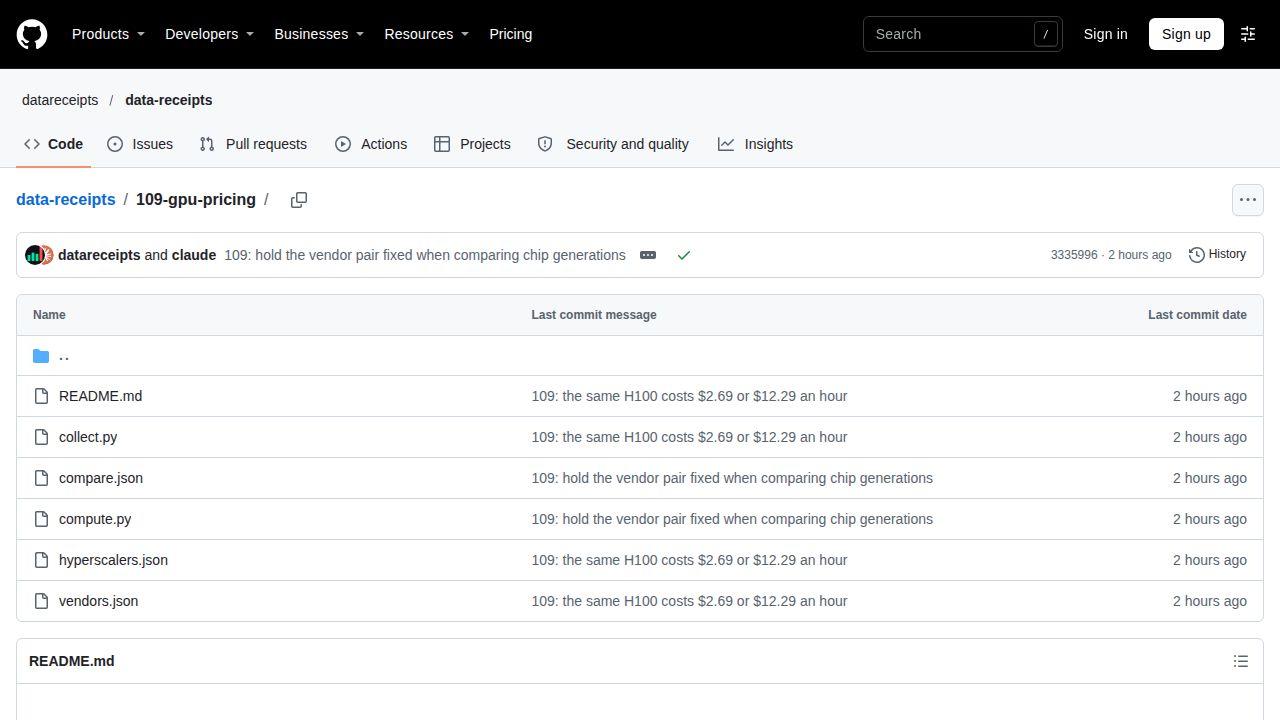
A data repository reveals that the hourly rental price for the same NVIDIA H100 GPU can vary by as much as 4.57 times depending on the hosting provider. This price disparity highlights a fragmented market where users must choose between low-cost 'community' access and premium infrastructure that includes high-speed networking and security guarantees.
The Price Gap in GPU Rentals
The primary source, a GitHub repository tracking GPU pricing, demonstrates that the cost of an H100 GPU is not fixed. Depending on the provider, a user might pay as little as $2.69 or as much as $12.29 for the same hardware on an hourly basis.
This variance suggests that the 'sticker price' of a GPU is heavily influenced by the surrounding infrastructure. Commenters on Hacker News noted that the 4.57x price difference is often driven by factors beyond the chip itself, such as the inclusion of InfiniBand for high-speed interconnects, committed capacity, and enterprise-grade compliance.
Trade-offs Between Cost and Security
Users seeking the lowest prices may face significant security trade-offs. One commenter on Hacker News, writing as plantain, warned that running valuable workloads on 'community' providers like Runpod or Vast could be risky because hosts may be able to peek inside the virtual machines.
Conversely, some participants argued that the risk of 'peeking' is a manageable trade-off for non-sensitive tasks. One commenter, writing as gpm, suggested that for many workloads, such as fine-tuning a model to identify strawberries, the risk of a competitor gaining a trade secret is lower than the risk of violating trade secret laws if a larger entity were involved.
Reliability and Availability Constraints
Lower-cost options are not always a reliable substitute for premium services. Commenters on Hacker News reported experiencing 'stuck' processes, outdated drivers, and poor internet connections when using certain hosted GPUs.
Availability also remains a hurdle for budget-conscious users. One commenter, writing as jdc0589, noted that while some providers offer attractive pricing, finding specific GPUs with high VRAM (above 20GB) can be difficult, potentially making the hourly price irrelevant if the desired hardware is unavailable.
Emerging Market Indices
To navigate this fluctuating market, new pricing indices are beginning to emerge. One commenter, writing as buredoranna, highlighted the 'Silicon Index' and the 'Ornn Compute Price Index (OCPI)' as tools to track pricing observations and executed transactions.
These indices aim to provide a clearer picture of what users are actually willing to pay, helping to clarify the market dynamics between different tiers of GPU providers.
Uncertainties in Provider Infrastructure
While the price data is visible, the specific technical differences between a $2.69 and a $12.29 H100 are not always transparent. It remains unclear exactly which providers are subcontracting cheaper capacity to higher-priced listings, a possibility raised by one commenter on Hacker News.
Furthermore, the specific data for different H100 variants and the exact breakdown of 'enterprise' costs across all providers remain largely unquantified in the current dataset.