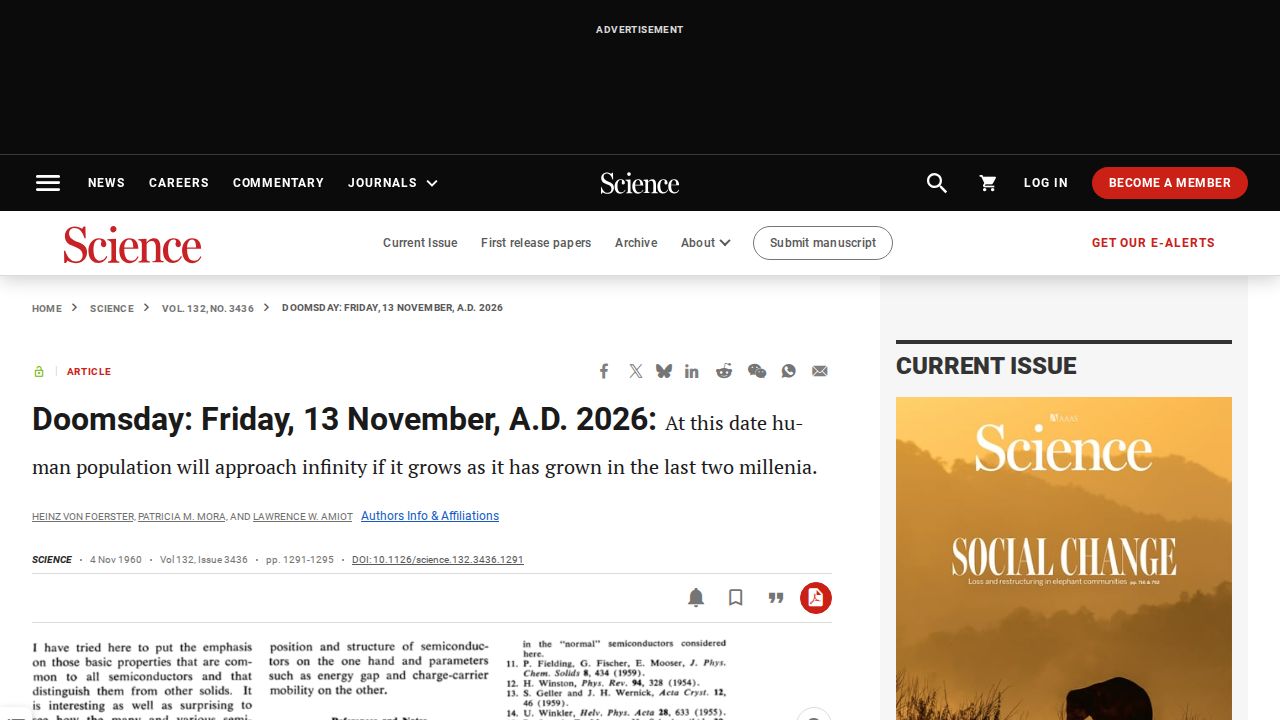
A 1960 scientific paper titled 'Doomsday: Friday, 13 November, A.D. 2026' presents a mathematical extrapolation of population growth that suggests a theoretical point of infinite population. While the date has long passed, the study serves as a primary example of how simplistic models can project catastrophic outcomes when extrapolating past data without accounting for biological or systemic constraints.
The 'Doomsday' Mathematical Model
The primary source, a 1960 paper published in Science, explores the concept of a 'Doomsday' date—the point at which a population growing at a constant exponential rate reaches infinity. This calculation is a purely mathematical exercise based on the assumption of unchecked growth.
Commenters on Hacker News noted that the paper's approach highlights how predictions derived from simple extrapolations of past data can be overly simplistic. One commenter suggested that plotting actual data from 1960 to the present would reveal where the real-world population curve diverges from this theoretical model.
“Doomsday: Friday, 13 November, A.D. 2026 (1960)”
— Doomsday: Friday, 13 November, A.D. 2026 (1960)
Shift from Overpopulation to Decline
The discussion highlights a significant shift in contemporary demographic concerns. While the 1960s were dominated by fears of overpopulation, many industrialized nations are now more concerned with population decline.
One commenter argued that the current focus on population decline is a reaction to the realization that the 'economic engine' of growth may be facing challenges. They suggested that while technology might provide solutions to scarcity, the demographic shift toward an aging population presents a different set of economic hurdles.
Biological and Fictional Contexts
A biologist contributing to the discussion pointed out that the world is not overgrown with bacteria because of biological restrictions like niches and natural selection. They argued that the 'Darwinian devil' of unchecked growth is mitigated by evolutionary arms races and environmental limits.
This shift in demographic reality is also reflected in popular culture. Commenters contrasted 1970s films like 'Soylent Green,' which depicted a world overwhelmed by too many people, with more recent works like 'Blade Runner,' which explores a world facing depopulation due to off-world colonization.
Risk Assessment and Uncertainty
The discussion also touched on the philosophy of risk assessment. One commenter argued that even if a catastrophe hasn't happened yet, it is a correct posture to evaluate risks independently rather than assuming a 'Doomsday' event is impossible simply because it hasn't occurred.
Ultimately, the 'Doomsday' paper remains a useful heuristic for understanding the dangers of simplistic modeling. It serves as a reminder that while mathematical models can project extreme outcomes, real-world systems are governed by complex biological, economic, and social feedback loops.