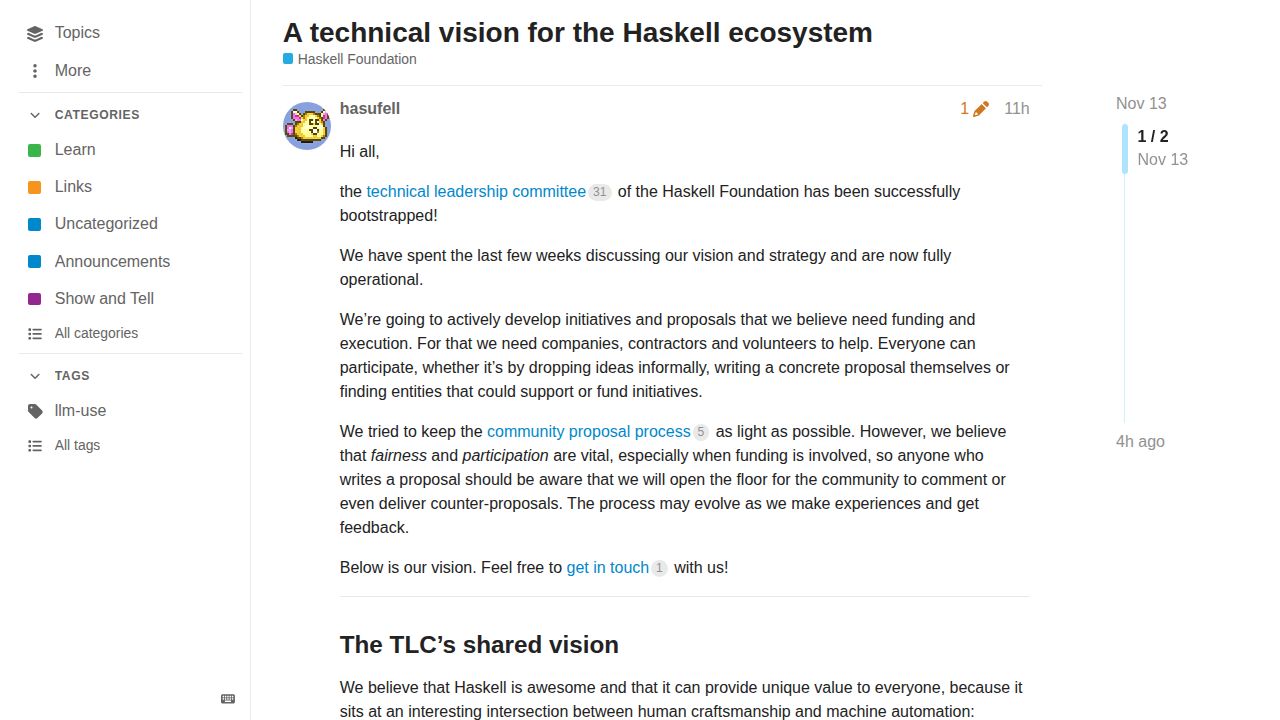
The Haskell Foundation's Technical Leadership Committee (TLC) has launched a new strategic vision to modernize the Haskell ecosystem, aiming to bridge the gap between high-level craftsmanship and industrial-scale productivity. The initiative focuses on drastically improving developer experience (DevX) by addressing systemic bottlenecks in build speeds, debugging tools, and onboarding processes.
Improving Iteration Speed and Debugging
A primary objective of the new vision is to improve the iteration speed of the Haskell ecosystem. The TLC identified that while Haskell scales well for code complexity, it currently struggles with build times, noting that GHC’s own CI turnaround times of 6 hours are a significant bottleneck.
The committee intends to bring these turnaround times down to 2 hours to support modern workflows. They also envision a shift toward deterministic debugging tools, such as live step-through debugging and ergonomic stack traces, integrated directly into IDEs and CLI interfaces.
“Imagine Haskell had the iteration speed of golang, the debugging capabilities of C# and the onboarding experience of rust.”
— A technical vision for the Haskell ecosystem
Onboarding and Developer Experience
The TLC plans to establish the 'best onboarding experience' in the programming language ecosystem as a benchmark for usability. This includes making installation nearly instantaneous and providing documentation that is comprehensive enough to prevent newcomers from getting stuck.
To achieve this, the foundation commits to Unix principles: writing programs that do one thing well, work together, and are extensible. The goal is to ensure that tooling is intuitive enough that users do not have to constantly seek external support.
Security and Ecosystem Stability
Security and trust are framed as foundational requirements that must be established through proactive measures. The foundation intends to implement the fastest incident response times in the language ecosystem, conduct regular penetration testing on infrastructure, and harden the software supply chain.
The vision also seeks to improve long-term stability for conservative corporate users. The TLC is exploring how to make the upgrade experience better and how users can opt out of breaking changes to ensure that software remains maintainable over long periods.