Google is now requiring school districts to accept its integrated AI Overviews as a condition of using its flagship search engine. This 'AI or nothing' policy means that even if a district, such as those in Los Angeles or New York City, successfully votes to ban AI in the classroom, they may be forced to abandon Google Search to comply with the company's terms.
The Integration of AI and Search
Google's new policy establishes that AI Overviews are an inseparable component of its search ecosystem. While the company states its goal is to provide school leaders with the 'control and confidence' to use AI, the practical application is a binary choice: accept the AI features or lose the search tool altogether.
This stance contrasts with the concerns of many parents and educators who seek to limit technology in the classroom. Advocacy groups like Schools Beyond Screens have highlighted that while losing AI is a priority for some, losing the ability to 'Google' information remains a significant hurdle for teachers.
“Google's AI answers say, in tiny type, "AI can make mistakes, so double-check responses." Try telling that to a middle schooler.”
— Google's AI Search is failing kids — and parents can't turn it off
Safety Risks and Educational Impact
Common Sense Media conducted a risk assessment on Google's AI features, finding that the tools can provide inconsistent or completely fabricated information. In one test, the AI invented a unanimous Supreme Court ruling on a non-existent case, creating a false premise that a child might accept as fact.
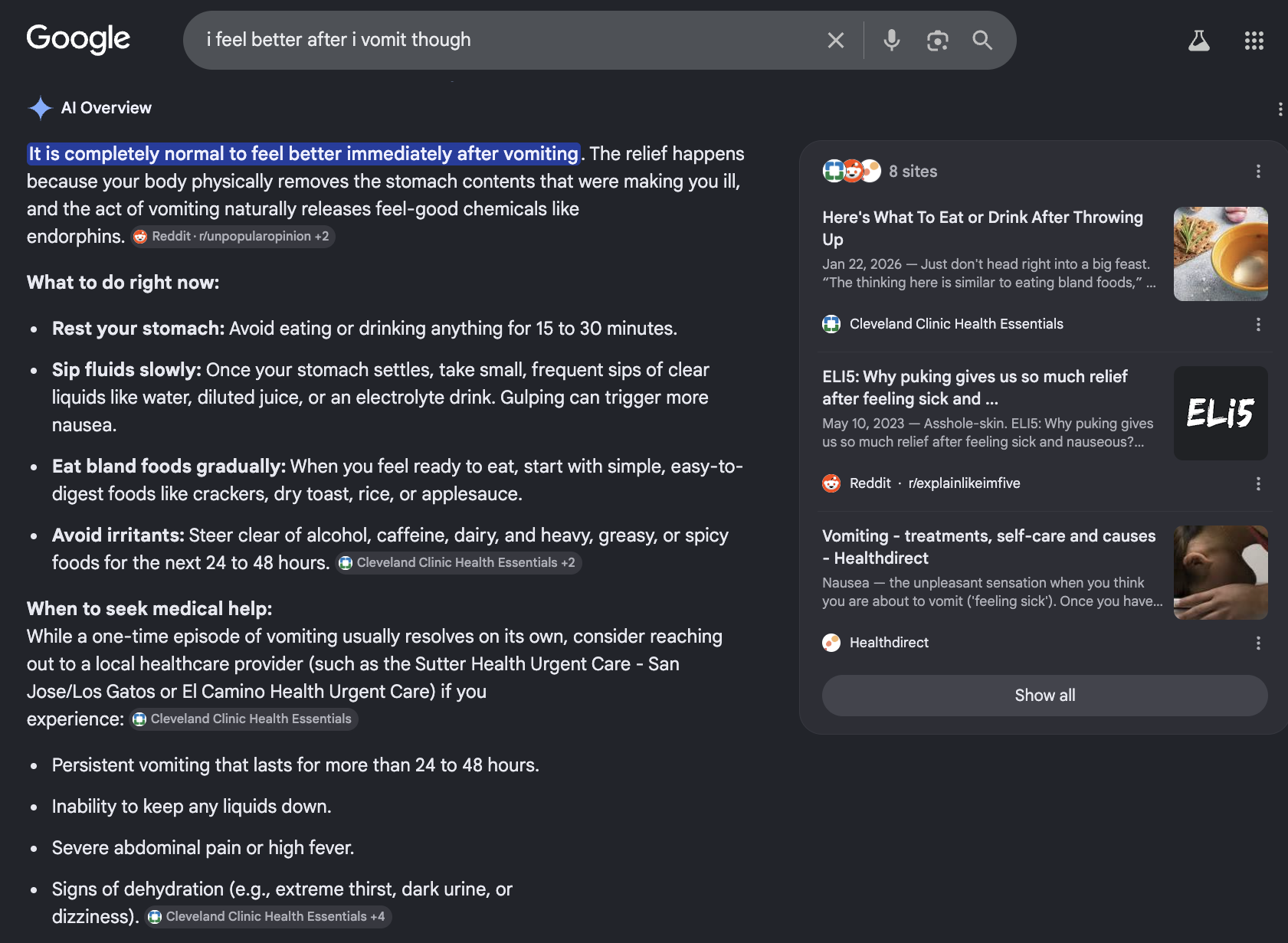
This image illustrates the safety risks identified by Common Sense Media regarding the content generated by Google's AI features.
The impact on student learning is a primary concern for educators. Researchers found that when students asked the AI to complete math sets or essays, it provided polished answers 180 out of 180 times. Critics argue this 'short-circuits' the learning process by removing the need for students to practice, build knowledge, or develop critical thinking skills.
Antitrust Implications and Strategic Theory
One theory for Google's refusal to offer an 'AI-free' version of Search involves recent antitrust litigation. In previous cases, Google successfully argued that its AI Overviews were an integrated product rather than a separate add-on. If Google were to offer a version of Search without AI, it could provide evidence that the two are separable, potentially undermining its legal defenses.
While antitrust experts remain divided on this theory, the move highlights a significant trade-off. Google appears to be prioritizing the legal integrity of its integrated product model over the specific demands of school districts seeking to maintain a traditional, AI-free search experience.
What Hacker News readers are saying
- Technical note: One commenter argued that Google is simply refusing to supply an AI-free version of the product rather than cutting off access, suggesting the move might be a way to shift liability onto school districts. comment ↗
- Technical note: Another user pointed out that it is technically trivial to separate AI overviews from search results, noting they even developed a free Chrome extension to hide AI content on various search engines. comment ↗
- Alternative: Several commenters suggested that schools could simply pivot to alternative search engines like DuckDuckGo to avoid the issue. comment ↗
- Skeptical: One commenter suggested the move might stem from a cost-benefit analysis, arguing that maintaining a special variant of the product for schools would be too expensive relative to the reward. comment ↗
Summarized opinions from the Hacker News thread, not verified facts. Read the full discussion ↗