For systems programming, C remains a foundational standard because of its small footprint and proximity to machine hardware. However, developers often face friction with C's manual management of resources and error states. Zig is positioned as a modern alternative that retains this low-level philosophy but introduces features designed to eliminate specific time-consuming and error-prone patterns. Unlike Rust, which introduces significant ceremony for memory safety, Zig focuses on making the common tasks of C more robust and easier to test.
One of the primary improvements in Zig is how it handles resource cleanup. In C, developers typically use `goto` labels to ensure that if a function fails halfway through, previously allocated resources are released in the correct reverse order. Zig replaces this with `errdefer`, a mechanism where cleanup instructions are placed immediately next to the allocation. Zig automatically executes these in reverse order only if the function returns an error. This approach not only simplifies the code but also allows for more granular testing; for example, developers can use a specialized 'FailingAllocator' to verify that every specific failure path correctly triggers its corresponding cleanup without leaking memory.
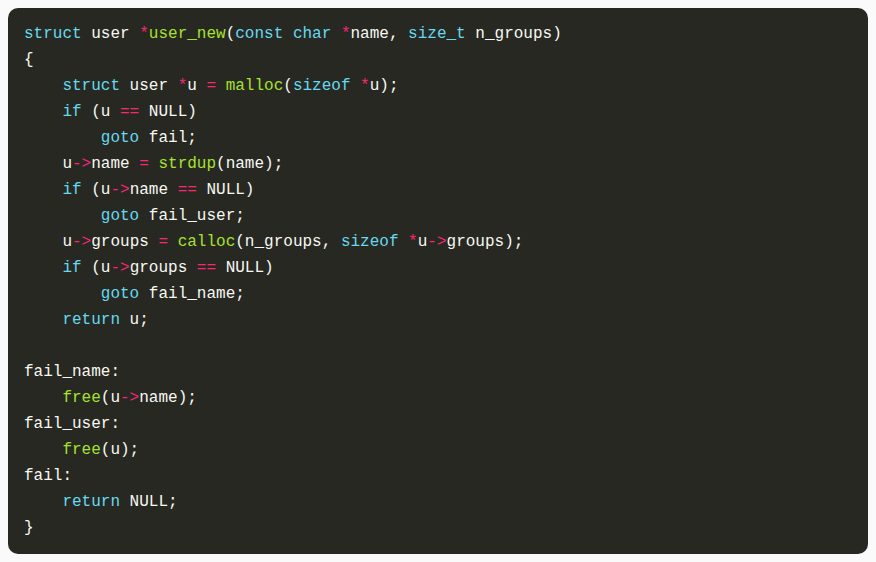
This image illustrates the Zig errdefer mechanism described in the text, showing how cleanup instructions are placed next to allocations.
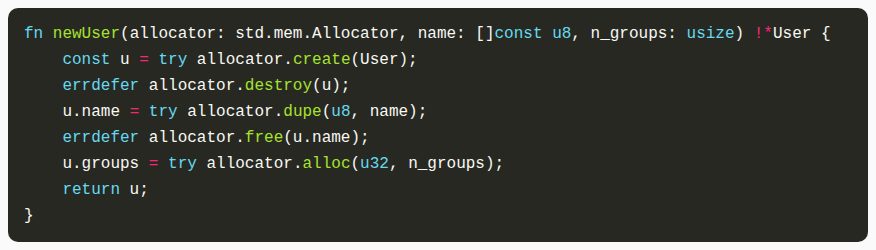
This visual provides a concrete example of the automatic reverse-order cleanup logic mentioned in the second paragraph.
Zig also addresses common C pitfalls regarding memory bounds and error handling. In C, an array passed to a function is often treated as a raw pointer, making it easy to accidentally access an index out of bounds. Zig uses 'slices,' which bundle the data with its length, allowing the compiler to catch such errors in debug and safe modes. Furthermore, while C allows developers to ignore return values from functions like `close()`, Zig treats errors as part of the return type. The compiler refuses to build the program unless the developer explicitly handles the error using `try`, `catch`, or `if` statements. Instead of the C preprocessor, which operates on text, Zig uses `comptime` to run ordinary Zig code at compile time, providing better type checking for generic data structures and configuration.
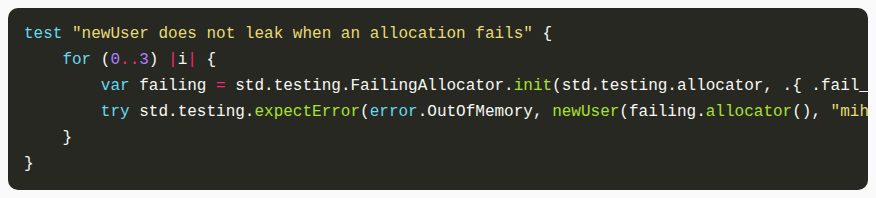
This image supports the discussion on how Zig treats errors as part of the return type, unlike C's optional return values.
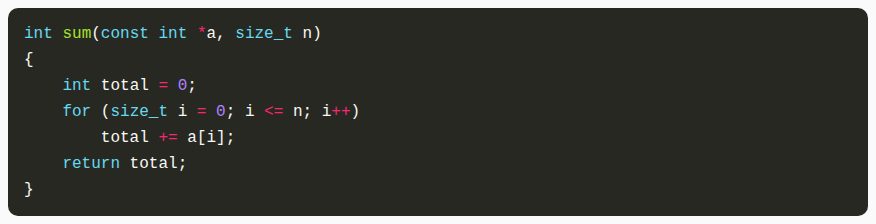
This screenshot illustrates the 'slices' concept described in the third paragraph as a solution to C's raw pointer pitfalls.
Despite these advantages, Zig involves specific trade-offs regarding stability and safety. Zig does not eliminate all memory errors; it still allows for use-after-free bugs and does not prevent pointers from dangling. Furthermore, in 'fast' and 'small' modes, many of the safety checks are disabled to match C's performance profile. Because Zig is still evolving, it lacks the decades of tooling, documentation, and hardware support that C provides. For developers working on legacy systems or microcontrollers with only vendor-specific C compilers, C remains the practical choice, but for new projects, Zig offers a way to write machine-close code with a more modern safety net.
What Hacker News readers are saying
- Alternative: One commenter expressed concern regarding the project's reliability, noting that they observed recurring, significant errors in the Zig rewrite of the MUSL library. comment ↗
- Skeptical: Another user suggested that the issues might not be catastrophic for a version prior to 1.0, noting that users could potentially link to other libc implementations. comment ↗
- Skeptical: A commenter argued that the project's small team size makes it difficult to prioritize specific bug fixes or features quickly. comment ↗
Summarized opinions from the Hacker News thread, not verified facts. Read the full discussion ↗