Pomerado can complete a complex task—onboarding two new employees across four different internal systems—in just 8 minutes and 16 seconds at a cost of 3 cents. In contrast, a general-purpose browser agent like Codex Computer Use took over 21 minutes and cost $41.01 to perform the same task, illustrating a significant shift toward deterministic web interactions for AI agents.
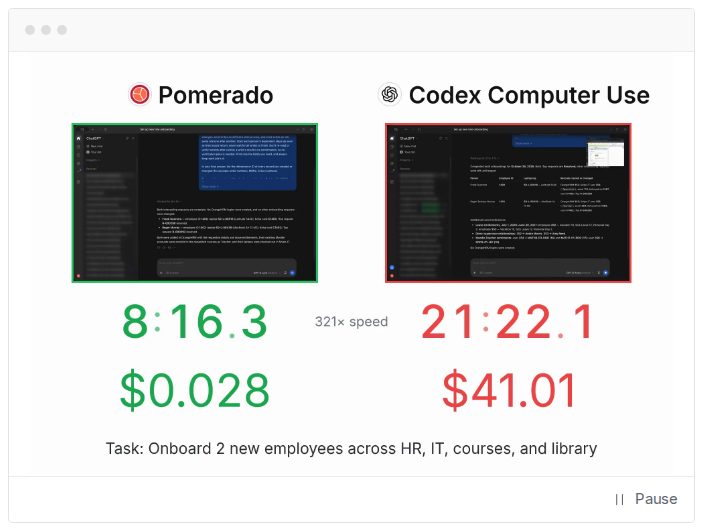
The image illustrates the performance and cost comparison between Pomerado and a general-purpose browser agent.
Deterministic APIs vs. Browser Reasoning
Most current AI agents interact with the web by 'reasoning' through every page, which can be slow and expensive. Pomerado instead builds deterministic APIs that run in seconds, providing a more stable way for agents to interact with legacy portals, consumer sites, and internal tools.
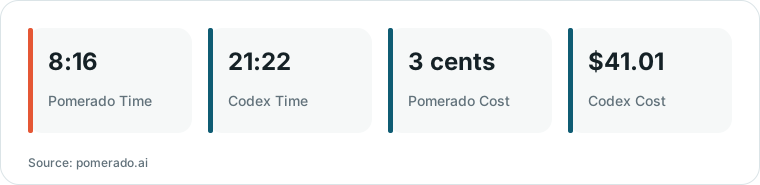
Chart drawn by HN Digest from figures reported by pomerado.ai; values are shown as written in the source.
By creating a specific tool for a specific task, the agent no longer needs to navigate the entire DOM. This approach has been shown to be up to 1,000 times cheaper than standard browser-use methods while maintaining higher accuracy.
This visual supports the claim regarding Pomerado's ability to handle complex tasks across various internal and consumer systems.
“Pomerado builds deterministic APIs that run in seconds.”
— Connect agents to any website. No API needed.
The Minting and Self-Healing Mechanism
To create a new integration, users provide a natural language description of the desired task. Pomerado then explores the site, completes an example of the task, and generalizes that logic into a functional tool. This process, called 'minting,' allows for rapid deployment of tools for sites like Coupa, Delta, or Marriott.
Because websites frequently update their layouts, Pomerado includes a self-healing layer. If a tool fails due to a UI change, the system detects the break, repairs the integration automatically, and returns the successful result to the agent without requiring manual intervention.
Authentication and Security Trade-offs
Pomerado handles the complexities of logging into sites that require two-factor authentication (2FA). It can securely store credentials or allow users to pass login details per request, ensuring that agents can access private dashboards and internal systems.
A primary trade-off is the initial setup: the 'minting' phase requires an OpenAI API key to build and review the integration. However, once the tool is minted, the cost of subsequent tool calls is limited to the model's list price, avoiding the high overhead of continuous browser-based reasoning.
Remaining Uncertainties
While Pomerado handles many common web hurdles, the source material does not specify how the system manages session isolation or proxy-level deduplication for high-traffic sites. It is also unclear how the system handles heavy Single Page Applications (SPAs) with infinite scroll or aggressive bot protection beyond its native rate-limiting and residential proxies.
What Hacker News readers are saying
- Technical note: One commenter raised questions regarding how the system handles credentials and session isolation for sites behind logins, expressing concern about potential prompt injection surfaces from untrusted page content. comment ↗
- Technical note: Another user questioned how the service manages rate-limiting and session isolation when dealing with heavy single-page applications or aggressive bot protections. comment ↗
- Technical note: A commenter who has built similar self-healing systems for agents asked if there is a dashboard available to monitor the maintenance of these integrations. comment ↗
Summarized opinions from the Hacker News thread, not verified facts. Read the full discussion ↗