Huawei's new MACaQ tool can quantize a massive 122B-parameter model in just 64 minutes using only 32.5 GB of device memory. This development addresses a significant bottleneck in local AI inference: the time and hardware resources required to compress large models into formats that can run on consumer-grade hardware without significant loss in quality.
Multi-Modal Quantization Capabilities
MACaQ is designed as a model-agnostic quantization framework, meaning it can be applied to various types of AI models rather than being restricted to a single architecture. It supports text generation, image and video generation via Diffusers, and speech generation through PyTorch.

This banner represents the MACaQ framework's primary purpose as a model-agnostic quantization tool.
The tool provides specific workflows for different backends. For example, it supports 2-, 3-, and 4-bit GGUF formats for llama.cpp, and W4A4 (4-bit weights and 4-bit activations) for vLLM and PyTorch-based speech models.
Efficiency and Performance Benchmarks
A primary advantage of MACaQ is its speed. The developers claim it can match the best Llama-3-8B perplexity while requiring 11x less quantization time than competing methods. This efficiency is critical for researchers and developers who need to iterate quickly on compressed models.
In testing with the Qwen3.6-35B-A3B model, MACaQ-R (a refinement method) achieved a KL divergence of 0.013367 compared to FP16, outperforming the Unsloth UD-Q4_K_XL method which scored 0.015731. Lower KL divergence indicates a higher-quality reconstruction of the original model's weights.
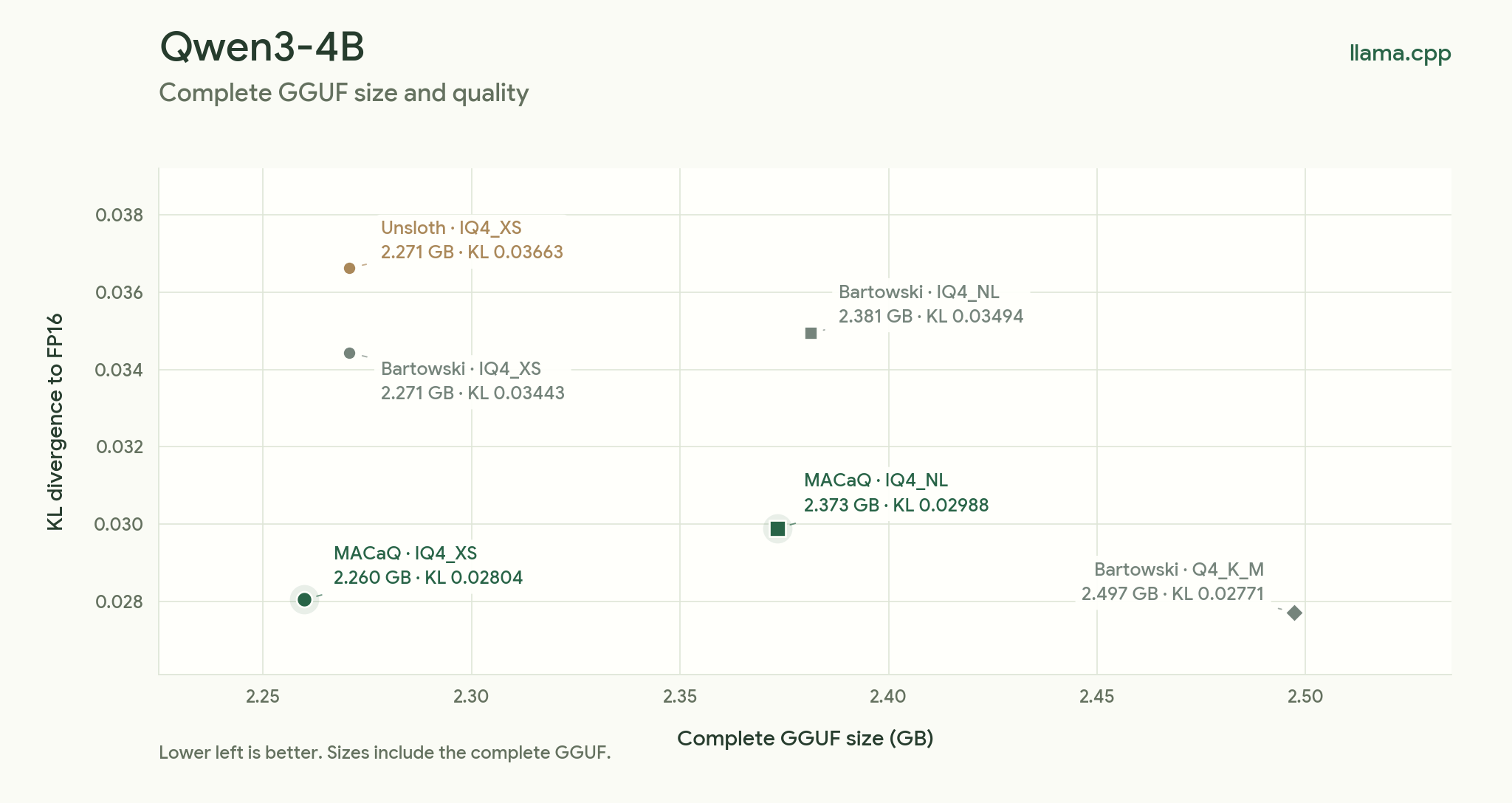
This chart provides a visual comparison of model size and reconstruction quality (KL divergence) mentioned in the performance benchmarks.
Inference Trade-offs and Hardware Integration
While MACaQ significantly improves inference speed, there are measurable trade-offs in precision. For the Qwen3.8-27B model, moving from BF16 to MACaQ W4A4 precision resulted in a slight increase in perplexity from 2.8463 to 2.8994, though this was offset by a substantial increase in decoding speed.
For users on Huawei's Ascend hardware, the project provides specific dense and grouped matmul kernels via CANN pull requests. This ensures that the quantization benefits can be fully realized on specialized NPU (Neural Processing Unit) architectures.
What Hacker News readers are saying
- Alternative: One commenter expressed a preference for using GitHub over official product pages because it allows for easier navigation and direct access to the code. comment ↗
- Skeptical: Another user raised concerns about the reliability of third-party hosting for Huawei products, suggesting that content on platforms outside of China could be removed at any time. comment ↗
Summarized opinions from the Hacker News thread, not verified facts. Read the full discussion ↗