Xing Mobility, a Taiwan-based battery manufacturer, has unveiled its Immersio CTP system, a battery architecture designed to store up to twice the energy of conventional marine batteries. By eliminating traditional module boxes and cold plates in favor of a single molded composite holder and liquid immersion, the system seeks to solve the dual challenges of heat dissipation and volume constraints in electric shipping.
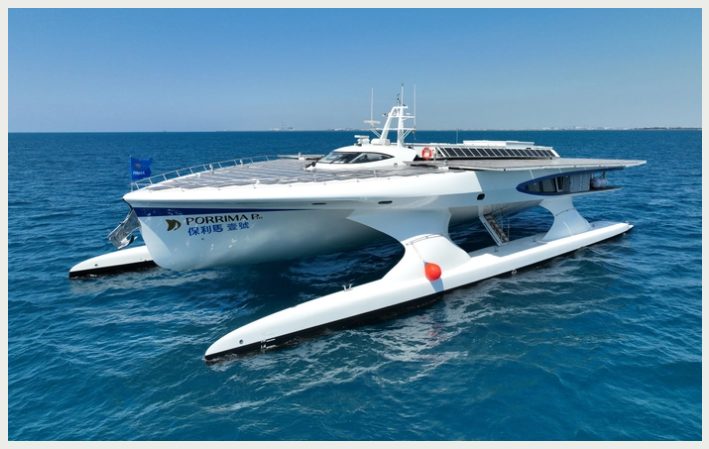
The image illustrates the maritime application of the Immersio CTP system for electric shipping.
Architecture of the Immersio CTP System
Most marine battery packs house cells within metal module boxes, which are then placed inside a larger enclosure. Xing Mobility’s 'cell-to-pack' (CTP) design removes these intermediate layers, using a molded composite holder to grip the cells and channel the coolant simultaneously.
This integration reduces 'dead weight'—the mass of the battery structure that does not store energy. By minimizing the volume of cooling pipes and module housing, the CTP system can pack cells more tightly, which is critical for ships where every cubic meter of space is a trade-off against cargo or passenger capacity.

These chassis represent the physical hardware and battery housing components discussed in the architecture section.
Heat Management and Safety Mechanisms
Traditional marine batteries use cold plates—metal sheets with tiny channels—to carry coolant past the cells. However, heat must still cross the cell casing and thermal paste before reaching the plate. Submerging every cell in a fluid removes these barriers, providing what experts describe as the most efficient possible heat transfer.
Xing Mobility claims this immersion scheme can prevent a single overheating cell from igniting its neighbors. According to the company, the fluid can cool a punctured cell from 1,000 °C to below 100 °C within 10 seconds. While experts find this plausible, the specific results of the IEC 62619 safety standard tests have not been publicly shared.
Performance Metrics and Maritime Constraints
In laboratory settings, the CTP system stores about 200 watt-hours per kilogram, including the weight of the coolant and management systems. While this is a significant improvement over the lithium iron phosphate (LFP) packs used for comparison, it represents a 19 percent increase over the 168 Wh/kg offered by Corvus Energy's Dolphin NxtGen system.
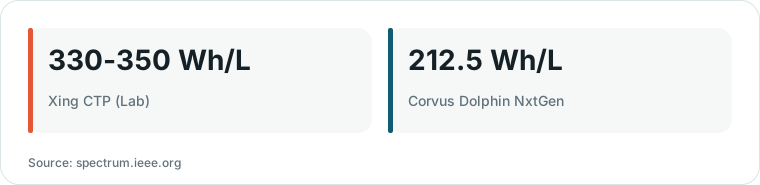
Chart drawn by HN Digest from figures reported by spectrum.ieee.org; values are shown as written in the source.
The system faces several hurdles before widespread adoption. The use of a flammable liquid coolant presents a risk if not managed correctly, and the long-term reliability of the oil—which must withstand thousands of heat cycles and potential salt contamination over a decade—remains unproven. Furthermore, the system has yet to receive DNV certification, a necessary step for deployment on large passenger ferries.
What Hacker News readers are saying
- Open question: One commenter questioned whether the system could provide enough power for long-distance ocean crossings, noting that marine diesel remains highly energy-dense and efficient for long durations. comment ↗
- Technical note: A commenter explained that sea water is too corrosive and conductive to be used directly for cooling, suggesting that a heat exchanger system is likely used instead. comment ↗
- Alternative: Another reader pointed out that while long-haul shipping is difficult, batteries could be highly effective for shorter routes like ferries, river transport, and feeder ships. comment ↗
Summarized opinions from the Hacker News thread, not verified facts. Read the full discussion ↗