Unsloth has released a new Dynamic V3.1 quantization algorithm that improves the accuracy of the Qwen3.8-27B model by 5-10% across major benchmarks without increasing the model's footprint. This update specifically targets the 2-bit to 6-bit quantization range, providing a high-performance option for users running dense models locally for vision, reasoning, and agentic coding tasks.
Accuracy Gains via Dynamic V3.1
The Dynamic V3.1 update provides a significant leap in accuracy for the Qwen3.8-27B model, which is a dense model featuring vision and reasoning capabilities. Unsloth reported that these improvements are consistent across most benchmarks, including LiveCodeBench v6, GPQA Diamond, and MMLU-Pro.

The article discusses the Qwen3.8-27B model's vision and reasoning capabilities, which are accessible via the Unsloth Desktop interface.
While most quants from 2-bit to 6-bit were updated, Unsloth opted to keep 3-bit UD3 quants as they performed on par with the new V3.1 algorithm. The update was validated using 256K context lengths for agentic benchmarks and 128K for general benchmarks.
“Qwen3.8-27B GGUFs now use Unsloth Dynamic V3.1 which improves average accuracy by 5-10% accuracy at comparable sizes including Terminal Bench, DeepSWE and more benchmarks.”
— Qwen3.8 - How to Run Locally | Unsloth Documentation
Optimizations for Agentic Workloads
Beyond raw accuracy, the new quants are optimized for agentic tools like Codex. They include developer role support and improved parsing of nested objects, which helps tools succeed more frequently during complex tasks.

The update includes improved parsing for nested objects to help agentic tools succeed during complex tasks.
The models also support Multi-Token Prediction (MTP) to facilitate faster inference. For users requiring high-speed reasoning, the Qwen3.8-27B model supports different reasoning efforts—xhigh, medium, low, or none—to balance accuracy and speed.
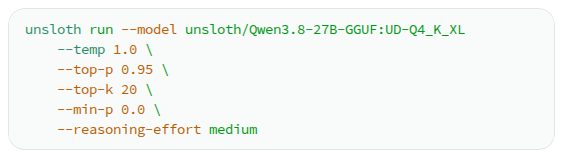
The article mentions the new quants are optimized for agentic tools and high-performance inference.
Hardware Requirements and Trade-offs
Running these models locally involves specific hardware trade-offs depending on the chosen quantization level. For example, 4-bit quants are designed to work on 16-19GB VRAM setups, such as an RTX 5080 or a Mac with 24GB of unified memory.
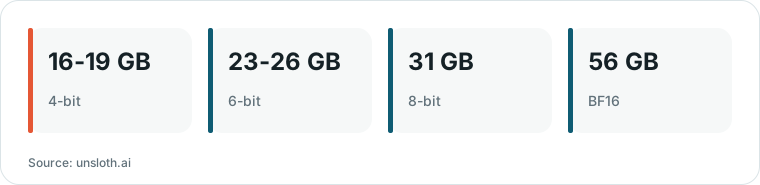
Chart drawn by HN Digest from figures reported by unsloth.ai; values are shown as written in the source.
For maximum performance, Unsloth released NVFP4 quants that run approximately 1.5x faster than BF16 checkpoints. However, these specific quants require NVIDIA Blackwell GPUs, such as the RTX 50X series, to achieve the advertised speedups.
Benchmarking Discrepancies
Unsloth addressed discrepancies in external benchmarking, specifically regarding GSQ-RCO results for LiveCodeBench. They noted that while some reports suggested their quants performed worse, those tests likely used a 96K context budget.
Unsloth's testing utilized a 128K context budget, where their UD3 quants outperformed the competition. They also noted that GPU non-determinism means benchmarks should be run multiple times to ensure reliable results.
What Hacker News readers are saying
- Alternative: One commenter noted that while Unsloth is more broadly applicable to off-the-shelf models, Bonsai 2 offers additional tuning for packing more parameters into smaller sizes. comment ↗
- Experience: A user reported successfully running the model on an M4 Mac mini, achieving speeds they found acceptable for local use. comment ↗
- Experience: One commenter shared their experience running a 27B model in CPU-only mode, noting that while it was very slow, it was capable of processing large files overnight. comment ↗
Summarized opinions from the Hacker News thread, not verified facts. Read the full discussion ↗