HolyArrs replaces a suite of six separate media management applications—Sonarr, Radarr, Lidarr, Bazarr, Prowlarr, and Seerr—with a single self-hosted tool that requires only 14.9 MB of disk space. By consolidating these functions, the developer aims to eliminate the need for multiple logins, ports, and API keys, providing a unified experience for users who manage their own media libraries.
This visual supports the description of the unified interface for managing movies, shows, and music.
Consolidating the 'Arr' Stack
A typical self-hosted media server setup often requires running six different applications to handle various aspects of content acquisition and organization. These include Sonarr and Radarr for TV and movies, Lidarr for music, Bazarr for subtitles, Prowlarr for indexer management, and Seerr or Overseerr for request handling.
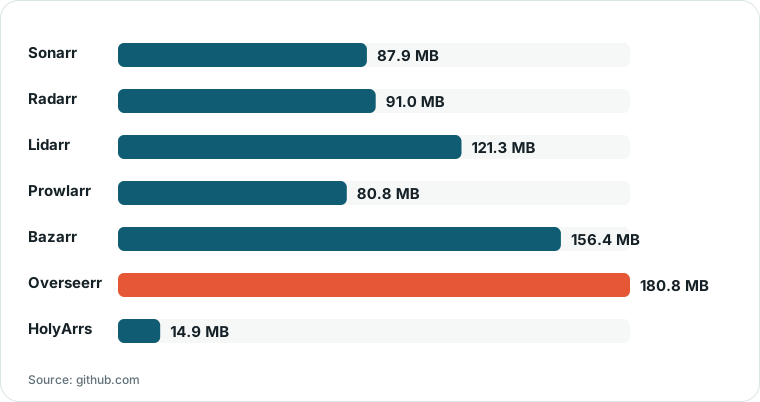
Chart drawn by HN Digest from figures reported by github.com; values are shown as written in the source.
HolyArrs unifies these workflows into one interface. It allows users to browse content like a streaming service, request titles, and manage 'Pick rules'—which determine which releases win based on size, quality, or language—all within a single login and port.
This image illustrates the unified browsing experience described in the consolidation section.
Technical Efficiency and Resource Savings
The primary technical advantage of HolyArrs is its reduced footprint. The developer reports that the six apps it replaces have a combined download size of 718.2 MB, whereas HolyArrs is approximately 15 MB to download.
In terms of memory usage, HolyArrs maintains about 140 MiB of idle RAM while managing a library of 10,000 titles and 55,000 movies/episodes. This is a notable contrast to the individual memory requirements of the separate apps, which can range from 80 MB to over 180 MB each.
Migration and Compatibility
To lower the barrier for switching, HolyArrs includes a migration tool. It can read data from existing Sonarr, Radarr, and Lidarr instances to import library folders, quality profiles, and indexers. It also supports importing Prowlarr indexers and Bazarr subtitle preferences.
The application functions as a coordinator rather than a standalone downloader; it connects to existing clients like qBittorrent, Transmission, Deluge, and SABnzbd. It also provides native compatibility with major media servers like Plex, Jellyfin, and Emby.
Current Limitations and Roadmap
While HolyArrs simplifies the management stack, it has specific functional boundaries in its 1.0 release. It does not currently feature a built-in downloader, meaning users must still maintain an external client for the actual file acquisition.
Additionally, the project does not yet include AI features, MCP (Model Context Protocol) support, or native phone and TV applications. Music support within the 'Explore' browsing interface is also currently under development.
What Hacker News readers are saying
- Skeptical: One commenter expressed skepticism regarding the project's longevity, noting that previous attempts to consolidate the 'arr' stack have often failed to overcome the stability and integration of the original applications. comment ↗
- Open question: A user questioned the technical trade-offs involved in reducing the application's size so significantly, asking what specific features were removed to achieve the smaller footprint. comment ↗
- Experience: One user explained that while the tool provides a unified interface, it functions by sending content to a downloader and filing it into existing players like Jellyfin or Plex rather than playing the media directly. comment ↗
- Open question: Another commenter inquired about the long-term plan for handling complex content acquisition tasks, such as parsing specific file names for formats, groups, and languages. comment ↗
Summarized opinions from the Hacker News thread, not verified facts. Read the full discussion ↗