Google has released the Gemini Decisions API, a specialized tool designed to evaluate up to 1,000 independent questions—such as yes/no checks, multiple-choice selections, and rubric scoring—in a single forward pass. Powered by the new Gemini Decision 1 model, the API achieves end-to-end latency of 150-250 ms, making it suitable for real-time applications like dynamic model routing and safety layers.
Purpose-Built for Bounded Choices
Unlike standard generative models that produce text token-by-token, the Gemini Decisions API scores candidate options in a single pass. This architecture is optimized for 'closed-set' decisions, where the goal is to select from a predefined list of options rather than generating open-ended content.
The API supports three specific decision types: 'noul' for yes/no conditions, 'choice' for selecting from 2 to 255 options, and 'score' for grading inputs against an ordered rubric. Each response includes normalized probabilities and confidence scores to help developers assess the model's certainty.
“Rather than generating answer text token by token, Gemini Decision 1 scores your candidate options in a single forward pass, returning probabilities and confidence scores in 150-250 ms end-to-end latency at $0.10 per 1M input tokens with zero output tokens billed.”
— Gemini Decisions API: Fast, calibrated multimodal decisions
Multimodal Processing and Latency
The Gemini Decision 1 model is built on a native multimodal architecture, allowing it to process diverse inputs—such as pairing a call recording with account metadata or a scanned PDF with photos—simultaneously. It maintains a nearly flat latency profile even as the number of questions per request increases from 1 to 100.
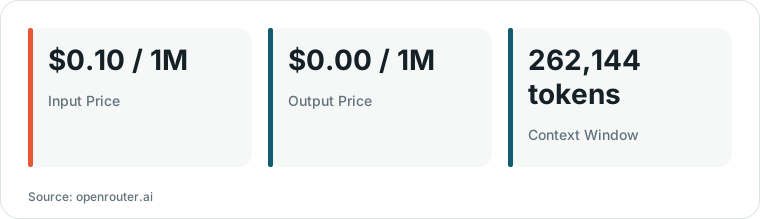
Chart drawn by HN Digest from figures reported by openrouter.ai; values are shown as written in the source.
By avoiding the overhead of token-by-token decoding, the model keeps median compute latency between 50-100 ms. This efficiency allows teams to use the API as a low-latency 'control plane' for tasks like detecting adversarial behavior in search queries or picking emoji reactions in real-time.
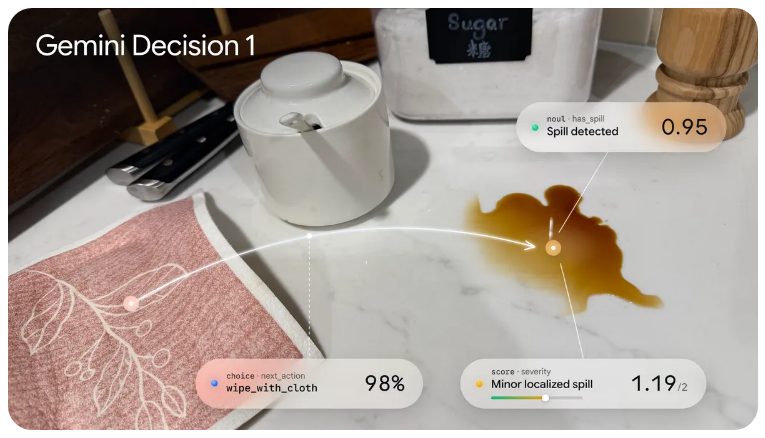
The API is designed for real-time applications and low-latency control planes, such as detecting specific behaviors or actions.
Cost Efficiency and Availability
The pricing structure is designed to favor high-volume, low-complexity tasks. Because the API does not bill for output tokens, it provides a significant cost advantage over general-purpose models like Gemini 3.5 Flash-Lite when performing shared benchmark tasks.
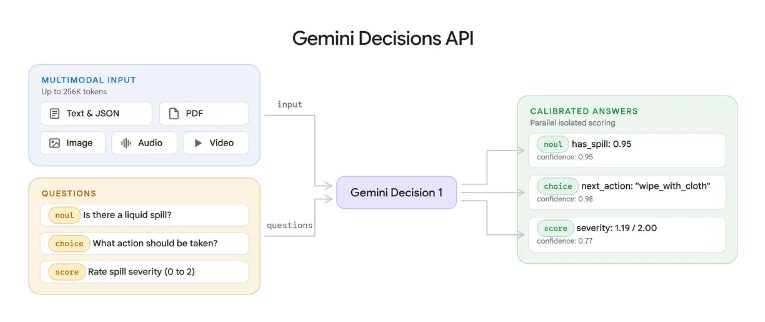
The article discusses how the Gemini Decisions API achieves significant cost and performance advantages over standard generative models.
While the tool is currently accessible via Google AI Studio and third-party providers like OpenRouter, its availability on Google Cloud's Vertex AI platform has not yet been confirmed. Developers can currently use the API to build rapid prototypes for intent classification, content grading, and tool selection.
What Hacker News readers are saying
- Technical note: One commenter suggested that while the API is more expensive than some competitors, its ability to accept audio and video inputs makes it uniquely useful for specific use cases. comment ↗
- Skeptical: A reader expressed skepticism regarding Google's motives, suggesting the product might be a way to capture market share from existing customers by offering a solid but non-superior alternative. comment ↗
- Technical note: One user shared their experience using a custom-built system for file indexing, noting that they prefer their own optimized setup for processing images and documents over standard offerings. comment ↗
- Open question: A commenter raised questions about the underlying mechanics of how these models calculate probabilities, wondering if the process is fundamentally different from other classifiers. comment ↗
Summarized opinions from the Hacker News thread, not verified facts. Read the full discussion ↗