In ergodic literature, the reader is no longer a passive observer but an active participant required to perform 'nontrivial effort' to traverse the text. This concept, pioneered by Espen J. Aarseth, shifts the focus from the medium—whether paper or digital—to the specific way a text functions and interacts with its human operator.
The Mechanics of Ergodic Traversal
Aarseth defines ergodic literature by contrasting it with 'nonergodic' literature, where the effort to traverse the text is trivial. In nonergodic works, the only requirements are eye movement and the periodic turning of pages. In ergodic works, the reader must perform material actions to produce a semiotic sequence.
To analyze these interactions, Aarseth divides a text into three elements: the medium, the human operator, and the strings of signs. He further splits the signs into 'textons' (the encoded strings) and 'scriptons' (the strings as they appear to the user). This allows for a distinction between the underlying structure of the work and the experience of the reader.
“In ergodic literature, nontrivial effort is required to allow the reader to traverse the text.”
— Ergodic literature - Wikipedia
The Seven Axes of Media Positions
Aarseth developed a typology of media positions based on seven variables: Dynamics (Static vs. Variable), Determinability (Predictable vs. Random), Transiency (User-driven vs. Automatic), Perspective (Personal vs. Impersonal), Access (Random vs. Controlled), Linking (Explicit vs. Conditional), and User functions (Interpretative, Explorative, Configurative, or Textonic).
These variables can produce 576 unique media positions. For example, a 'controlled' access text might require a reader to follow a specific path through other passages to reach a certain point, while a 'configurative' user function allows the reader to choose or create scriptons during a specific reading session.
Cybertext and Practical Examples
The concept of 'cybertext' is a subset of these dynamics, reserved for texts where 'calculation' produces scriptons. A chatbot like ELIZA or the I Ching are examples of cybertext because they calculate responses based on user input or embedded rules. In contrast, a simple hypertext novel might be ergodic but not cybertext if it lacks these computational elements.
Ergodic literature exists across various formats. Paper-based examples include B. S. Johnson's 'The Unfortunates,' which was printed in 27 separate unbound sections to be read in any order, and Raymond Queneau's 'Cent mille milliards de poèmes,' where lines on separate strips can be combined in nearly infinite combinations. Digital examples include 'Colossal Cave Adventure,' where players interact with locations via word prompts.
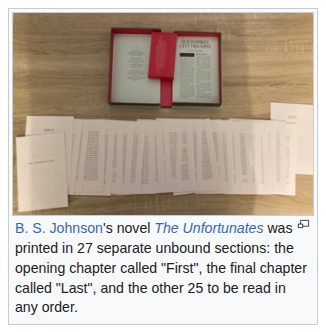
This image illustrates a primary example of paper-based ergodic literature where the physical structure requires reader navigation.
Trade-offs and Limitations
The primary trade-off of ergodic literature is the increased cognitive and physical demand placed on the reader. Because these works require 'extranoematic' responsibilities, they can be intentionally difficult or exhausting, shifting the experience from consumption to navigation. However, the source material does not provide specific metrics for 'nontrivial effort' or empirical data on how these different media positions affect reader engagement.
Scholars continue to debate the fine points of these definitions, particularly regarding the clarity of the distinction between ergodic literature and cybertext. The framework remains a theoretical model for understanding how text functions as a machine rather than a static object.
What Hacker News readers are saying
- Experience: One commenter shared their experience with a specific novel, noting that while the complex structure was mentally taxing, they felt the author's intentional difficulty in navigation was off-putting. comment ↗
- Alternative: A reader suggested that the video game Myst serves as a practical example of ergodic literature because it allows for non-linear navigation and reassembly of information. comment ↗
- Skeptical: One commenter questioned whether 'stunt writing' techniques, such as shifting narrative action into footnotes, actually qualify as ergodic literature. comment ↗
- Skeptical: Another user pointed out that the experience of ergodic literature might be compromised by modern technology, arguing that e-readers can ruin the intended physical layout. comment ↗
Summarized opinions from the Hacker News thread, not verified facts. Read the full discussion ↗