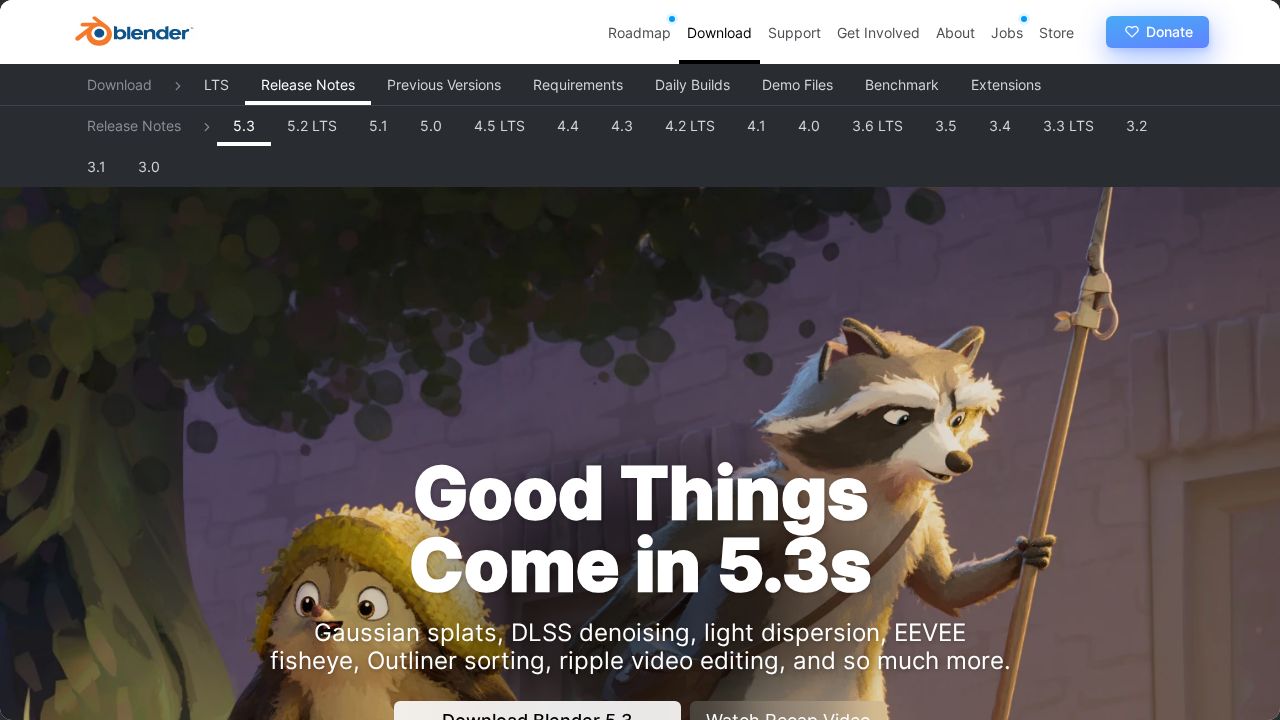
Blender 5.3 has officially launched, introducing native support for Gaussian Splatting to its suite of 3D creation tools. This development allows users to work with a rendering backend that has become a dominant representation for spatial and reconstructive world models, moving the software closer to a unified pipeline for both traditional assets and modern 3D reconstructions.
New Features in Blender 5.3
The primary announcement for Blender 5.3 is the inclusion of Gaussian Splatting support. This technology is increasingly recognized as a dominant rendering backend for spatial and reconstructive world models.
In addition to splatting support, the release introduces bundle support within geometry nodes. This update is designed to facilitate complex pipelines and workflows by mapping traditional coding concepts, such as lists and closures, into a visual paradigm.
Community Perspectives on Gaussian Splatting
Commenters on Hacker News discussed the implications of Gaussian Splatting in the Blender ecosystem. One commenter, writing as devy, noted that while it is not the core technique for all world models, it has become a dominant representation for spatial and reconstructive models.
Another commenter, hermitShell, suggested that the technology is a key part of the convergence toward text-to-3D world specifications, potentially serving as a 'killer app' for VR headsets.
Conversely, jfrei pointed out a technical limitation, noting that Gaussian Splatting may not be the ideal method for producing the well-structured, low-vertex mesh data typically required for standard video game development.
Technical Trade-offs and Future Outlook
The discussion highlighted a distinction between reconstruction and traditional game assets. While Gaussian Splatting excels at capturing complex spatial data, it does not currently offer the same advantages as traditional polygonal meshes for specific use cases like game engine optimization.
Users also expressed interest in the expansion of these technologies into 4D and video-based splats. The community remains curious about how these representations will evolve as they become more integrated into mainstream production tools.