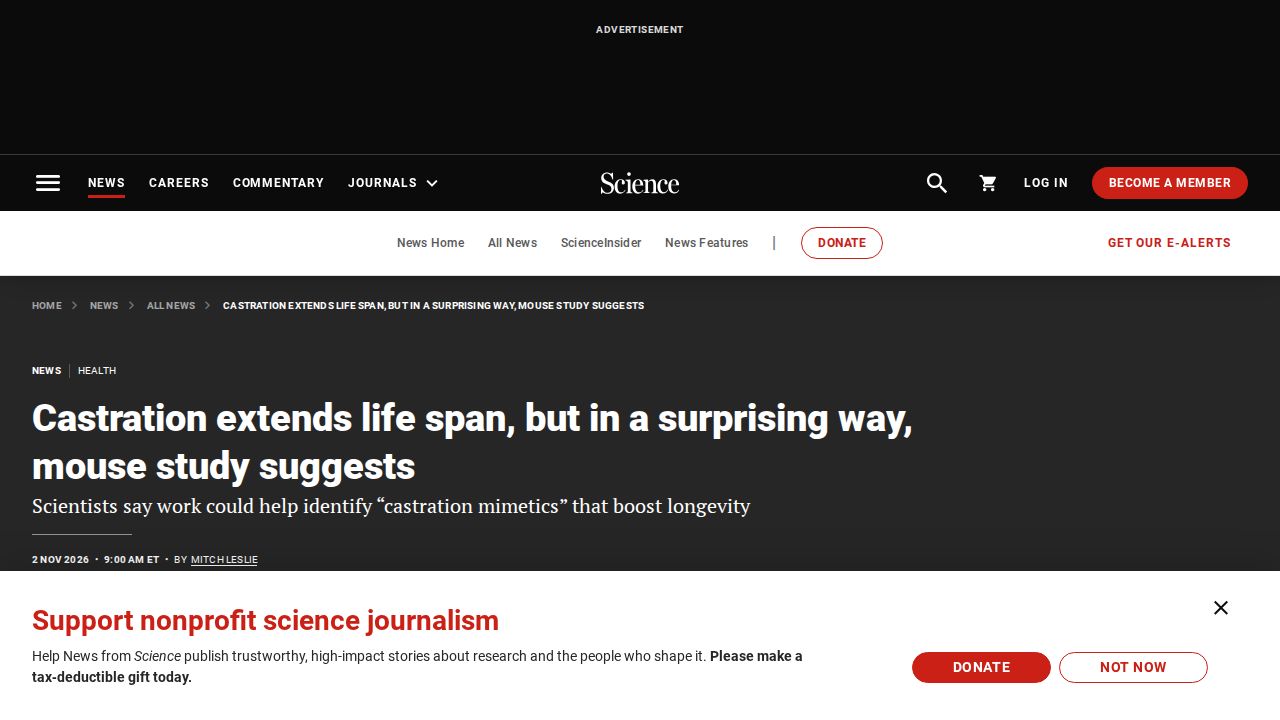
Castrating male mice as adults can extend their lifespans by approximately 33%, a significantly higher increase than when the procedure is performed during earlier developmental stages. This finding, highlighted in a study shared on Hacker News, challenges the assumption that the total duration of hormone exposure is the primary driver of aging in these subjects.
The Core Findings
The primary source reports on a study suggesting that castration extends the lifespan of male mice in a non-linear fashion. The most significant life extension occurred in mice neutered as adults, which lived about 33% longer than their intact counterparts.
In contrast, mice fixed before puberty saw a 19% increase in lifespan, while those fixed during puberty saw a 26% increase. This data suggests that the timing of the intervention is a critical factor in the magnitude of the life-extending effect.
Contradicting the Hormone Model
One commenter, writing as Aurornis, noted that these results go opposite to what would be expected from a simple 'area under the curve' model. In such a model, the presence of testes correlates with reduced lifespan, implying that the earlier the testes are removed, the less total hormone exposure occurs, and the longer the animal should live.
The fact that adult castration provides the greatest benefit suggests a more complex interaction between male hormones and the aging process than a simple cumulative exposure model would predict.
Community Perspectives and Skepticism
The Hacker News discussion included various interpretations of the data. One commenter, writing as world2vec, pointed out that these observations are already well-known in farming, where capons and wethers are known to live longer than intact roosters and rams.
Other participants expressed skepticism regarding the applicability of mouse studies to human biology. One commenter, writing as andrewclunn, argued that if mouse studies were directly analogous to humans, many other conditions would have been cured by now, and expressed a lack of willingness to undergo such a procedure based on correlation alone.
The discussion also touched on the 'catch' of such findings, with one commenter, writing as antonmks, noting that while the study suggests a way to extend life, there is usually a significant practical or biological trade-off involved.
Context and Limitations
While the study provides a specific biological observation in mice, it does not offer a roadmap for human longevity. The evidence is limited to a specific rodent model, and the practical, ethical, or biological feasibility of applying these results to humans remains unknown.
The study serves as a point of interest for understanding the link between male hormones and aging, but it does not provide a definitive mechanism for how adult castration specifically triggers such a significant lifespan increase.