The rapid expansion of artificial intelligence has led major tech companies like Google, Amazon, and Meta to become 'cash incinerators,' spending astronomical amounts on data center buildouts and AI development. While these investments are often viewed as corporate maneuvers, a growing portion of the capital fueling this infrastructure is being sourced from the retirement accounts of public and private sector workers.
The Shift to Opaque Private Markets
Public pension fund systems have increasingly allocated the retirement savings of public sector workers to opaque, unregulated private equity and credit funds. These institutions have become a new center of gravity in financial markets, moving assets away from traditional, transparent investment vehicles.
Recent administrative efforts have further expanded this trend by making $15 trillion in private sector retirement accounts available for investment in private funds for the first time in history. These funds are the primary source of capital for companies building out the massive data centers and gas plants required to power AI.
“By putting our retirement chips in their basket, we are bound up in the risks that these companies are taking in the AI boom—even though they do not have to disclose those risks to us.”
— Your Retirement Savings Are Fueling the AI Bubble
Systemic Risks and Debt Correlation
The scale of loans made to data center operators and Big Tech is creating a financial structure that some analysts compare to the complexities of the 2008 financial crisis. Because these projects rely on a dense web of financing and customer relationships, the risks are highly correlated across the sector.
S&P has noted that the credit quality of hyperscalers is weakening due to the projected $7 trillion in spending by 2030, much of which must be financed by debt. If demand for AI disappoints or data center utilization declines, the losses could impact the operators, sponsors, or guarantors—many of whom are tied to the retirement funds providing the capital.
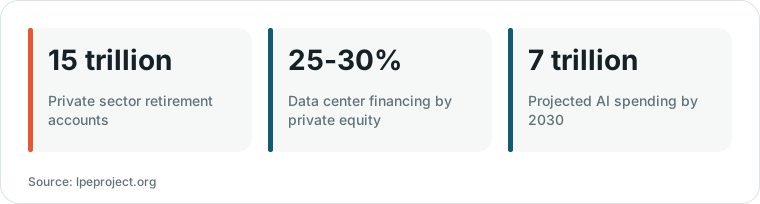
Chart drawn by HN Digest from figures reported by lpeproject.org; values are shown as written in the source.
Trade-offs and Potential Redirections
While the current trend favors high-growth tech infrastructure, some pension fund trustees have begun demanding that funds refrain from holding risky, unregulated assets linked to the data center boom. However, simply shifting back to index funds may not solve the issue, as many major AI players are already part of the S&P 500.
A potential alternative involves redirecting retirement savings toward productive investments like affordable housing or renewable energy transitions. Proponents suggest that establishing public asset managers or public credit funds could change the structure of how pension funds are deployed, moving away from the 'invisible hand' of the current AI-focused market.
What Hacker News readers are saying
- Alternative: One commenter argued that the current investment flow is a normal function of a healthy market and suggested that the situation should be left alone. comment ↗
- Skeptical: Another reader expressed skepticism regarding the article's claims, arguing that it fails to prove pension funds are fueling a bubble and that the suggested solutions are unreasonable. comment ↗
- Experience: A commenter pointed out that data centers remain profitable and that hyperscalers have faced capacity issues for non-AI growth since 2020. comment ↗
- Open question: One user raised a question about whether implementing measures to slow down data center spending, similar to an arms control treaty, might actually benefit overall finances. comment ↗
Summarized opinions from the Hacker News thread, not verified facts. Read the full discussion ↗