Next-Concept Modeling (NCM) can generate text up to 31 times faster than existing diffusion language models while maintaining competitive quality scores. Developed by a team including researchers from institutions like the University of Washington, the framework addresses the primary bottleneck of current large language models: the slow, sequential nature of generating text one word at a time.
Moving Beyond Sequential Generation
Most current text generation relies on autoregressive models, which produce text one token at a time. While Diffusion Language Models (DLMs) offer a path toward parallel sampling, they often suffer from rapid quality degradation when using fewer sampling steps and require many passes over the dataset to reach high-quality outputs.
NCM introduces a two-stage, coarse-to-fine framework to solve these efficiency issues. By shifting the focus from individual tokens to 'concepts' represented by discrete codes, the model can process information at different levels of abstraction simultaneously.
The Coarse-to-Fine Mechanism
The architecture begins with a multiscale residual VQ-VAE (Vector Quantized Variational Autoencoder). This component encodes text into a hierarchy of discrete codes, effectively creating a multi-layered map of the content.
A transformer then generates these codes one level at a time. Crucially, the model predicts all codes within a single level in parallel. This 'coarse-to-fine' approach allows the model to establish the broad structure of a sentence before refining the specific details, bypassing the linear constraints of traditional generation.
Performance and Reasoning Gains
The efficiency gains of NCM are substantial. On the LM1B dataset, NCM achieved better generative perplexity than the strongest DLM baseline while running 21x faster. On the XSum dataset, it matched the strongest DLM's ROUGE-L score while running 31x faster.
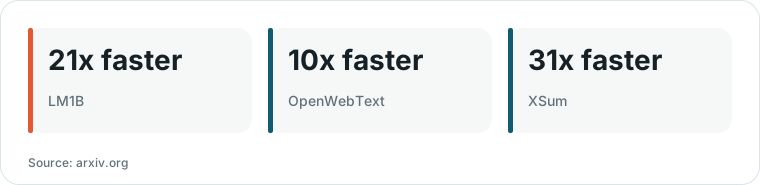
Chart drawn by HN Digest from figures reported by arxiv.org; values are shown as written in the source.
Beyond standard text generation, NCM demonstrated superior reasoning capabilities. In a Sudoku task, the model outperformed both autoregressive and diffusion baselines across all difficulty levels, requiring fewer function evaluations to reach the correct solution.
Limitations and Uncertainties
While the speedups are significant, the source material does not specify the exact number of levels within the VQ-VAE hierarchy or the specific architectural hyperparameters used to balance the coarse and fine stages.
Additionally, while NCM excels in parallel generation, the trade-offs regarding the complexity of the initial VQ-VAE training versus the inference speed of the transformer remain an area for further investigation.