Google is expanding its eighth-generation Tensor Processing Unit (TPU) portfolio with two new specialized systems: the TPU 8tx and the TPU 8i Max. These additions are designed to address the 'agentic era' of AI, where workloads increasingly require both high-security environments for sensitive data and the ability to reason across massive amounts of information simultaneously.
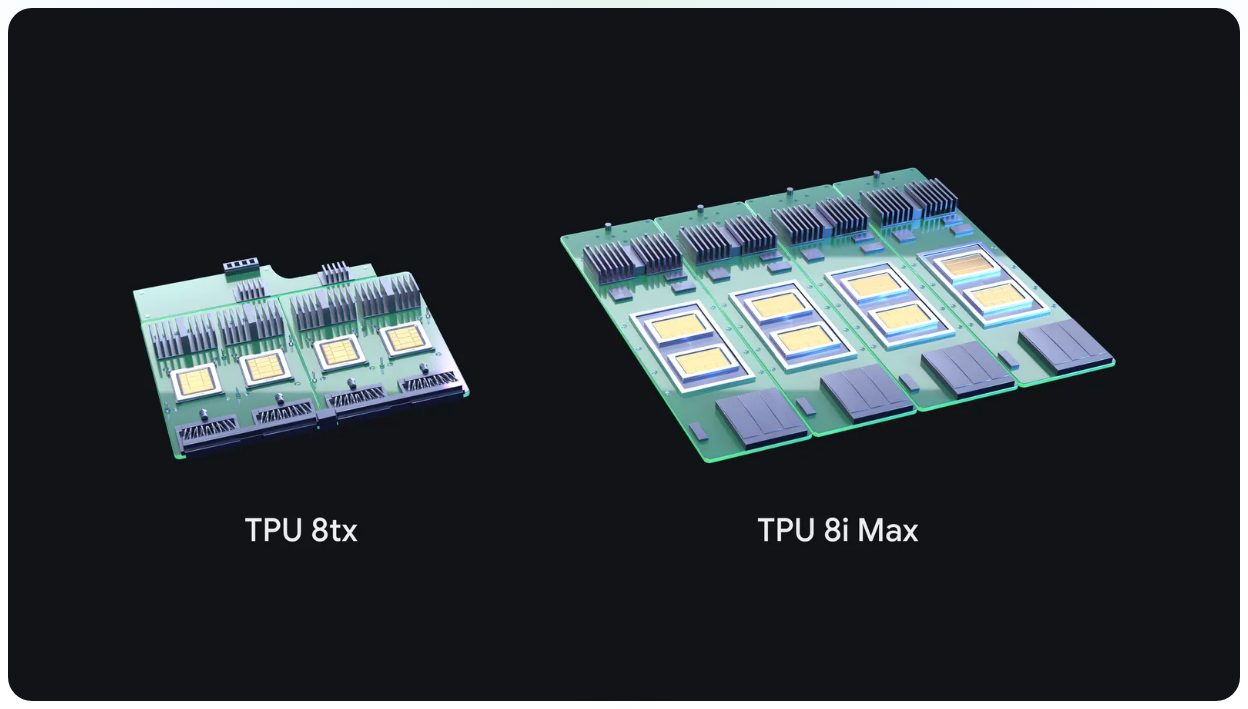
This image illustrates the two primary new systems introduced in the eighth-generation TPU portfolio.
Specialized Hardware for Security and Context
The TPU 8tx is specifically engineered for regulated enterprises and governments that need to run frontier models alongside sensitive data. Unlike standard encryption that protects data at rest or in transit, the 8tx builds security directly into the hardware layer, ensuring that data remains isolated even while being processed in memory.
By pairing training-grade compute with a fast inference network, the 8tx allows organizations to simultaneously run and customize models on a single system. This configuration enables teams to perform private fine-tuning and reinforcement learning without needing to migrate sensitive data between separate clusters.
“TPU 8tx provides hardware-level security for sensitive data, while TPU 8i Max handles massive context windows.”
— Our newest TPUs: 8tx and 8i Max, built for the agentic era
Breaking the Memory Wall with TPU 8i Max
The TPU 8i Max addresses the 'memory wall'—a bottleneck that occurs when AI agents must process vast amounts of data, such as entire software codebases or hours of video. It achieves this by combining two TPU 8i chips onto a single package to scale compute and memory in lockstep.
By doubling the SRAM and HBM bandwidth of the base 8i model, the 8i Max ensures that processors remain equipped with essential data so that large workloads do not stall. This design also allows data centers to deploy significantly more computing power per square foot and per watt by fitting twice the silicon within the existing rack footprint.
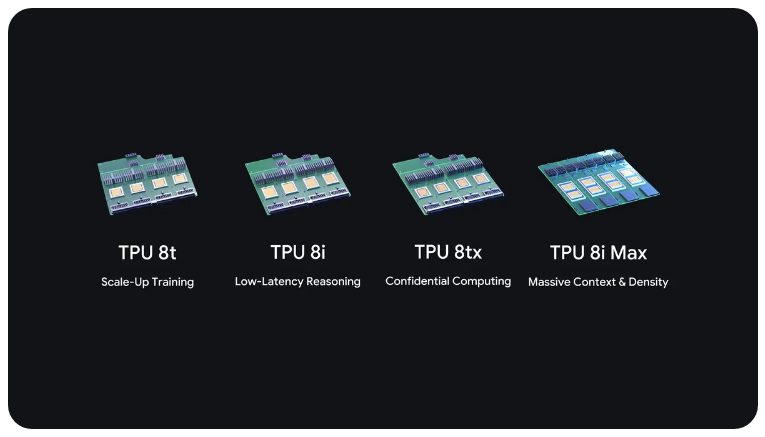
This visual helps differentiate the new 8tx and 8i Max models from the existing 8t and 8i systems.
System Modularity and Developer Accessibility
Google distinguishes these new offerings as 'systems' rather than just 'chips.' Because silicon manufacturing is bound by long-duration cycles, Google uses a modular architecture that allows engineers to rapidly adjust packaging, high-speed memory, and optical networking around the core TPU building blocks.
To lower the barrier to entry, Google is integrating these systems with an open software stack. This includes TorchTPU, which allows PyTorch code and Hugging Face models to run natively on TPUs, and a new TPU agent suite that automates onboarding and kernel autotuning using plain language.
Performance Metrics and Limitations
While Google reports that the 8t and 8i systems offer up to 2.7x better training performance and 80% better inference price-performance than previous generations, specific figures for the new 8tx and 8i Max models are not provided in the announcement.
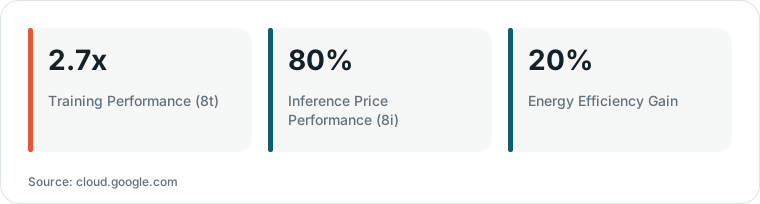
Chart drawn by HN Digest from figures reported by cloud.google.com; values are shown as written in the source.
The current documentation focuses on qualitative improvements, such as 'double the compute' and 'near-zero performance penalty' for security features. Specific watt-per-token figures or direct price-to-performance comparisons against NVIDIA's latest offerings remain unstated.
What Hacker News readers are saying
- Technical note: One commenter pointed out that the article fails to define the acronym TPU as a Tensor Processing Unit. comment ↗
- Skeptical: Several commenters expressed frustration that the announcement lacks specific performance metrics, such as cost per token or power efficiency, and provides no clear path for developers to actually purchase or access the hardware. comment ↗
- Alternative: One commenter noted that while the announcement is marketing-heavy, more technical specifications can be found through other online sources. comment ↗
Summarized opinions from the Hacker News thread, not verified facts. Read the full discussion ↗