In the near-future world of Alfonso Cuarón’s 2006 film Children of Men, humanity has faced a mass infertility epidemic that has left the world without a single newborn for nearly two decades. Rather than focusing on the scientific 'why' of this crisis, the film uses the resulting social collapse to examine the treatment of refugees, the rise of propaganda, and the lived experiences of the marginalized in a crumbling United Kingdom.

This image depicts a primary character from the film, illustrating the human element and intimate experience the director prioritized over world-building mechanics.
Shifting Focus from Mechanics to Experience
While loosely based on P.D. James’s 1992 novel, the film departs significantly from the source material's focus on how and why authoritarian regimes rise to power. Cuarón chose to narrow the scope, moving the sociopolitical commentary toward what the societies they build do to the least powerful among them.
This shift allows the film to function as a mirror for the present. By focusing on the characters' immediate survival, the movie explores the exploitation of immigrant populations and the role of faith in personal and political lives without becoming a dry lecture on political theory.
Intentional World-Building and Realism
Cuarón deliberately chose not to provide a scientific explanation for the infertility epidemic. He argued that as soon as a story starts explaining the 'why,' audiences begin to nitpick the logic, which distracts from the emotional and social weight of the setting.
To achieve a visceral sense of reality, the production used location filming in London combined with sophisticated visual effects to transform familiar landmarks like Fleet Street and Trafalgar Square into a grittier future. This approach was designed to make the audience feel the misery and safety of the streets rather than just observing a fictional setting.
The Mechanics of the Chase
The film operates primarily as a 'chase movie,' a structure that maintains high tension by focusing on the movement of the protagonists through a hostile landscape. The audience is asked to trust the characters' actions and the direction of their journey, even when the final destination remains unknown.
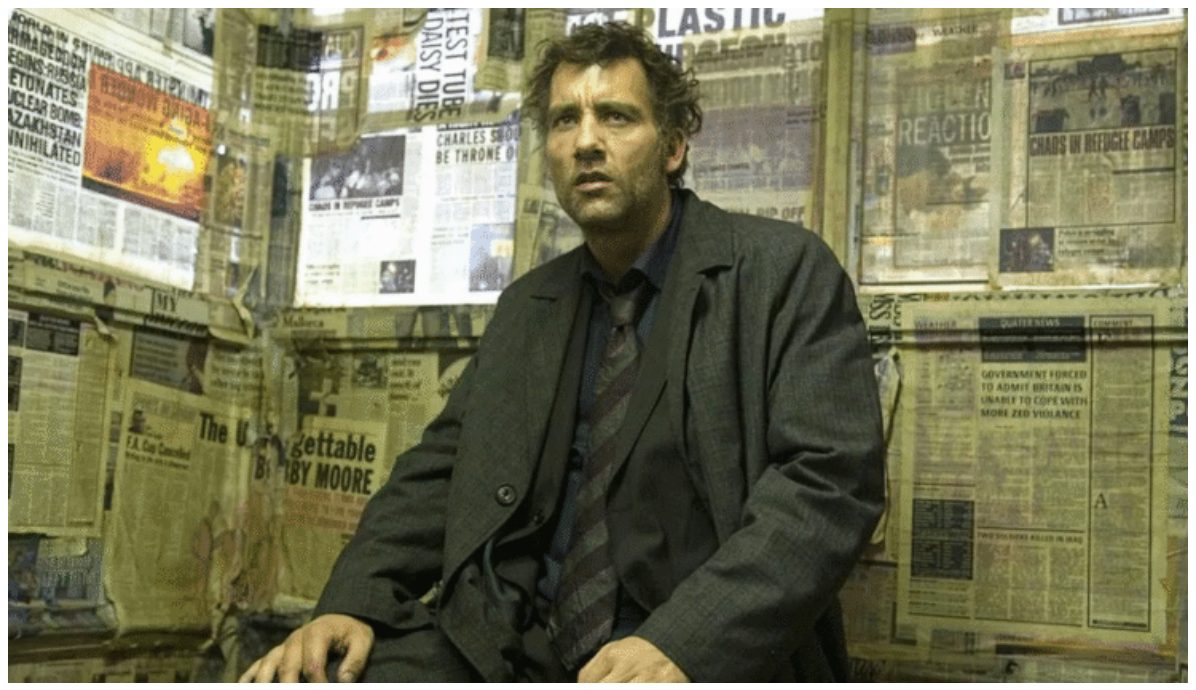
This screenshot provides a visual example of the film's narrative style, focusing on the immediate stakes and the movement of the protagonists.
This lack of exposition regarding the endpoint forces the viewer to focus on the immediate stakes: the protection of Kee, the world's first known pregnant woman in eighteen years. The tension is built not through high-speed spectacle, but through the escalating danger of navigating a society that has closed its borders and turned toward propaganda.
Limitations and Unresolved Questions
Because the film prioritizes intimacy over exposition, certain details remain intentionally obscured. The source does not clarify the specific fate of the characters at their final rendezvous or the ultimate outcome of the world's infertility crisis.
This ambiguity is a deliberate creative choice to maintain the film's focus on the human element. However, it leaves the specific long-term consequences of the speculative world as an open question for the viewer to interpret based on the social cues provided.
What Hacker News readers are saying
- Alternative: One commenter argued that the film should be considered one of the best movies of the 21st century overall, rather than just being categorized as a top science fiction film. comment ↗
- Alternative: Several commenters pointed out that the film functions as a nativity story or a Christian allegory where faith overcomes nihilism, noting that these themes are explicit in the original book. comment ↗
- Open question: One reader questioned whether the film has different versions of its ending, noting a discrepancy in whether a ship appears in the final fog scene. comment ↗
Summarized opinions from the Hacker News thread, not verified facts. Read the full discussion ↗