Developers using AI coding agents often find their work scattered across various terminal sessions, ephemeral cloud instances, and different machines, making it difficult to maintain context. Atuin Threads addresses this by syncing these agent sessions as append-only logs, enabling a user to start a task in one tool, such as Claude Code, and resume it in another, like Codex, on a completely different device.
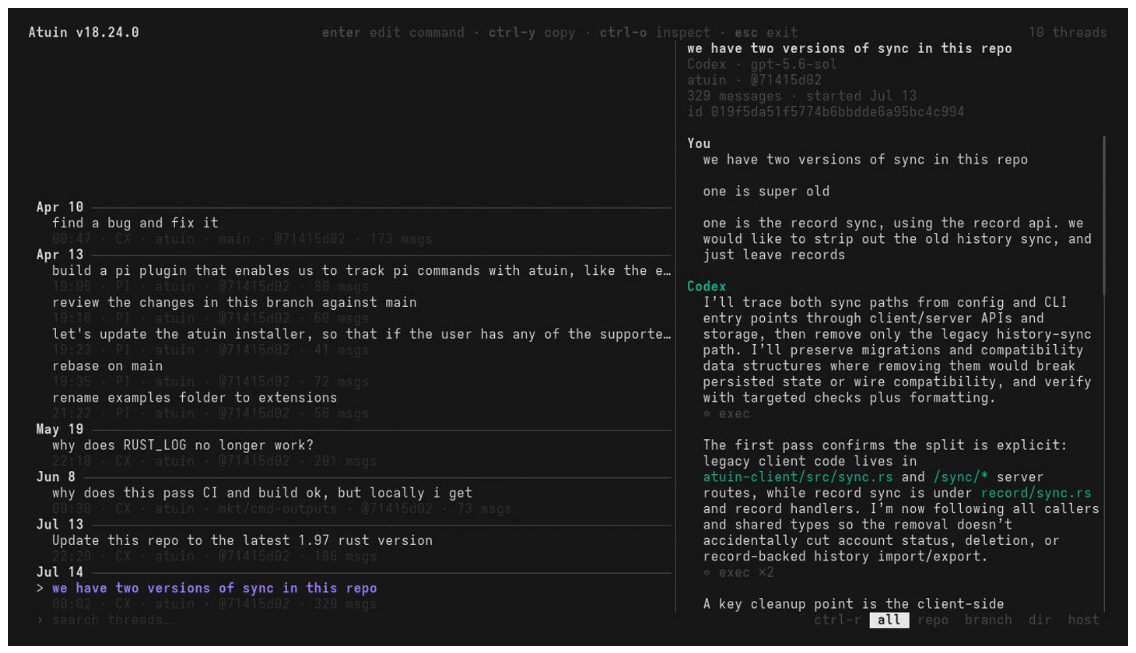
This image provides a visual reference for the Atuin Threads tool and its ability to manage persistent AI agent sessions.
Persistent Context for AI Workflows
While traditional shell history records individual commands, it often misses the reasoning and intent behind them. Atuin Threads captures the full scope of an agent session, including every command, its output, and the user's intent, storing it in a way that is easily accessible.
This persistent history allows agents to reference previous work. For example, an agent can look back at 'work that never shipped' to understand why certain paths were abandoned, helping it build on previous investigations without requiring the user to provide a new specification.
“Atuin Threads: one searchable, synced history for every agent session, on every machine”
— Atuin Threads: All your agent sessions on every machine
Cross-Machine Synchronization and Forking
The underlying mechanism relies on a generic, encrypted sync engine designed to handle any data modeled as an append-only log. Because AI sessions fit this model, Atuin can synchronize them across a user's laptop, dev servers, and bare metal boxes.
A notable feature is the ability to 'fork' a thread. If a machine performs poorly during a heavy task, a user can move the session to a machine with better I/O performance. The original thread can then pull the results from the new machine to complete the fix, eliminating the need for manual copy-pasting.
Integration and Team Collaboration
Atuin provides a Model Context Protocol (MCP) implementation that allows agents to search and reference these previous sessions directly. This helps agents understand past decisions and build on previous investigations autonomously.
While currently focused on individual workflows, the project is moving toward opt-in session sharing for teams. This would allow team members to hand off agent threads similar to how they share Git branches, potentially capturing context that usually remains trapped in individual terminal sessions.
Privacy and Noise Trade-offs
To maintain security, Atuin Threads uses end-to-end encryption for all synced data, meaning the sync server cannot read the session contents. Users have the option to host their own sync server or keep everything local.
However, the transition to a shared history model introduces considerations regarding data 'noise.' Because many coding sessions are experimental or throwaway, users must decide how much of this ephemeral data is worth preserving in a permanent, searchable history.
What Hacker News readers are saying
- Experience: One commenter who is building a similar tool expressed concern that saving every session from every machine might create too much noise, especially for experimental or throwaway coding sessions. comment ↗
- Skeptical: Several commenters expressed reservations about the security implications of storing shell history and agent sessions on a shared server, with one user noting they would avoid the feature to maintain strict isolation and sandboxing of their agents. comment ↗
- Alternative: Another user shared their experience of avoiding remote servers by using a custom script to search through local backups synchronized across machines via Syncthing. comment ↗
Summarized opinions from the Hacker News thread, not verified facts. Read the full discussion ↗