In 1995, 3Com was a 5.8 billion dollar company that held the naming rights to San Francisco's Candlestick Park, a testament to its status as a premier brand in the networking industry. Founded in 1979 by Bob Metcalf, the co-inventer of Ethernet, the company became the go-to provider for reliable network cards throughout the 1980s and 1990s. However, a series of strategic missteps and a shift in market dynamics eventually led to its disappearance from the hardware landscape.
Strategic Retreats and Market Shifts
A primary factor in 3Com's decline was its decision to walk away from the enterprise networking equipment business. While Cisco was a formidable competitor, 3Com was the only other brand successfully operating in that space at the time.

This image illustrates the type of enterprise networking equipment 3Com provided before its strategic retreat from the market.
Analysts noted that this move did not save the company money; instead, it caused revenue to drop and alienated customers and dealers who began purchasing Intel cards. The company also struggled to maintain its premium pricing for network cards as Intel began undercutting their prices to gain market share.
“Walking away from the profitable network switch business is a key reason why 3Com failed.”
— What happened to 3Com?
Diversification into Fading Technologies
3Com attempted to pivot by branching into businesses outside its core networking competency, most notably through the purchase of US Robotics. This acquisition gave 3Com a foothold in the modem market, but the move was poorly timed.
By the late 1990s, the industry was beginning to move toward broadband, and 3Com lacked a clear plan to transition away from dial-up modems. These investments failed to provide a safety net as US Robotics modems were undercut by cheaper competitors.
The Final Transition to Hewlett-Packard
By the time 3Com realized it needed to return to the network equipment business, the cost of doing so was prohibitively high. The company failed to turn a profit between 2000 and 2005, marking a period of significant decline following the dotcom bust.
The company's journey ended in late 2009 when Hewlett-Packard purchased 3Com's assets. Today, while HP still sells networking equipment, the 3Com brand is no longer a primary name in the space, and many modern HP-branded network cards are simply Intel cards with HP branding.
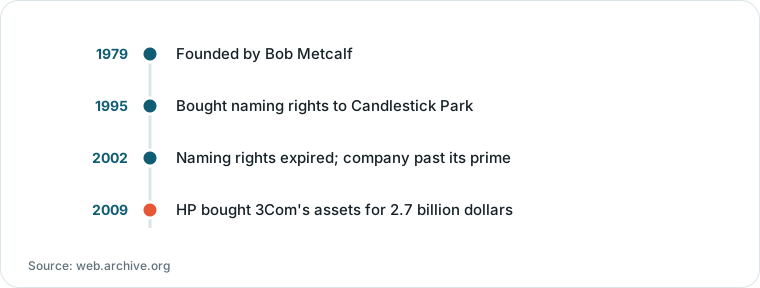
Chart drawn by HN Digest from figures reported by web.archive.org; values are shown as written in the source.
Legacy and Retro Appeal
Despite its corporate decline, 3Com's legacy remains significant among retro computing enthusiasts. Its cards from the 1980s and 1990s are still well-regarded for their driver support and reliability, often serving as period-correct hardware for vintage systems.
What Hacker News readers are saying
- Alternative: One commenter suggested that 3Com's decline was linked to a failure to diversify beyond high-end network cards, noting that their premium pricing may have been less appealing to many users. comment ↗
- Experience: A reader shared their experience with the hardware, noting that integrated motherboard ports and modern Wi-Fi have largely made standalone network cards obsolete for home users. comment ↗
- Experience: Another commenter recalled their practical experience creating boot discs for 3Com's specific NIC models, such as the 905, during the era of Novell's Cool Solutions. comment ↗
Summarized opinions from the Hacker News thread, not verified facts. Read the full discussion ↗